Imagine arriving at work tomorrow morning and saying just one sentence.
“Prepare everything I need for today’s meetings.”
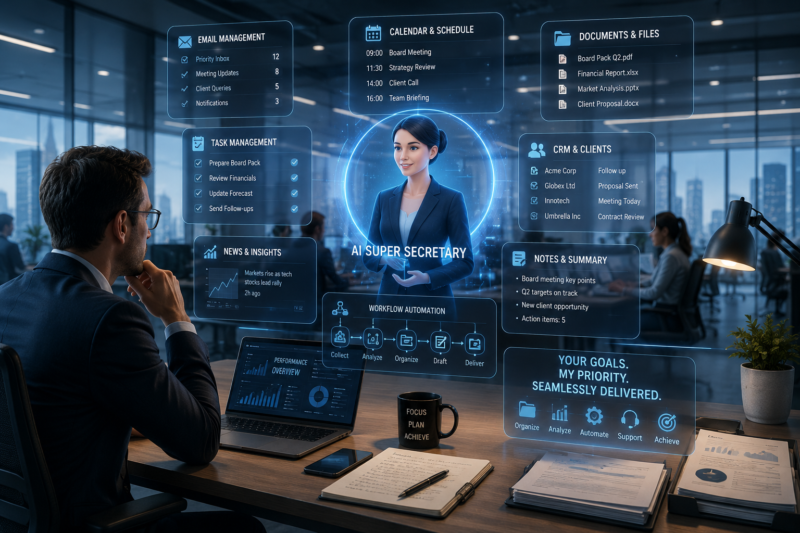
Within a few minutes your emails have been prioritised, yesterday’s meeting notes summarised, relevant documents gathered together, presentation slides updated, your diary reorganised, customer records refreshed and draft follow-up emails prepared before your first meeting even begins.
Only a short time ago, that sounded like science fiction.
Today, it represents one of the most important directions in artificial intelligence.
For the past two years, AI has become remarkably good at answering questions, writing emails, summarising documents and generating content. Millions of people now use tools such as ChatGPT, Claude, Gemini and Microsoft Copilot to help them complete individual tasks more quickly.
However, the next phase of AI is shaping up to be something very different.
Rather than simply responding to prompts, many of the world’s largest technology companies are now competing to build AI capable of organising work, coordinating multiple tasks and helping people achieve broader objectives across an entire working day. Recent announcements from OpenAI, Anthropic and Microsoft all point towards AI that moves beyond conversation and into practical workplace automation. OpenAI’s recently announced ChatGPT Work, for example, has been designed to work across applications and files to help users complete complex tasks rather than simply answer questions.
Anthropic is pursuing a remarkably similar vision. Its Claude Cowork platform has been developed to continue working in the background, organising information, gathering material from connected workplace applications and completing longer-running tasks without constant user interaction.
Microsoft is taking the same direction with Copilot Cowork, describing it as the next step in transforming Copilot from a productivity assistant into a platform capable of taking action across Microsoft 365 applications.
Although each company uses different terminology, the overall objective is becoming increasingly clear.
The race is no longer about building AI that simply answers questions.
It is about building AI that helps organise work.
From Individual Tasks to Complete Workflows
The first generation of generative AI focused largely on individual requests. Users asked AI to write emails, summarise reports, explain spreadsheets or draft presentations before moving on to the next task. Although these capabilities transformed productivity, every instruction remained largely independent.
The next generation of AI is expected to behave very differently.
Instead of asking AI to draft an email, then searching for supporting documents, opening your calendar, updating your CRM system and preparing meeting notes separately, future workplace assistants are increasingly being designed to understand a broader objective and coordinate the individual activities required to achieve it.
Imagine saying:
“Organise everything I need to start today’s work.”
Rather than simply generating text, the AI could review overnight emails, identify urgent tasks, gather supporting documents, prepare reports, organise your diary, draft correspondence, update business systems and highlight anything requiring immediate attention before your working day even begins.
That represents a significant change in the role of artificial intelligence.
Instead of completing isolated requests, AI begins coordinating connected workflows.
What Could an AI Super Secretary Actually Do?
The easiest way to understand this concept is to imagine the world’s most capable administrative assistant. Every profession relies on administration, whether that involves organising information, preparing documents, scheduling appointments or coordinating communication. The difference is that future AI assistants could potentially support these activities across almost every industry.
In finance, an AI workplace assistant could download bank transactions overnight, reconcile supplier invoices, identify unusual spending patterns, prepare draft management accounts, generate KPI dashboards and assemble monthly board papers ready for review. Rather than spending hours gathering information from different systems, finance professionals could begin the day with everything already organised.
Within banking and wealth management, the same assistant could prepare client review packs, analyse recent market activity, organise compliance documentation, draft investment summaries, arrange meetings and prepare follow-up correspondence before relationship managers even meet their clients.
For healthcare, where administration consumes a significant proportion of the working day, AI could coordinate patient appointments, prepare consultation summaries, organise clinic schedules, draft referral letters, manage waiting lists and assemble supporting documentation before each clinic begins. Clinical judgement would always remain with healthcare professionals, but much of the surrounding administration could become far more streamlined.
Legal Services, Human Resources and Education
The same principles extend far beyond finance and banking.
In legal services, an AI workplace assistant could prepare case bundles, organise supporting evidence, monitor court deadlines, draft routine correspondence, summarise lengthy legal documents and assemble research from multiple sources before a solicitor even opens the file. Rather than spending valuable time searching for information, legal professionals could begin with a well-organised case ready for review.
For human resources, administrative responsibilities often consume significant amounts of time. An AI assistant could organise recruitment campaigns, screen applications against job criteria, schedule interviews, prepare employment contracts, monitor mandatory training, draft onboarding documentation and coordinate routine employee communications. HR professionals remain responsible for recruitment decisions and employee welfare, but much of the administrative preparation could become considerably more efficient.
Within education, teachers and school administrators often spend almost as much time preparing resources and managing administration as they do teaching. An AI workplace assistant could organise timetables, prepare lesson materials, draft student reports, coordinate parents’ evenings, summarise inspection documentation and manage routine communications. The objective is not to replace teachers, but to reduce the administrative workload that surrounds teaching.
Even executives and senior managers could benefit from increasingly capable AI assistants. Instead of spending the first hour of every morning reviewing emails and preparing for meetings, AI could prioritise correspondence, reorganise diaries, prepare meeting agendas, draft presentations, summarise overnight developments, track outstanding actions and produce personalised daily briefings before the working day even begins.
Although these examples come from very different industries, they all demonstrate exactly the same principle. The future of workplace AI is becoming less about generating content and increasingly about organising work.
One AI or an Entire Team?
The concept becomes even more interesting when we consider Swarm AI, an area we explored in an earlier AI Tuition Hub article. Rather than relying on one AI system to complete every task, future workplace assistants may consist of multiple specialist AI agents working together behind a single interface.
Imagine asking your AI assistant to prepare everything needed for tomorrow’s board meeting. Instead of one AI attempting to manage every aspect of the request, one agent could review emails, another analyse financial reports, another gather supporting documents, another prepare presentation slides, another update the CRM and another reorganise your calendar. To the user, it appears that one assistant has completed everything, but behind the scenes several specialist AI systems may have collaborated to produce the final result.
This approach allows organisations to combine specialist expertise while presenting employees with a single, simple and intuitive AI assistant. Rather than becoming experts in multiple AI tools, users simply describe what they want to achieve while a team of AI agents works together to complete the task as efficiently as possible.
Although Swarm AI is still developing, it illustrates just how quickly workplace AI is evolving beyond today’s single chatbot model.
Why Big Tech Is Investing Billions
The fact that so many of the world’s largest technology companies are pursuing similar strategies is unlikely to be a coincidence.
OpenAI, Microsoft, Google, Anthropic, Amazon and many others are investing billions of dollars into creating AI that integrates directly with workplace software, productivity tools and enterprise applications. Their objective is no longer simply to produce better answers to questions. It is to build AI capable of reducing the amount of routine administration that takes place across every organisation. Recent developments from OpenAI, Anthropic and Amazon all point towards AI systems that can complete longer, more connected sequences of work rather than isolated requests. Reuters, Wired and other industry publications have all highlighted this shift towards more autonomous workplace assistants as one of the next major stages in enterprise AI adoption.
The commercial attraction is obvious. Every organisation spends thousands of hours each year organising meetings, preparing reports, searching for documents, updating databases, coordinating projects, managing correspondence and carrying out countless other administrative activities. While each task may only take a few minutes, together they represent a significant investment of time and money.
If AI can reliably organise much of this work, businesses have the opportunity to improve productivity, accelerate decision making and reduce operating costs without fundamentally changing the software they already use. Instead of replacing existing business systems, AI increasingly acts as an intelligent layer sitting across them, helping information move more efficiently from one task to the next.
Accuracy, Trust and Human Oversight
For AI workplace assistants to become widely adopted, they will need to demonstrate an exceptionally high level of accuracy and reliability. Unlike a chatbot that occasionally produces an incorrect answer, an AI assistant capable of updating records, scheduling appointments, preparing financial reports or drafting legal documents must operate with far greater precision.
The world’s largest AI companies are therefore investing not only in making these systems more capable, but also in making them more dependable. Improvements in reasoning, fact-checking, security, permissions and human oversight will all play a critical role in ensuring AI workplace assistants can be trusted with increasingly important administrative responsibilities.
Even as these technologies mature, human oversight is likely to remain essential. AI may organise work, prepare documents and coordinate workflows, but professionals will continue to review important decisions, approve sensitive communications and ensure the final output is accurate before action is taken.
Looking Ahead
The Rise of the AI Super Secretary is still in its early stages, but the direction of travel is becoming increasingly clear. The world’s biggest technology companies are no longer competing solely to build the most intelligent chatbot. They are racing to create AI that can organise work, coordinate information and support professionals throughout the entire working day.
Whether these technologies ultimately become known as AI assistants, AI copilots, AI agents or something entirely different is almost secondary. What matters is the transformation taking place behind the scenes. Artificial intelligence is steadily evolving from a tool that responds to questions into one that helps people achieve broader objectives with less manual administration.
The AI Super Secretary may not arrive overnight, and it is unlikely to replace human judgement or professional expertise. What it promises instead is something potentially just as significant: the ability to remove much of the routine administration that surrounds modern work, allowing professionals across finance, healthcare, law, education, banking, human resources and countless other industries to spend more time applying their knowledge and less time organising information.
If the current pace of development continues, the AI Super Secretary could become one of the defining workplace technologies of the next decade, not because it replaces existing software, but because it brings everything together into one intelligent, coordinated assistant.
Further Reading
If you would like to explore the technologies and developments discussed in this article, the following resources provide useful background:
- Reuters – OpenAI launches ChatGPT Work
- TechRadar – OpenAI unveils ChatGPT Work for workplace automation
- The Verge – GPT-5.6 and ChatGPT Work explained
- Business Insider – Amazon’s Project Moonraker and the future of Alexa
- Reuters – Microsoft launches Frontier Company to accelerate enterprise AI adoption
- Ars Technica – OpenAI wants ChatGPT Work to do your work for you
Explore More AI Resources
If you enjoyed this article, you’ll find many more practical guides, blogs and industry-focused AI courses on the AI Tuition Hub website. We regularly publish new content covering artificial intelligence across business, finance, education, healthcare, cybersecurity and many other sectors.
Visit the AI Tuition Hub home page:
AI Tuition Hub