Artificial Intelligence is already becoming a familiar part of everyday life. From online search and digital assistants to content creation and data analysis, AI technologies are advancing at a remarkable pace. Yet while much of the public discussion focuses on today’s tools, researchers and technology companies are already investing billions into the next generation of AI systems.
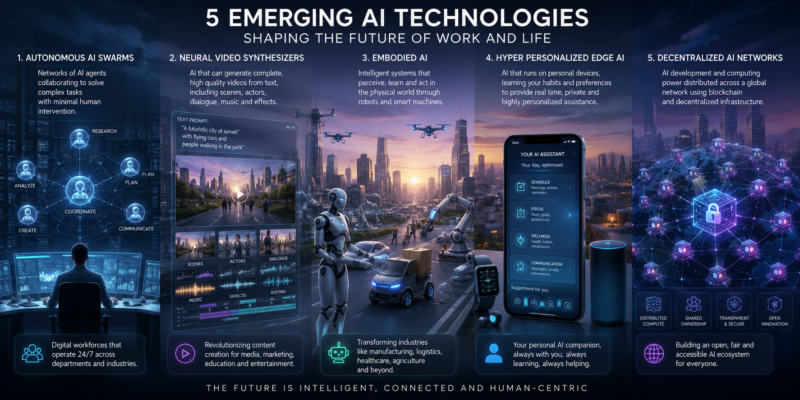
Artificial Intelligence is often discussed as though it were a single technology. In reality, AI development is occurring across multiple fields simultaneously, with researchers pursuing very different goals. Some are focused on creating digital teams capable of working together without human intervention. Others are developing systems that can generate realistic media, operate robots in the physical world, or provide highly personalised assistance tailored to individual users.
Why These Five Emerging AI Technologies Matter
What makes these developments particularly interesting is that they are not being pursued in isolation. Many of the world’s largest technology companies are investing heavily across several of these areas at the same time. As a result, future AI systems may eventually combine multiple capabilities, becoming more autonomous, more adaptable, and more deeply integrated into everyday life than today’s tools.
The five technologies explored below are not predictions or science fiction concepts. They are active areas of research and development where significant progress is already being made. While their ultimate impact remains uncertain, they provide a useful indication of the direction in which Artificial Intelligence appears to be heading.
Autonomous AI Swarms
Autonomous AI Swarms represent a major shift in how AI systems may operate in the future. Unlike today’s AI tools, which generally perform individual tasks, Autonomous AI Swarms involve multiple specialist AI agents working together towards a common objective.
One agent may conduct research, another analyse information, another create reports, while others handle planning, quality control, communication, and decision support. These agents share information and coordinate their activities with minimal human intervention.
The implications could be significant. Rather than simply assisting employees, Autonomous AI Swarms may eventually perform many of the functions currently carried out by entire departments. Marketing, administration, customer support, project management, and research functions could potentially be coordinated by networks of AI agents operating continuously.
Many leading AI developers are already exploring increasingly autonomous agent based systems. As AI reasoning capabilities improve, Autonomous AI Swarms could become one of the most important developments in the future of business operations.
Further Reading: The AI Agents Stack (2026 Edition) – O’Reilly
Neural Video Synthesizers
Neural Video Synthesizers aim to transform how visual content is created. Current AI systems can already generate images, voices, music, and short video clips. The next objective is to combine these capabilities into systems capable of producing complete professional quality videos from simple text instructions.
A user may eventually be able to describe almost any type of visual content. From advertisements and documentaries to television programmes and feature films, the AI would generate actors, environments, dialogue, camera movements, music, editing, and visual effects automatically.
The potential applications are extensive. From advertising and entertainment to journalism and corporate communications, organisations may be able to produce high quality video content more quickly and at lower cost than is possible today. Independent creators could gain access to capabilities that were previously available only to large production studios.
However, this technology also raises important questions around authenticity, copyright, misinformation, and content ownership. As AI generated media becomes increasingly realistic, distinguishing between real and synthetic content may become more challenging.
Further Reading: Google is pushing AI video into ordinary life — just as OpenAI pulls Sora back | TechRadar
Embodied AI
Embodied AI combines advanced Artificial Intelligence with robotics, allowing AI systems to interact directly with the physical world. Rather than existing solely within software applications, Embodied AI enables machines to move, observe, learn, and perform tasks within real environments.
Examples include warehouse robots, autonomous delivery systems, healthcare assistants, manufacturing robots, and future domestic helpers. Unlike traditional automation, Embodied AI systems can adapt to changing conditions, interpret their surroundings, and make decisions based on new information.
Technology companies are investing heavily in this area because of its potential to transform industries that rely on physical activity. Warehousing, logistics, manufacturing, healthcare, agriculture, and construction are all sectors where Embodied AI could have a significant impact.
As machines become increasingly capable of operating independently within physical environments, organisations may rethink how facilities are designed, how services are delivered, and how humans interact with intelligent machines.
Further Reading: Embodied AI In Action: How Robots And Intelligent Machines Are Moving Into The Real World
Hyper Personalized Edge AI
Hyper Personalized Edge AI focuses on bringing advanced AI capabilities directly onto personal devices rather than relying entirely on cloud based services. These systems are designed to run locally on smartphones, laptops, wearable technology, vehicles, and future connected devices.
Unlike traditional digital assistants, Hyper Personalized Edge AI aims to learn an individual’s habits, preferences, interests, goals, and working style. Over time, these systems could become highly personalised companions capable of assisting with organisation, planning, communication, learning, and decision support.
Because processing occurs locally, Edge AI may also provide advantages relating to privacy, speed, and security. Sensitive information can remain on the user’s device rather than being transmitted to external servers.
Some researchers have described the concept as creating an external digital brain. Future systems may remember information, anticipate needs, recommend actions, and help individuals navigate increasingly complex personal and professional lives.
Further Reading: Edge AI Moves Closer To Becoming A Personal Digital Assistant
Decentralized AI Networks
Decentralized AI Networks represent an alternative vision for the future of Artificial Intelligence. Today, much of the world’s AI capability is concentrated within a relatively small number of large technology companies. Decentralized AI Networks seek to distribute ownership, computing power, and development across wider communities.
Rather than relying on centralised infrastructure, these networks may utilise distributed computing resources contributed by individuals and organisations. Participants could help train models, provide processing power, and share access to AI capabilities.
Supporters argue that Decentralized AI Networks could encourage innovation, reduce dependence on major providers, improve transparency, and create a more open AI ecosystem. They believe AI development should not be controlled by only a handful of organisations.
Critics point to challenges involving governance, accountability, quality control, and security. Managing highly distributed AI systems may prove more complex than managing centrally controlled alternatives.
Regardless of the outcome, Decentralized AI Networks are attracting growing attention from researchers, developers, and investors who see them as a potential counterbalance to increasing concentration within the AI sector.
Interest in Decentralized AI Networks continues to grow as researchers explore ways to distribute computing power, model development, and data ownership beyond a small number of centralised providers. Advocates argue that blockchain technology could help support these networks by enabling transparent coordination, shared ownership, and distributed access to AI resources.
Further Reading: Why Some Experts Believe Blockchain Could Help Power Decentralized AI Networks
Conclusion
It is impossible to predict exactly how quickly these technologies will mature or which organisations will ultimately lead the market. What is clear, however, is that these developments are no longer confined to research papers and science fiction.
Major technology companies, start ups, investors, and governments are investing heavily in Autonomous AI Swarms, Neural Video Synthesizers, Embodied AI, Hyper Personalized Edge AI, and Decentralized AI Networks. In many cases, early versions already exist and development is accelerating rapidly.
The race is now on to build the next generation of Artificial Intelligence. The organisations that succeed may help define how businesses operate, how content is created, how machines interact with the physical world, and how individuals use AI in their everyday lives.
While the exact outcome remains uncertain, these emerging technologies suggest that the current generation of AI tools may represent only the beginning of a much larger transformation. The next few years could prove to be some of the most important in the history of technological development.
Interested in learning more about Artificial Intelligence? Explore our growing library of AI courses, guides, and resources designed to help individuals and organisations understand the technologies shaping the future. Visit the AI Tuition Hub homepage to get started.
Published – June 2026.