Payroll has always been one of the most important functions within any organisation. Every employee expects to be paid accurately, on time and in full, while employers must ensure they comply with employment legislation, taxation requirements and payroll reporting obligations. Although payroll software has automated many calculations over the years, AI is now taking payroll management to an entirely new level.
As AI continues to reshape payroll, we’ve launched our new AI in Payroll Management course at AI Tuition Hub. The course explores the complete payroll lifecycle, showing how AI is improving payroll processing, compliance, employee services, analytics and global payroll operations.
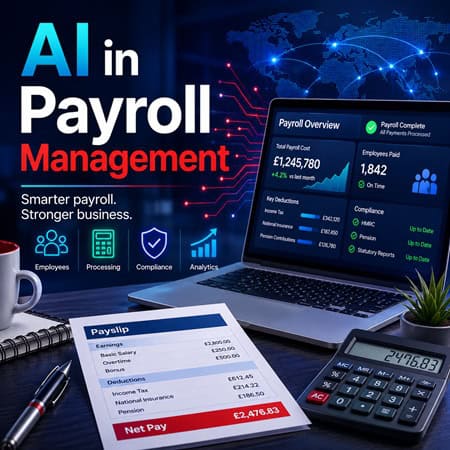
AI is transforming modern payroll management by helping organisations collect payroll data, validate information, process salaries, detect errors and support strategic business decisions. Rather than simply making payroll faster, AI is making payroll smarter by improving accuracy, reducing manual administration and strengthening compliance.
As AI technology continues to develop, payroll professionals are increasingly working alongside intelligent systems that automate repetitive tasks while leaving critical decisions in human hands.
Payroll Has Become Increasingly Complex
Modern payroll extends far beyond calculating salaries and producing payslips.
Payroll departments are responsible for processing overtime, bonuses, commissions, pension contributions, statutory deductions, expenses, holiday pay, sickness absence and a growing range of employment arrangements. Every payroll cycle depends upon accurate information being collected, validated and processed before employees are paid.
Organisations must also keep pace with changing employment legislation, tax rules and reporting requirements while protecting sensitive employee information from fraud and cyber threats.
For businesses operating internationally, payroll becomes even more complex. Different countries have different tax systems, employment laws, reporting requirements and currencies, requiring payroll professionals to manage multiple compliance frameworks simultaneously.
This increasing complexity is one of the main reasons why AI in Payroll Management is attracting so much attention across payroll, HR and finance departments.
How AI Is Improving Payroll Management
AI is already improving many of the most time-consuming aspects of payroll processing.
Before payroll calculations even begin, AI can validate employee information, identify missing records, detect duplicate entries and highlight unusual changes that deserve further investigation.
During payroll processing, AI can compare current payroll calculations with historical payroll data, identifying salary changes, unexpected overtime payments or unusual deductions that differ from previous payroll cycles.
Rather than replacing payroll software, AI works alongside existing payroll systems, providing an additional layer of intelligence that helps payroll professionals identify potential issues before salaries are released.
This reduces manual checking while improving payroll accuracy, efficiency and compliance.
Improving Payroll Compliance
Compliance remains one of the biggest responsibilities facing payroll departments.
Incorrect tax calculations, missed statutory reporting deadlines or inaccurate payroll records can lead to financial penalties, regulatory investigations and damaged employee trust.
AI helps reduce these risks by continuously monitoring payroll information and identifying inconsistencies before payroll is finalised.
Machine learning systems can compare current payroll activity against previous payroll cycles, highlight transactions that appear unusual and notify payroll professionals whenever additional review may be required.
However, AI does not remove organisational responsibility.
Payroll professionals continue to review payroll calculations, interpret employment legislation and approve payroll before employee payments are released. AI supports better decision making, but human oversight remains essential.
AI Is Improving The Employee Payroll Experience
AI is also changing how employees interact with payroll departments.
Many organisations now provide employee self-service portals where staff can access payslips, update personal information and submit payroll-related requests online.
AI-powered virtual assistants are taking this even further by answering common payroll questions, explaining deductions and helping employees understand how their salary has been calculated.
Instead of contacting payroll departments for routine enquiries, employees can often receive immediate answers through intelligent payroll assistants, allowing payroll professionals to concentrate on more complex issues that require human expertise.
This improves both efficiency and employee satisfaction.
Payroll Analytics Is Becoming A Strategic Business Tool
Payroll data is no longer used solely for paying employees.
Modern organisations increasingly use payroll information to analyse labour costs, monitor overtime, forecast staffing requirements and support workforce planning.
AI is making payroll analytics significantly more powerful.
AI can identify long-term workforce trends, estimate future payroll expenditure, monitor labour costs across departments and provide management with valuable business intelligence that supports strategic decision making.
Rather than producing static payroll reports, AI helps organisations understand why payroll costs are changing and what those changes may mean for future business performance.
Global Payroll Is Becoming Easier To Manage
As organisations expand internationally, managing payroll across multiple countries has become easier thanks to advances in cloud technology and AI.
Modern AI-powered payroll platforms can monitor legislative changes, validate payroll calculations across different jurisdictions, process multilingual documentation and identify inconsistencies between multiple payroll systems. They also help organisations consolidate payroll information from different countries, providing greater visibility of global labour costs while supporting local compliance requirements.
Although international payroll still requires local expertise and human oversight, AI is helping organisations simplify administration, improve consistency and reduce the time required to manage global payroll operations.
The Future Of AI In Payroll Management
AI will continue transforming payroll over the coming years.
One of the most significant developments is the emergence of agentic AI, where intelligent software agents are capable of managing complete workflows rather than individual tasks.
Future payroll systems may automatically monitor payroll information throughout the month, identify missing approvals, reconcile payroll records with HR systems, prepare payroll reports and present only unusual exceptions for human review.
Rather than processing payroll only at the end of each month, organisations may gradually move towards continuous payroll management where issues are identified and resolved throughout the payroll cycle.
This will allow payroll professionals to spend less time performing routine administration and more time supporting employees, ensuring compliance and providing strategic advice.
What You’ll Learn In Our AI in Payroll Management Course
To help professionals understand these developments, we’ve launched our new AI in Payroll Management course.
Throughout the course, you’ll explore:
- The complete payroll lifecycle and where AI fits into each stage.
- How AI improves payroll data collection, validation and preparation.
- AI-powered payroll processing and intelligent automation.
- Payroll accuracy, compliance and fraud detection.
- Employee self-service, virtual assistants and AI-powered payroll support.
- Managing global payroll across multiple countries.
- Payroll analytics, workforce planning and business intelligence.
- The emergence of agentic AI and the future of payroll.
- Why payroll professionals remain essential despite increasing automation.
- The practical skills payroll professionals should develop as AI becomes part of everyday payroll operations.
Whether you work in payroll, HR, finance or business management, this course provides a practical understanding of how AI in Payroll Management is transforming one of the most important functions within every organisation.
Start Learning Today
Payroll is changing rapidly, and AI is becoming an increasingly valuable tool for improving efficiency, strengthening compliance and supporting better business decisions. Understanding these technologies today will help payroll professionals and business leaders prepare for the workplace of tomorrow.
Subscribers to AI Tuition Hub receive unlimited access to more than 110 AI courses covering finance, accounting, HR, governance, healthcare, cybersecurity and many other subjects.
Use the discount code FOUNDER50 when subscribing to receive 50% off your first month, giving you unlimited access to our complete course library for less than £10.off your first month, giving you full access to the entire course library for less than £10.
Published: 10th July 2026.