More than 200 economists, AI researchers and technology leaders, including 15 Nobel Prize winners, have warned that artificial intelligence could trigger one of the most significant economic transformations since the Industrial Revolution, with governments and businesses potentially having only a few years to prepare. Their warning focuses not only on employment, but on the wider economic consequences of AI adoption.
Their statement raises an important question. As artificial intelligence reshapes the global economy, who will benefit the most? Will the greatest long term rewards flow to the countries and companies developing AI, or to those simply purchasing and using it?
AI economic impact is becoming one of the most important questions facing governments, businesses and economists. Artificial intelligence is widely expected to transform the global economy, with organisations investing billions to improve productivity, reduce costs and automate routine work, while the companies developing AI continue expanding their workforces to meet growing global demand.
Much of the discussion surrounding AI focuses on one question: will it create jobs or eliminate them? That is certainly an important debate, but it may not be the most important one. What if the long-term economic impact of artificial intelligence is very different for the economies that develop and supply AI compared with those that primarily purchase and use it?
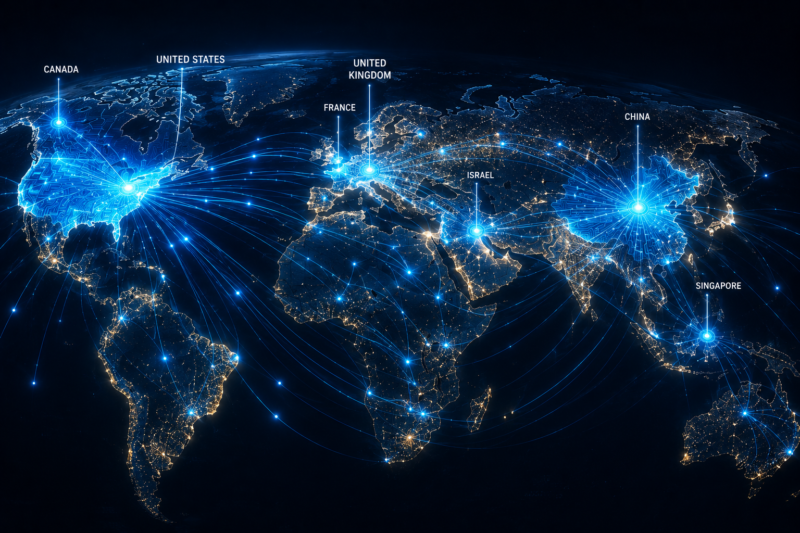
Throughout this article, we refer to these as AI suppliers and AI customer economies. AI suppliers design, develop, own and export artificial intelligence technologies. AI customer economies purchase those technologies to improve productivity, automate routine work and enable organisations to produce the same output with fewer employees. Both benefit from AI, but they may not benefit equally.
Looking Back To Look Forward
History shows that economies developing and exporting valuable resources or transformative technologies have often captured a disproportionate share of the long-term economic benefits. Oil provides one obvious example. Countries producing and exporting oil generate export revenues, create high value industries, attract investment and collect taxes from both businesses and workers throughout their energy sectors. Countries importing oil clearly benefit from using it, but much of the long-term economic value ultimately flows back to the producers.
Artificial intelligence is obviously very different from oil, but it raises an interesting macroeconomic question. Could AI become another globally traded technology where the economies developing and supplying it capture a greater share of the long-term economic benefits than the economies primarily purchasing and using it?
The following example is entirely hypothetical. However, it explores an economic question that organisations such as the OECD have begun examining as they study how the benefits and labour market impacts of artificial intelligence may be distributed unevenly between countries and regions.
A Hypothetical Scenario
Imagine an economy employing 10,000 white collar workers.
Over the next five years, organisations across the economy embrace artificial intelligence. Routine administration, research, document preparation, customer communications, software development and many other knowledge based tasks become increasingly automated. Businesses discover they can produce the same level of output with fewer employees.
As AI adoption accelerates, the number of white collar workers required falls to 7,000 and recruitment for many of these roles more or less dries up. The economy has become significantly more productive. Businesses are more efficient and, in many cases, more profitable.
Now consider where the AI comes from.
The technology is supplied by an AI company headquartered in California. Organisations throughout the economy pay millions each year in subscription fees to use its AI platform.
Because modern AI software is highly scalable, the supplier only needs to recruit perhaps 100 to 300 additional engineers, researchers, software developers and support specialists to meet growing demand from this economy, while also supporting thousands of other organisations around the world.
The result is a striking imbalance. The AI customer economy now requires 3,000 fewer white collar workers, while the AI supplier creates only a relatively small number of additional highly skilled jobs.
It is important to stress that this is a hypothetical scenario rather than a prediction. However, it touches on issues that organisations such as the OECD have already begun exploring. The OECD has highlighted that the economic and labour market impacts of artificial intelligence are unlikely to be distributed evenly between countries and regions. While it does not make the specific argument presented here, it does recognise that AI may create different outcomes depending on where technology is developed, where it is deployed and how economies adapt to it.
Following The Money
The consequences extend far beyond employment.
Those 3,000 workers were previously paying income tax, spending their wages in local businesses, supporting the housing market and contributing to the wider economy. If large numbers of white collar jobs disappear, governments may eventually collect less employment related tax, while reduced consumer spending could affect retailers, restaurants, construction, transport and countless other sectors.
Meanwhile, the AI supplier recruits additional highly paid employees. Those workers also pay income tax, spend money in their local economy, buy homes and support surrounding businesses. The AI company itself generates higher revenues, invests in research and development, expands its workforce and pays taxes where it operates.
The subscription fees paid by organisations using AI also flow back to the supplier, helping fund further innovation, employment and investment in the economy where the technology is developed rather than where it is consumed.
A New Macroeconomic Divide?
This hypothetical example does not suggest that AI is bad for the economy. Nor does it suggest that artificial intelligence cannot create new jobs. Instead, it asks a different question.
If this pattern were repeated across dozens of economies, could artificial intelligence gradually create a widening divide between AI suppliers and AI customer economies?
Could economies that primarily build, own and export AI capture a growing share of high value employment, investment and tax revenues, while economies that mainly consume AI become more productive but support fewer white collar workers?
No one knows the answer. However, it is a question worth asking because the effects would extend far beyond employment statistics. They could influence government finances, public services, consumer spending, housing markets and long-term economic growth.
Why Don’t AI Suppliers Simply Move?
One obvious question is why AI suppliers would not simply establish major operations within the customer economy.
The answer is that, in many cases, there is little commercial incentive to do so.
The world’s leading AI companies are typically based in established technology ecosystems where they have access to specialist talent, venture capital, world-class universities, research partnerships and existing infrastructure. These locations have often spent decades building the conditions needed for innovation.
Once an AI platform has been developed, it can usually be delivered to customers anywhere in the world over the internet. Unlike manufacturing or traditional industries, there is often no requirement to build factories, warehouses or large regional workforces close to every customer.
Customer economies may employ local consultants, implementation specialists, trainers and sales teams, but these roles are likely to represent only a small fraction of the highly skilled research, engineering and product development jobs that remain concentrated where the AI is created.
This is one reason why the long-term AI economic impact may differ between AI suppliers and AI customer economies. The technology can be exported globally, while much of the highest value employment, investment and innovation remains concentrated where the AI is developed.
The Debate We Should Be Having
Artificial intelligence has enormous potential to improve productivity, create new industries and transform the way organisations operate. Perhaps, however, the debate should move beyond whether AI creates or destroys jobs.
Perhaps we should also be asking whether AI suppliers and AI customer economies will experience fundamentally different economic futures.
Governments are rightly encouraging businesses to adopt artificial intelligence. But should they also be thinking about how their economies can participate in creating, developing, exporting and supporting AI rather than simply consuming it?
If the answer is yes, then the real challenge of artificial intelligence may not simply be technological.
It may be macroeconomic.
Continue Your AI Learning
AI is changing the workplace faster than ever. At AI Tuition Hub, our practical AI courses help individuals and organisations understand artificial intelligence, develop valuable new skills and prepare for the opportunities and challenges ahead.
Published: 14th July 2026.