Earlier this year, we explored AI, Real Time Knowledge and the Future of Assessment, asking whether education places too much emphasis on remembering information when AI makes explanations and answers readily accessible.
The subject attracted considerable interest on LinkedIn. It touches something many people recognise: passing an exam, understanding a subject and applying knowledge in practice are related, but they are not identical.
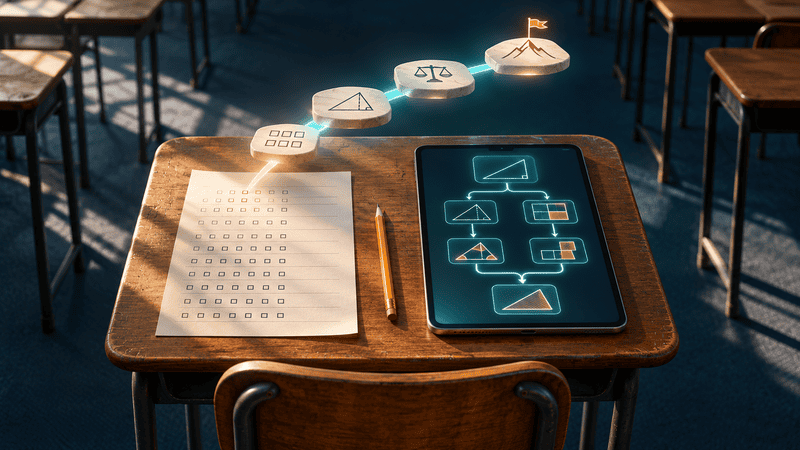
Recent developments give us an opportunity to revisit that discussion. Google is introducing more guided learning tools, research has measured time savings in teachers’ lesson planning, and a university study has highlighted differences between lecturers’ perceptions of AI use and students’ own accounts.
AI is changing learning. Are exams measuring the right things? Answering that requires us to consider what students need to know, what they should be able to do independently and how they demonstrate their understanding when AI is available.
From providing answers to guiding learning
On 3 November, Google announced the global availability of Guided Learning in Google Classroom. It also outlined a pilot bringing guided learning capabilities into Search for student accounts in selected US schools later in November.
The approach aims to support students through questions and explanations, helping them work through a problem. Google describes this as encouraging “productive struggle”: enough challenge to develop understanding without leaving the learner overwhelmed.
This is a promising direction. There is educational value in helping someone reach an answer through a process they understand.
Imagine a student struggling with percentages. An AI assistant could explain the method, ask them to attempt a calculation and help identify where they went wrong. It could offer another example without the student feeling embarrassed about asking again.
However, successfully completing a guided exercise does not necessarily demonstrate independent understanding.
The student might follow each prompt correctly while remaining unable to decide which method to use when presented with a different problem. They could become skilled at responding to assistance without developing confidence on their own.
Assessment therefore needs to examine what happens after the guidance ends. Can the student explain the method, recognise when it applies and use it in a new situation?
These questions matter whether the support comes from AI, a textbook or a human tutor.
Instant answers do not remove the need for knowledge
Our earlier article questioned the value placed on recall. That argument deserves an important qualification: knowledge held in our own minds remains essential.
Someone who understands a subject can recognise an implausible answer, notice a missing consideration and ask a useful follow-up question. Someone encountering the subject for the first time may struggle to distinguish a convincing explanation from an inaccurate one.

AI makes this distinction particularly important because fluent language can create an impression of authority.
A student reviewing an AI explanation of a historical event needs enough background knowledge to notice confused dates or an oversimplified argument. A trainee accountant needs to understand the principles behind a calculation before accepting its result.
Access to information becomes more useful when we have the knowledge to interpret it.
The challenge for education is deciding which foundations students need to develop and how to assess their ability to build upon them. Recall has a role, alongside explanation, application and judgement.
Faster preparation is only part of the story
Another recent development concerns teachers’ work.
On 6 October, the Education Endowment Foundation published an evaluation of Aila, Oak National Academy’s AI lesson planning assistant. The trial involved 464 teachers across 108 primary schools.
Teachers using Aila spent approximately 24% less time on lesson planning and resource preparation, equivalent to around 49 minutes a week. The assessed quality of their lesson plans was maintained. However, teachers’ views were mixed and use declined during the trial.
This is useful evidence of a practical benefit. It also illustrates why we need to be precise about what success means.
Reducing preparation time is one outcome. Improving classroom teaching or pupil understanding involves further questions. The trial does not establish that students learned more because their teachers planned more quickly.
A similar distinction applies to students. Producing an essay faster does not tell us whether the writer has developed a stronger understanding of its subject.
We should welcome useful efficiencies while examining what they enable. For teachers, saved time could create opportunities for individual support or more thoughtful feedback. For students, it could allow deeper exploration of a topic. Those benefits depend on how the time is used.
Suspicion cannot provide a reliable assessment system
The relationship between students and lecturers is also changing.
Research announced by the University of Manchester on 4 November found that staff perceived students’ AI use to be considerably greater than students reported themselves.
The study involved 45 staff and 86 students in one university school covering social science subjects. Its questionnaires were completed between April and June 2024, and students may have underreported their use. It therefore offers a limited historical snapshot rather than a measure of current behaviour. Nevertheless, it highlights the difficulty of developing policy around incomplete information.
Lecturers need confidence that assessed work reflects a student’s ability. Students need confidence that their work will receive a fair hearing.
A polished assignment alone may leave important questions unanswered. How did the student develop the argument? Which sources did they check? Can they explain why they reached their conclusion?
Clear rules about permitted AI assistance can help. So can assessment that reveals more of the learning process, through selected drafts, practical tasks, discussion or reflection on decisions.
These approaches require careful design, including appropriate support for students with disabilities or different communication needs.
Assessing independent ability and AI assisted work
Education could benefit from making two expectations more explicit.
Students need opportunities to demonstrate what they can do independently. They also need opportunities to show how responsibly and effectively they can work with AI.
For example, a student might first explain a concept without assistance. In a separate task, they could examine an AI generated response, identify weaknesses, verify its claims and improve it.
A practical project could require students to disclose their use of AI and explain which suggestions they accepted or rejected.
This would make judgement visible. It would also help distinguish understanding from the ability to obtain a plausible answer.
Traditional exams can still contribute, particularly where independent knowledge and fluent recall matter. Other assessments can examine research, collaboration and the responsible use of tools.
Our view is that education needs a thoughtful combination. Students should leave with knowledge they can rely upon, confidence in their own reasoning and the skills to question AI when its answers sound convincing.
As AI becomes more capable, demonstrating those abilities becomes increasingly important.
At AI Tuition Hub, we help people understand how AI is changing learning, teaching and preparation for working life. Our courses connected to education include:
- AI in Education and Learning Technologies
- AI for Educational Administration and Student Management
- AI for Students – Smarter Study, Research, and Career Skills
- AI Leadership & Global Competition: Education at the Frontier
- AI for Parents: Supporting Children in an AI World
- Let’s Learn About AI Without the Technical Jargon
- Free Course – Beware Online: Scams, Threats & Traps (Ages 11–18)
Whether you are an educator, student or parent, explore our courses to build your understanding of AI, its practical uses and the questions it raises for education.
Published: 7th November 2026.