For decades, education has relied on a simple assumption: if you can remember it, you understand it.
But AI real time knowledge is now starting to challenge that idea.
Exams have been built around that idea. Revise, retain, reproduce. The better your memory, the better your result.

That approach made complete sense in a world where knowledge was limited and not easily accessible. If you knew something, it gave you a clear advantage.
But AI is starting to challenge that logic in a very real way.
Because we are no longer living in a world where knowledge needs to be stored in your head to be useful. It is available instantly, and increasingly, it is being updated in real time.
That shift is not subtle. It changes the foundation of how we think about ability.
The move from stored knowledge to accessible knowledge
In the past, knowledge had to be carried with you.
Books were not always available. Experts were limited. Research took time. Exams reflected that reality. They rewarded those who could retain and recall information under pressure.
Now, AI has changed the equation.
Information is no longer something you need to store. It is something you can access, interpret, and apply in real time. Whether it is explaining a concept, summarising a document, or helping structure an argument, AI tools are effectively acting as on demand support systems.
That does not remove the need for understanding. If anything, it makes understanding more important.
But it does reduce the value of memory as the primary measure of capability.
And that is where tension begins to emerge.
The problem with memory based assessment
One of the biggest issues with traditional exams is that they are static.
They measure what a student knows at a fixed moment in time. That might have worked when knowledge changed slowly. It does not work as well in a world where entire industries evolve within a few years.
What you learn in one decade can easily become outdated in the next.
Technology moves. Regulation changes. Methods improve. Entire job roles appear and disappear. Yet exam systems often move at a much slower pace, meaning what is being assessed can lag behind what is actually relevant.
AI highlights this problem.
Because it keeps information moving in near real time, it exposes how artificial a fixed memory test can be. It raises a simple but important question.
If knowledge is constantly changing, why are we still measuring ability based on how much of it someone can store and recall at a single point in time?
AI is exposing weaknesses, not creating them
A lot of discussion around AI in education has focused on cheating.
Can students use AI to write essays? Can coursework still be trusted? How do institutions detect AI generated content?
These are valid concerns, but they are only part of the picture.
Recent commentary has suggested that AI is not creating a new problem. It is exposing an old one.
If a machine can produce a high quality essay that meets marking criteria, then it raises an uncomfortable question. Were those criteria ever measuring true understanding in the first place?
For years, education has relied heavily on outputs.
Essays, reports, and written answers have been treated as proof of knowledge. But AI has weakened that link. Producing something that looks correct is no longer the same as understanding it.
This is sometimes described as an output problem.
And it is forcing educators to rethink what they are actually assessing.
The rise of real time thinking
As AI reduces the importance of recall, other skills become far more valuable.
Interpretation becomes critical. Can someone take information and understand what it actually means?
Synthesis becomes important. Can they connect different ideas and build something new?
Judgement matters more. Can they assess whether information is reliable or flawed?
And problem solving becomes central. AI can assist with answers, but it does not define the problem itself.
These are not new skills. They have always mattered.
But they are now becoming the primary way ability is expressed.
That represents a shift from what you know to how you think.
Education is struggling to keep up
One of the clearest themes emerging in 2026 is the speed gap.
Technology is evolving quickly. The workplace is adapting quickly. But education systems are not.
Curriculums take years to change. Assessment models take even longer. Policy decisions move slowly. By the time updates are implemented, the landscape has often shifted again.
That creates a growing disconnect.
Students are being assessed in ways that do not fully reflect the environments they are about to enter. Employers are increasingly looking for adaptability, judgement, and practical thinking, while assessment systems are still heavily weighted toward recall and structured outputs.
This gap is becoming harder to ignore.
Different responses are emerging
There is no single agreed solution yet.
Some institutions are reinforcing traditional exams. The logic is simple. Controlled environments make it harder to rely on AI, and therefore easier to assess individual ability.
Others are taking a different approach.There is growing experimentation with in class assessment, oral questioning, and live problem solving. These methods focus less on what students can produce in isolation and more on how they think in real time.
There is also increasing interest in project based learning, where students are asked to apply knowledge over time rather than reproduce it under pressure.
Each of these approaches has strengths and limitations.
But they all point in the same direction.
Assessment is starting to shift away from memory and toward thinking.
Not everyone agrees
It is important to recognise that not everyone believes exams are becoming less relevant.
Some argue that internal knowledge still matters deeply. Without a foundation of understanding, it is difficult to interpret or challenge information, even with AI support.
There is also concern that over reliance on AI could weaken critical thinking rather than strengthen it.
These are valid points.
The debate is not about removing knowledge from education. It is about rebalancing how it is valued and assessed.
Where this leaves exams
Exams are not disappearing.
They still serve a purpose. They provide structure. They create standardisation. They allow comparison across large groups.
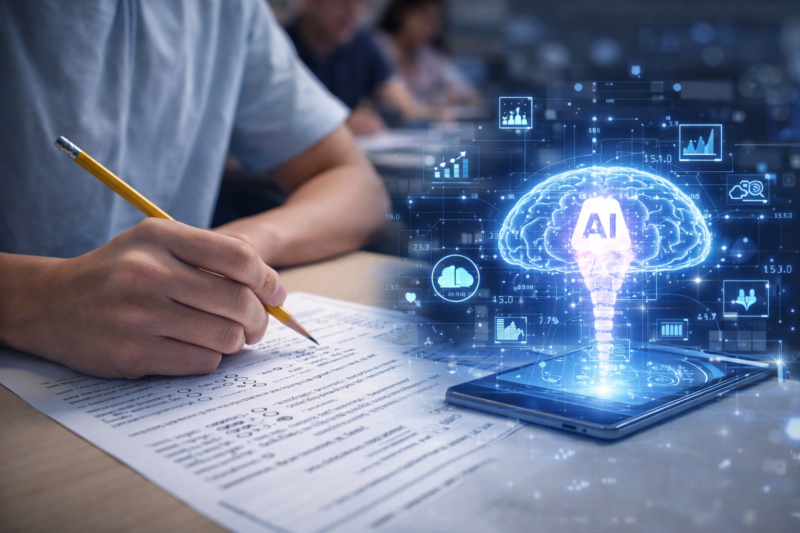
But their role is changing.
They are no longer the only, or even the best, way to measure ability in a world where knowledge is always available and constantly evolving.
The more AI develops, the more this becomes clear.
A bigger question is emerging
AI is not just making coursework harder to police.
It is forcing a deeper conversation.
If knowledge is accessible, dynamic, and constantly updated, then ability can no longer be defined by memory alone.
It has to be defined by how effectively someone can use that knowledge.
That means thinking, not just remembering.
Understanding, not just repeating.
Applying, not just recalling.
And that is where the future of assessment is heading.
Explore how these changes are reflected in practice through a range of education focused courses available within AI Tuition Hub.