Artificial intelligence is changing the world faster than almost any technology before it, but one question continues to come up: what programming languages are used in AI? Many people assume the answer is simply Python. While Python is undoubtedly the best known AI programming language, it is only one piece of a much larger puzzle.
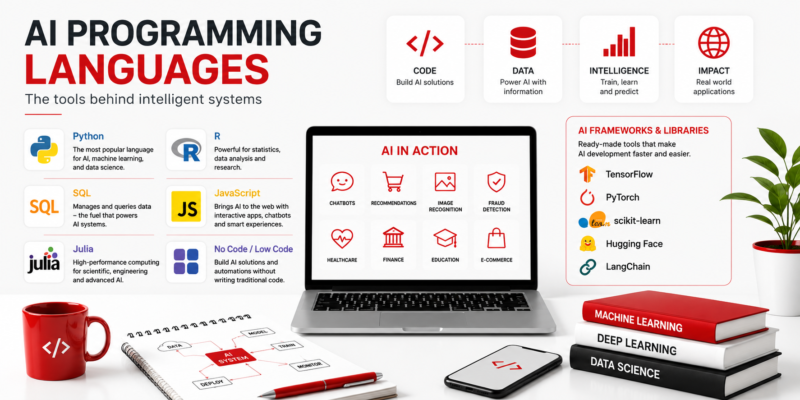
Modern artificial intelligence relies on a combination of programming languages, databases, frameworks and development tools that work together to create the intelligent systems we use every day. Whether you are curious about AI, considering a career change or simply want to understand what sits behind tools like ChatGPT, this guide explains the main AI programming languages in plain English.
Python: The Language Behind Modern AI
When people think about AI programming languages, Python is usually the first that comes to mind. It powers many of today’s most recognisable AI applications because it is relatively easy to learn while being powerful enough to build sophisticated artificial intelligence systems.
Python is used to develop chatbots, recommendation engines, image recognition software, fraud detection systems, virtual assistants and generative AI tools. Companies such as Netflix use AI to recommend films and television programmes, banks use Python powered AI to detect suspicious transactions, while healthcare organisations use it to analyse medical images and improve diagnostics.
Many of today’s large language models and AI assistants also rely heavily on Python, making it the most important programming language in the AI world.
R: Turning Data into Intelligence
Artificial intelligence depends on data, but before AI can make intelligent decisions, someone needs to understand that data.
This is where R excels.
R is widely used by statisticians, universities, pharmaceutical companies, researchers and financial institutions to analyse enormous datasets and identify patterns that humans might otherwise miss. It is particularly valuable wherever statistical accuracy is critical, making it an important part of the wider AI ecosystem.
While it may not receive as much publicity as Python, R remains one of the most respected AI programming languages for data science and research.
SQL: The Organised Memory Behind AI
Artificial intelligence is only as good as the information it receives.
SQL is the language used to communicate with databases, allowing organisations to store, organise and retrieve huge amounts of information.
Supermarkets use SQL to analyse customer purchases, hospitals use it to manage patient records, airlines track bookings and financial institutions manage millions of transactions every day. Whenever an AI system needs reliable, organised data, SQL is often working quietly behind the scenes.
Although SQL does not build AI models itself, it provides the information that allows artificial intelligence to function effectively.
JavaScript: Bringing AI to Your Screen
Whenever you visit a website with an AI chatbot, receive personalised shopping recommendations or use an intelligent search box, there is a good chance JavaScript is involved.
JavaScript allows developers to integrate artificial intelligence directly into websites and online applications. It helps create responsive customer support systems, intelligent online banking services, interactive learning platforms and modern e-commerce experiences.
While Python often provides the intelligence, JavaScript is frequently responsible for delivering that intelligence to the people using it.
Julia: High Performance Artificial Intelligence
Some AI projects involve enormous amounts of mathematics and scientific computing.
Climate modelling, robotics, engineering simulations, financial forecasting and advanced research all require exceptional computational performance.
Julia was designed specifically for these demanding environments. It combines impressive speed with a relatively straightforward programming language, making it increasingly popular among researchers and engineers developing cutting edge artificial intelligence solutions.
Although Julia is less common than Python, it has become an important part of modern AI development in specialist industries.
No Code and Low Code AI
One of the biggest surprises for many people is that you no longer need to become a software developer to make use of artificial intelligence.
Modern no code and low code platforms allow users to create AI assistants, automate workflows, analyse documents and build intelligent business applications using simple visual interfaces instead of traditional programming.
Marketing teams automate campaigns, HR departments create employee assistants, accountants streamline reporting and small businesses develop customer service chatbots without writing thousands of lines of code.
Artificial intelligence has become far more accessible than many people realise.
AI Frameworks and Libraries
Programming languages alone do not build modern artificial intelligence.
Developers also rely on frameworks and libraries such as TensorFlow, PyTorch, Scikit-learn, Hugging Face and LangChain. These provide ready-made building blocks that dramatically reduce development time.
Instead of creating complex mathematical models from scratch, developers can concentrate on solving real business problems, whether that involves computer vision, speech recognition, recommendation engines or generative AI applications.
These frameworks are one of the main reasons artificial intelligence has advanced so rapidly over the past decade.
Which AI Programming Language Should You Learn?
There is no single answer because it depends on what you want to achieve.
Python remains the best all-round choice for AI development. SQL is essential for managing data. JavaScript powers intelligent websites. R continues to dominate many areas of statistics and research, while Julia excels in scientific computing.
At the same time, millions of people are now using no code AI platforms without learning traditional programming at all.
For many beginners, understanding how these AI programming languages work together is actually more valuable than becoming an expert in any one language.
Understanding the Bigger Picture
The world of artificial intelligence is far more diverse than many people imagine.
Rather than relying on a single programming language, modern AI combines databases, statistical analysis, software development, cloud computing and specialist AI frameworks into one connected ecosystem.
Understanding the role each technology plays gives you a much clearer picture of how artificial intelligence is transforming businesses, industries and everyday life.
Continue Your AI Learning Journey
If you would like to explore AI programming languages in more detail, our course, A Beginner’s Guide to Programming Languages Used in AI, is available within the AI Tuition Hub library, which now contains more than 110 AI courses covering a wide range of artificial intelligence topics.
The course is designed specifically for beginners. Rather than teaching advanced software development, it explains where each programming language fits within the wider AI landscape, making it the perfect starting point for anyone who wants to understand artificial intelligence without needing a computer science background.
If you are new to AI Tuition Hub, you can also use the discount code FOUNDER50 to receive 50% off your first month’s subscription, giving you affordable access to our growing library of AI learning resources.
We are continually expanding our course library and would love to hear your ideas. If there is an AI topic, technology or practical skill you would like us to cover in a future course, please get in touch through our contact page.
Your suggestions help us continue building practical, beginner friendly AI courses that make artificial intelligence accessible to everyone.