Imagine arriving at work tomorrow to discover your newest colleague isn’t human. They don’t need a desk, they never call in sick, they work around the clock and they can analyse thousands of documents before you’ve finished your first coffee. It might sound like something from a science fiction film, but the Rise of AI Employees is already underway. Organisations across the world are quietly deploying artificial intelligence to perform real business tasks, and this shift could become one of the biggest workplace transformations since the arrival of the internet.
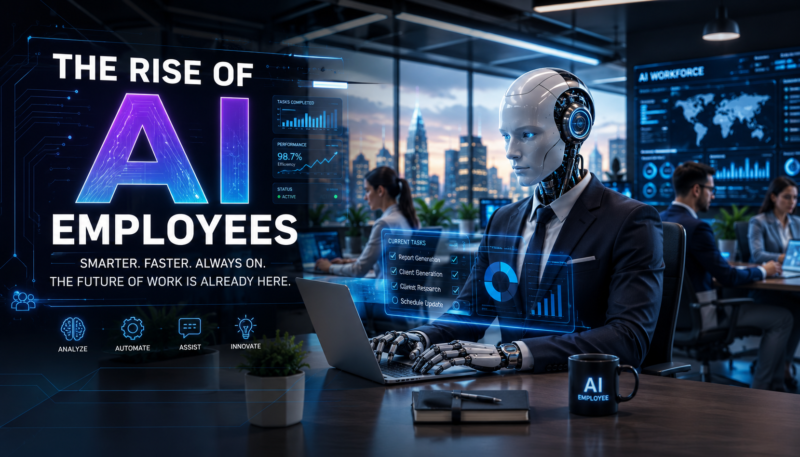
The conversation around AI has changed dramatically over the past two years. Businesses are no longer asking whether artificial intelligence is useful. Instead, they are asking where it can save time, reduce costs and improve productivity. Increasingly, the answer is by giving AI real responsibilities within the organisation.
AI Is Growing Up
For years, AI has been viewed as little more than an intelligent assistant. You asked it a question, it answered. You requested an image, it created one. Useful? Absolutely. Revolutionary? Perhaps not.
Today’s AI is very different.
Modern AI systems can complete workflows, analyse information, write reports, monitor business activity, answer customer enquiries and even work alongside other AI systems to complete larger projects. Instead of waiting for instructions every few minutes, they are beginning to work towards objectives.
That is why many experts have started referring to them as AI employees rather than AI assistants.
It is a subtle difference, but an important one.
Why Businesses Are So Interested
Every organisation has work that consumes valuable hours without creating much competitive advantage. Administrative tasks, data entry, report writing, scheduling meetings, reviewing documents and responding to routine customer enquiries all need doing, but they rarely represent the best use of talented employees.
AI can now perform many of these activities with remarkable speed.
A finance team might use AI to prepare management reports before the working day begins. A customer service department might resolve hundreds of routine enquiries overnight. A marketing team might analyse campaign performance and suggest improvements before the first meeting of the morning.
The goal is not simply to work faster. It is to allow people to spend more time solving problems, building relationships and making better decisions.
AI Employees Are Already Here
It is easy to assume this is something that will happen in five or ten years’ time, but it isn’t.
Banks are using AI to review transactions and identify suspicious activity. Finance teams are deploying AI for bookkeeping, invoice processing, reconciliations and preparing management reports. Marketing departments use AI to analyse customer behaviour, monitor competitors and identify emerging market trends. Businesses are also using AI for customer service, HR administration, diary management, email handling, document preparation and countless other secretarial functions that once consumed hours of an employee’s day.
Think of it as having a highly capable administrative assistant available whenever you need one. An AI employee can research a topic, summarise lengthy reports, draft correspondence, organise meetings, prepare presentations, analyse sales figures and produce detailed market intelligence in minutes. It doesn’t replace human judgement, but it provides organisations with a super administrator that’s available 24 hours a day, seven days a week.
Many businesses already have AI performing work that was once carried out entirely by people. In most cases, organisations are not replacing entire departments. Instead, they are removing repetitive, time-consuming work so employees can focus on solving problems, building relationships and creating greater value.
The Workplace Is Starting To Change
Perhaps the biggest impact will not be the technology itself, but the way organisations are structured.
Instead of every task being assigned to a person, future businesses may allocate work to whoever is best suited to complete it, whether that is a human employee or an AI employee.
Imagine a project where AI gathers research, analyses market data, prepares the first draft of a proposal and identifies potential risks. A human manager then reviews the recommendations, applies experience and judgement, speaks with the client and makes the final decision.
That is collaboration rather than replacement.
Businesses that learn how to combine human expertise with AI capabilities are likely to gain significant advantages over competitors that continue working in traditional ways.
New Opportunities, New Challenges
Of course, introducing AI employees is not without risks.
Artificial intelligence can make mistakes. It can misunderstand instructions, generate inaccurate information or produce convincing answers that are completely wrong. Organisations also need to think carefully about data security, privacy, governance and accountability.
Who is responsible if AI makes a poor recommendation?
How should sensitive information be protected?
When should a human always make the final decision?
These are questions every organisation will need to answer as AI becomes more deeply integrated into everyday operations.
That is why successful adoption is about much more than installing new software. It requires planning, oversight and clear policies to ensure AI is used responsibly.
The Skills Employers Will Value
Every major technological shift changes the skills employers look for.
When computers arrived, digital literacy became essential. When the internet transformed business, online skills became increasingly valuable.
AI is creating another shift.
The people who thrive are unlikely to be those competing with AI to perform repetitive tasks. Instead, organisations will increasingly value professionals who understand how to work alongside AI, supervise its output, identify risks and use it to improve business performance.
Critical thinking, leadership, communication, creativity and ethical judgement will become even more important because these are the areas where human expertise continues to make the greatest difference.
Understanding AI is rapidly becoming a business skill rather than simply a technical one.
Preparing For The Future
One of the biggest mistakes organisations can make is assuming they have plenty of time.
Artificial intelligence is improving at an extraordinary pace, and every new generation becomes more capable than the last. Businesses that start learning now will be in a much stronger position than those waiting until competitors have already transformed the way they work.
Preparation does not mean replacing employees overnight.
It means understanding where AI can genuinely improve productivity, where human oversight remains essential and how both can work together to achieve better results.
The companies investing in AI knowledge today are laying the foundations for tomorrow’s competitive advantage.
Final Thoughts
The Rise of AI Employees is no longer a prediction for the distant future. It is happening now, and it is reshaping how organisations think about productivity, leadership and the future of work. Businesses that understand this shift will be far better prepared to take advantage of the opportunities while avoiding many of the risks.
This article has only scratched the surface. If you want to explore how AI employees work in practice, where they are already being deployed, how to manage them effectively and what this means for the future of your organisation, our Working with AI Employees course takes a much deeper dive into one of the most important developments in modern business.
At AI Tuition Hub, you’ll also gain access to more than 110 AI courses covering business, finance, cybersecurity, productivity, education and many other topics designed to help you stay ahead in an AI driven world.
When you subscribe, don’t forget to use the code FOUNDER50 to receive 50% off your first month, giving you unlimited access to the entire AI Tuition Hub course library for less than £10.