Artificial intelligence has moved far beyond being the latest technology trend. During 2026, AI investment has reached unprecedented levels as the world’s largest technology companies commit hundreds of billions of dollars to new infrastructure, advanced chips, cloud platforms and research. From Microsoft and Amazon to Alphabet, Meta and Nvidia, the scale of spending suggests these companies believe AI will fundamentally reshape the global economy.

The phrase “follow the money” has long been used by investors, and nowhere is that more relevant today than in artificial intelligence. Companies do not invest hundreds of billions of dollars without expecting enormous long term returns. Whether AI ultimately transforms every industry or falls short of today’s expectations remains to be seen, but one thing is already clear. The investment taking place today is unlike anything the technology sector has witnessed for many years.
The AI Investment Race
Over the past year, Microsoft, Amazon, Alphabet, Meta and other technology giants have continued increasing their investment in AI infrastructure. Collectively, they are expected to spend hundreds of billions of dollars on capital projects during 2026, with artificial intelligence accounting for a significant proportion of that spending.
This investment extends far beyond consumer AI tools such as ChatGPT or Gemini. Behind every AI assistant sits an enormous amount of computing power. Companies are constructing vast data centres, purchasing tens of thousands of specialist AI chips, expanding cloud networks and securing access to enough electricity to power these facilities for years to come.
However, this is no longer simply a race between technology companies. It has also become a strategic competition between nations. The United States and China are investing heavily in artificial intelligence because both recognise its potential to shape future economic growth, scientific research, military capability and national security. Other countries are also increasing investment to avoid falling behind in what many now see as one of the defining technological races of the century.
The AI race has therefore become both an infrastructure race and a geopolitical race. Just as previous generations invested in railways, electricity networks and the internet, today’s governments and technology leaders are building the foundations they believe will support the next era of computing.
Where Is The Money Going?
Much of the recent investment is being directed towards areas that many people never see.
Modern AI models require specialist graphics processing units, commonly known as GPUs, capable of performing trillions of calculations every second. Companies such as Nvidia have become central to this revolution by designing the chips that power many of today’s most advanced AI systems.
Alongside these chips come vast data centres containing thousands of servers operating around the clock. These facilities require advanced cooling systems, high speed networking and increasingly large supplies of electricity. Some technology companies are even investing directly in energy infrastructure because reliable power is becoming a competitive advantage in the AI era.
The investment does not stop there. Billions more are being committed to cloud platforms, AI research, semiconductor development and recruiting many of the world’s leading artificial intelligence specialists.
Why Spend So Much?
The obvious question is why companies are prepared to invest such extraordinary amounts of money.
The answer appears to be that artificial intelligence is no longer viewed as simply another software product. Instead, many business leaders believe AI could become the foundation upon which future business services are built.
If organisations increasingly rely on AI to write software, analyse financial information, assist healthcare professionals, improve customer service and automate routine administration, demand for AI computing power could continue growing for many years.
Owning that infrastructure may prove just as valuable as owning cloud computing platforms became during the previous decade.
Confidence Or Competition?
Another reason for the surge in AI investment is competition.
No major technology company wants to risk being left behind. If one organisation develops faster AI systems, more efficient chips or larger cloud platforms, it could attract millions of customers and generate substantial long term revenues.
That has created an investment race in which standing still may be viewed as a greater risk than spending billions today.
For investors, governments and businesses alike, the message is becoming increasingly clear. Artificial intelligence is no longer regarded as an experimental technology. It is now one of the biggest investment priorities in the global economy.
The Bigger Questions
The scale of AI investment is remarkable, but perhaps the most important discussion is not how much money is being spent. It is what these companies expect to happen next. Businesses do not invest hundreds of billions of dollars simply because a technology is fashionable. They invest because they believe it will generate significant long term returns. Artificial intelligence is increasingly being viewed as the next major computing platform, and many of the world’s largest organisations appear determined to secure their place at the centre of it. Exactly how those returns will be achieved remains one of the biggest questions of the AI era.
What Does This Mean For Jobs?
For decades, new technologies have created new industries while changing or replacing others. Artificial intelligence is unlikely to be any different, but nobody yet knows how that balance will develop. Some experts believe AI will create entirely new professions in areas such as AI governance, robotics, cybersecurity, healthcare and advanced engineering. Others believe the technology will mainly allow existing employees to become more productive, enabling organisations to produce more work with the same workforce or, in some cases, fewer employees. We have previously explored how many of these new opportunities may emerge in countries where labour costs are lower and AI expertise is already well established. If businesses can recruit highly skilled AI specialists anywhere in the world, the geographical distribution of future employment may look very different from today.
Productivity Is Only Part Of The Story
One of the strongest arguments in favour of artificial intelligence is that it allows employees to spend less time on repetitive administration and more time on higher value work. There is certainly logic behind that view, but it also raises another important question. Where does the additional work come from? If one accountant, lawyer, software developer or marketing professional can complete significantly more work than before, businesses may need to attract many more clients simply to maintain the same number of employees. Increased productivity is clearly beneficial for organisations, but sustaining employment still depends on demand continuing to grow.
The Nvidia Question
Nvidia perhaps illustrates the AI revolution better than any other company. Employing around 50,000 people, it has become one of the world’s most valuable businesses by designing the specialist chips that power today’s leading AI systems. Those are highly skilled, well paid jobs that many countries would like to attract.
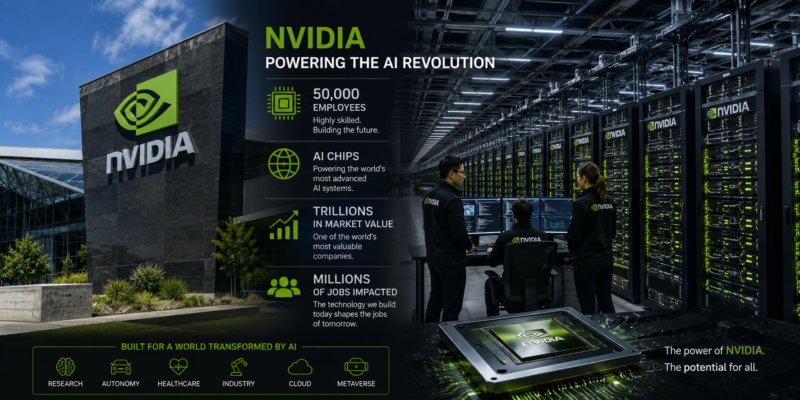
Yet an even bigger question follows.
How many jobs could eventually be influenced by the AI systems running on those chips?
Every new generation of AI hardware makes artificial intelligence faster, cheaper and more capable. Those chips may help organisations create entirely new products and industries, but they may also allow businesses to automate tasks that currently require millions of people across finance, administration, customer service, software development, healthcare and many other professions.
The comparison is striking. A company employing around 50,000 people is helping build technology that could eventually reshape the working lives of hundreds of millions around the world. Whether that ultimately leads to more jobs, different jobs or fewer jobs remains one of the biggest unanswered questions surrounding artificial intelligence.
The Productivity Paradox
Recent events also illustrate that record AI investment does not necessarily mean more jobs. In July 2026, the Financial Times reported that US technology companies had cut almost 140,000 jobs since the start of the year, even as Microsoft, Amazon, Meta and Oracle continued to increase spending on artificial intelligence infrastructure. Rather than directing more money towards expanding their workforces, many of the world’s largest technology companies are investing billions in data centres, specialist AI chips and cloud computing capacity. The result is a growing disconnect between capital investment and employment, raising important questions about how AI-driven productivity gains will affect the future labour market.
Preparing For The Future
Nobody can say with certainty how artificial intelligence will reshape the global economy. Some of today’s investment will undoubtedly create new industries, while some existing jobs and business models will evolve. History suggests both outcomes can happen at the same time.
What is already clear is that AI is becoming an increasingly valuable workplace skill. Whether you work in finance, healthcare, education, marketing, governance, manufacturing or another sector, understanding how artificial intelligence is changing your profession is likely to become an important advantage over the coming years.
That is why we created AI Tuition Hub. Rather than focusing on complex technical concepts, our library of more than 110 beginner friendly AI courses explains artificial intelligence in plain English, helping individuals and organisations understand how AI is changing industries, careers and everyday working life.
The investment is already happening. The technology is advancing at remarkable speed. The biggest questions about employment, productivity and economic change are still unfolding. While nobody can predict exactly how the story will end, learning about AI today is one of the best ways to prepare for whatever comes next.
If you would like to build your AI knowledge, explore our growing library of more than 110 AI courses at AI Tuition Hub. New members can also take advantage of our FOUNDER50 offer, giving 50% off their first month of membership.
Updated: 25th July 2026.