Every major technological breakthrough has eventually been exploited by criminals. The internet transformed fraud, smartphones created new opportunities for identity theft, and social media changed the way misinformation spreads. Artificial Intelligence is proving no different. As AI becomes faster, cheaper and more accessible, it is providing criminals with powerful new ways to deceive, manipulate and exploit people. Many of these capabilities were once limited to organised crime groups or highly skilled hackers, but AI is lowering those barriers and making sophisticated criminal techniques available to a much wider audience.
The growing criminal use of AI is rapidly becoming one of the defining cybersecurity and societal challenges of our time. It is happening today. Criminals are using AI to commit fraud, manipulate public opinion, spread propaganda, create fake identities and launch increasingly sophisticated cyberattacks. In many cases, AI is not creating entirely new crimes, but making existing ones faster, cheaper and far more convincing.
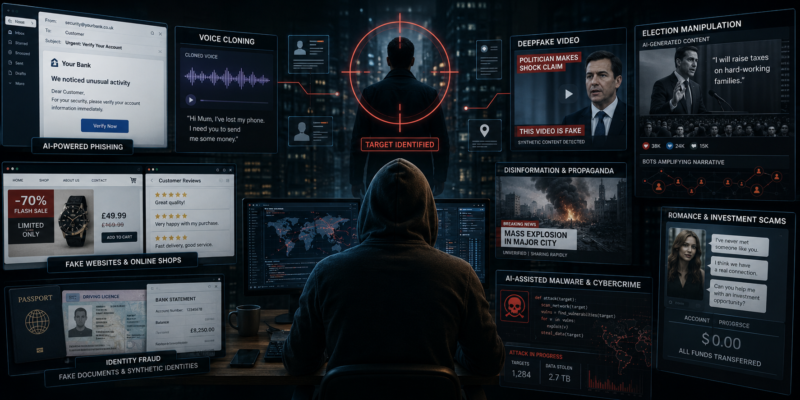
While AI is already helping businesses become more productive, supporting medical research and transforming education, it is also becoming one of the most powerful tools criminals have ever possessed. What once required specialist skills, expensive software or large criminal organisations can now often be achieved using readily available AI tools.
AI Is Making Fraud More Convincing
Fraud has always relied on deception, but AI has raised that deception to an entirely new level. Scam emails that once contained obvious spelling mistakes and poor grammar can now be generated in perfect English, tailored to individual victims and adapted instantly if someone replies.
Criminals are also using AI to create fake banking websites, online shopping platforms and customer support services that closely resemble genuine organisations. Combined with realistic logos, professionally written content and AI-generated images, these websites can be extremely difficult to distinguish from legitimate businesses.
The result is that many of the warning signs people once relied upon are disappearing. AI is making fraud appear increasingly authentic, forcing individuals and businesses to become far more cautious when sharing personal or financial information.
When You Can No Longer Trust Your Eyes or Ears
One of the most significant developments in AI is its ability to imitate people with remarkable realism. Voice cloning software can reproduce someone’s speech using only a few seconds of recorded audio, allowing criminals to impersonate family members, colleagues or senior executives.
Deepfake technology has progressed just as rapidly. AI can now generate convincing photographs and videos showing people saying or doing things that never actually happened. Celebrity endorsements, fake interviews, fabricated business meetings and explicit deepfakes have all emerged in recent years, demonstrating how difficult it is becoming to separate genuine evidence from digital fabrication.
Researchers have also highlighted the emergence of AI-generated “experts”. One widely reported example involved synthetic doctors appearing on TikTok and offering medical advice despite not existing at all. For many viewers there was nothing to suggest these presenters were artificial. The same technology could easily be used to create fake lawyers, accountants, financial advisers or other trusted professionals.
AI Is Changing Political Propaganda
Propaganda has always evolved alongside technology. Newspapers, radio, television and the internet have each been used to influence public opinion. AI has the potential to take that manipulation to an entirely new level.
During election campaigns, AI-generated videos and cloned voices can be used to depict political candidates making statements they never made or appearing at events that never took place. Even if such material is quickly disproved, it may already have reached millions of people through social media before corrections appear.
The objective is not always to persuade voters to support one particular candidate. Sometimes the goal is simply to create confusion, undermine trust in democratic institutions or convince people that they can no longer believe anything they see online. In that respect, AI has become a powerful tool for information warfare as well as political campaigning.
AI Has Become Part of Modern Warfare
Modern wars are no longer fought solely on the battlefield. They are also fought across social media, where information spreads almost instantly around the world.
Recent conflicts have demonstrated how AI-generated images and videos can circulate alongside genuine footage, making it increasingly difficult for the public to determine what is real. During the Israel-Iran conflict, fabricated videos claiming to show missile strikes, destroyed military facilities and dramatic battlefield successes spread rapidly online. Some were entirely AI-generated, while others recycled genuine footage from unrelated events and presented it as current.
Whether the objective is to damage morale, influence international opinion or inflame tensions between different communities, AI has become another weapon in the information war. Journalists, governments and fact-checkers are now engaged in a constant race to verify material before false narratives become accepted as truth.
AI Is Expanding the Criminal Toolkit
Beyond misinformation, AI is making many traditional crimes easier to commit. Criminals are generating fake passports, bank statements, utility bills and employment references that can support identity fraud or financial crime. Others are creating entirely synthetic online identities that appear genuine across multiple platforms.
Romance scams are also evolving. AI-generated profile photographs, realistic conversations and automated messaging systems allow fraudsters to build trust with victims on a scale that was previously impossible. Investment scams are following a similar pattern, using fabricated testimonials, fake financial experts and convincing promotional material to persuade victims to part with their savings.
Cybercriminals are also using AI to assist with writing malicious software, identifying vulnerabilities and automating repetitive hacking tasks. AI has not replaced skilled hackers, but it has lowered the barrier to entry, allowing less experienced criminals to launch attacks that would previously have required significant technical expertise.
Law enforcement agencies are also warning about the growing use of AI to generate illegal child abuse imagery. While the technology does not replace existing offences, it introduces new investigative challenges and demonstrates once again that AI can be exploited in some of the most serious forms of criminal activity.
The Biggest Victim Could Be Trust
Perhaps the greatest danger posed by AI is not financial loss but the gradual erosion of trust. For generations, photographs, videos and recorded conversations have been treated as strong evidence that an event really happened. AI is fundamentally changing that assumption.
As synthetic media becomes increasingly realistic, people will need to question images, videos and even telephone conversations in ways that previous generations never imagined. Businesses, governments and technology companies are investing heavily in detection systems, but the technology continues to evolve at remarkable speed.
The Growing Criminal Use of AI should not overshadow the enormous benefits that Artificial Intelligence is bringing to society. AI is improving healthcare, accelerating scientific research, enhancing education and helping organisations become more productive every day. The technology itself is not the criminal. The responsibility lies entirely with those who choose to misuse it.
Understanding both the opportunities and the risks of AI has therefore become an essential skill. As the technology continues to develop, digital literacy, critical thinking and effective verification will become just as important as traditional cybersecurity. The challenge over the coming decade will not simply be building more powerful AI, but ensuring society develops equally powerful ways to recognise when it is being used for harm.
Learn More About AI
AI is transforming every profession, every industry and every workplace. Understanding how it works, where it adds value and how it can be misused has never been more important.
At AI Tuition Hub, you’ll find more than 110 practical AI courses covering business, finance, compliance, education, cybersecurity, productivity and much more. Whether you’re just beginning your AI journey or looking to deepen your knowledge, our courses are designed to help you stay ahead in a rapidly changing world.
Use the discount code FOUNDER50 to receive 50% off your first month and gain unlimited access to the full course library. Join today and discover how AI can help you work smarter, while understanding the challenges and risks that come with one of the most transformative technologies of our lifetime.