The humanoid robot hype is becoming increasingly difficult to separate from reality. Social media is now filled with apparently convincing videos of robots cooking meals, completing factory work and behaving like human companions.
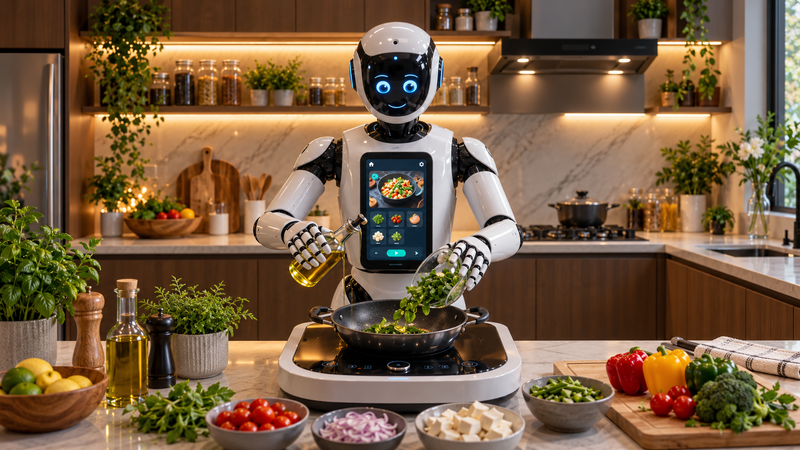
A recent post on X shows a humanoid robot preparing dinner in an immaculate kitchen while its owner supposedly relaxes on the sofa. The robot scans the refrigerator, chooses a recipe and controls the cooking temperature with perfect precision. The post then claims that appliance manufacturers have designated 2027 as the year such robots will appear in mainstream shops.
No manufacturers are named. There is no product model, price, launch announcement or supporting evidence. The accompanying picture appears to be an AI generated concept rather than a photograph of an identifiable working robot.
The Robot That Will Supposedly Cook Dinner
Automated cooking technology is real. Machines such as the Thermomix can weigh, mix, heat and guide people through recipes. More advanced countertop appliances are being developed.
The start-up Mirabelle says it plans to test its robot chef in homes during 2026 and begin deliveries in January 2027. However, this is a countertop appliance slightly larger than a microwave. It is not a humanoid robot that searches the refrigerator and prepares dinner in an ordinary kitchen without assistance.
Commercial cooking robots are also being tested in restaurants and supermarkets. They usually operate inside specially designed workstations using prepared ingredients and controlled processes. That is completely different from coping with a cluttered family kitchen.
Even the promise of “no pile of dirty dishes” is misleading. Food still touches blades, containers, cooking surfaces and removable components. Automation does not make grease and washing-up disappear.
The Perfect Robot Demonstration
There has been impressive progress in robotics. Humanoid machines can walk, carry boxes, sort objects and perform selected industrial tasks.
The problem is how that progress is presented.
A short video may show a robot completing a task perfectly, but it does not reveal how many attempts failed. The surroundings may have been carefully arranged, the movements programmed in advance or the robot controlled remotely by a human operator.
Teleoperation allows somebody to see through a robot’s cameras and guide its actions. It is useful for training and dealing with difficult situations, but it is not the same as autonomous intelligence.
A robot folding one shirt during a demonstration does not prove that it can sort an entire basket of different clothing every day. Moving identical boxes in a controlled warehouse does not mean it can safely navigate a home containing children, pets, stairs, spillages and unfamiliar objects.
Reuters reported in August 2026 that many Chinese humanoid robots remain dependent on choreographed routines and are not yet intelligent or dexterous enough for widespread factory deployment. If they still struggle in controlled industrial environments, the average home presents a much greater challenge.
Fake Female Companion Robots
Another growing trend is the supposed female companion robot.
These videos often feature unusually perfect women with mechanical joints or metallic sections around their faces and necks. Captions claim they are robot girlfriends, domestic assistants or bodyguards already being manufactured in China, Japan or the United States.
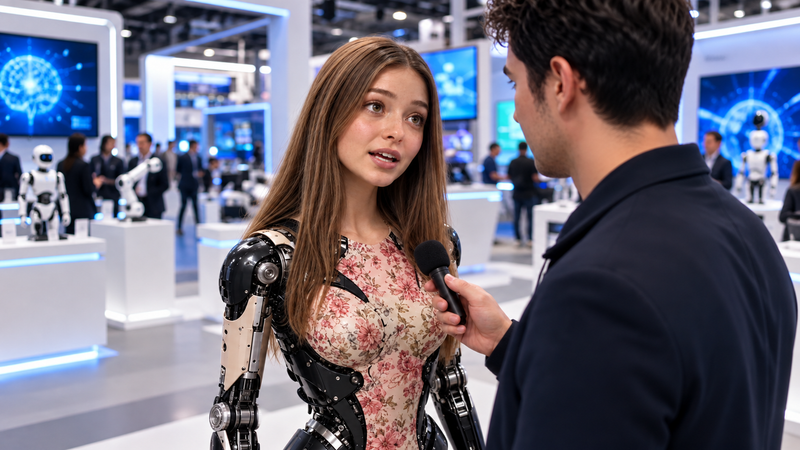
Many are AI generated videos, actresses presented out of context or edited concepts. Fact-checkers have repeatedly disproved footage supposedly showing fully functioning female robots.
Their appearance is no accident. Combining attractive women, loneliness, sexual curiosity and futuristic technology creates material that people are likely to watch and share.
The videos also avoid practical questions. Where is the battery? How long does it last? Can the robot climb stairs? Who repairs it? Is it genuinely autonomous? Could a remote operator see inside the owner’s home?
A convincing artificial face is far easier to generate than a safe, reliable and useful robot.
Why Is There So Much Humanoid Robot Hype?
The first reason is money. Robotics companies require enormous investment. A video suggesting that a robot could become a factory worker, cook or domestic servant sells a much larger commercial vision than footage of it repeatedly moving one container.
Market forecasts involving millions of robots and billions of pounds attract investors, media coverage and government support. However, projections are based on assumptions about future costs, reliability and demand. They do not prove that the products already work.
The second reason is social media. Platforms reward attention rather than accuracy. A careful engineering demonstration explaining a robot’s limitations will rarely travel as far as a claim that robot servants or companions will be available next year.
AI video generation makes deception easier. Almost anyone can now create a realistic looking robot, place it inside a kitchen or factory and make it perform movements that genuine machines still struggle to complete.
National competition adds further pressure. Robotics is presented as a race between China, the United States and other economies. Impressive videos support claims of technological dominance, whether or not the machines can repeat those performances reliably.
Finally, many people want these stories to be true. A machine that cooks dinner and cleans the house is enormously attractive. Others fear robots taking people’s jobs. Both excitement and anxiety encourage sharing before verification.
When Will Robots Actually Cook for Us?
Specialised cooking machines are already here and will become increasingly automated during the remainder of the 2020s. Early systems will prepare a limited range of meals from ingredients placed into the correct compartments.
Between 2030 and 2035, more advanced appliances may identify ingredients, perform basic preparation and cook complete meals. They will probably operate within purpose-built units or adapted kitchens rather than walking around like people.
A humanoid robot that can search an ordinary refrigerator, chop different ingredients, use existing appliances, clean spillages and serve food safely is a much greater challenge. The first extremely expensive versions could appear during the 2030s. Affordable and dependable ownership may not arrive until the 2040s, if the humanoid design proves practical at all.
The more likely future is a collection of specialised appliances controlled by one AI system, rather than a mechanical person standing at the cooker.
When Will Humanoid Robots Enter Offices?
AI software has already entered the office. It drafts correspondence, summarises meetings, searches documents and analyses information. That is where the most immediate disruption will occur.
There is little reason to build a robot to sit at a desk and operate a keyboard when AI can work directly inside the computer. Physical robots may greet visitors, carry supplies, inspect buildings or perform repetitive duties, but these will initially be limited service roles.
More trials are likely in factories, warehouses, hospitals and large commercial buildings during the late 2020s. Wider deployment could develop throughout the 2030s if the machines become reliable and economical.
Goldman Sachs estimates that humanoid robot shipments could reach 1.4 million by 2035. Spread across the entire world and numerous industries, that would still make them relatively uncommon.
Real Progress Does Not Need Fake Evidence
Robotics is advancing, but genuine engineering, ambitious forecasts and synthetic fiction are increasingly presented as though they are the same thing.
AI generated robot videos distort public understanding, mislead investors and create false expectations about how quickly work and domestic life will change. They may eventually damage the industry itself. If promised robot workers, cooks and companions repeatedly fail to arrive, excitement will turn into cynicism.
Before believing the next extraordinary robot video, ask who manufactured it, where it was demonstrated, whether it was autonomous, what it costs and whether independent observers have tested it.
If none of those questions has an answer, we may not be witnessing the robot revolution. We may simply be watching an advertisement for an imaginary future.
We recently updated our course, AI and the Future of Crime and Policing, which examines how artificial intelligence and other emerging technologies are changing investigations, digital evidence, public safety and modern policing.
AI is already assisting police forces with information analysis and evidence processing, while robots can be used for surveillance, bomb disposal and other dangerous situations. But how long will it be before these separate technologies come together?

How long will it be before we see a real RoboCop: an autonomous humanoid machine able to patrol public spaces, identify possible crimes and decide when to intervene? The technology is nowhere near that point today, and the legal, ethical and safety obstacles could prove even greater than the engineering challenge.
For now, RoboCop remains science fiction. Given the speed of progress, however, the question of whether society would accept one may eventually become just as important as whether engineers can build one.
Published: 14th September 2026.