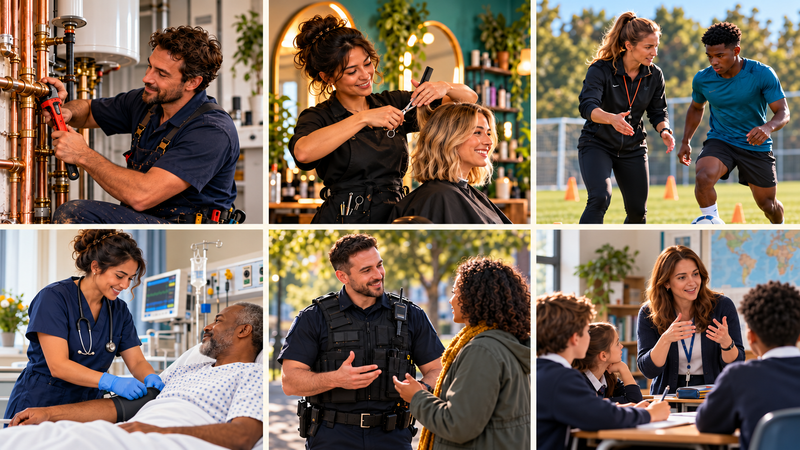
Plumbers, hairdressers, swimming instructors and care workers provide services that depend on someone being physically present. Completing their core work still requires practical skill, observation and direct interaction.
Jobs escaping the influence of AI are therefore attracting attention from people thinking about their employment prospects. Other occupations, including nursing, teaching and policing, are being influenced by AI while continuing to require substantial human staffing.
This is a current assessment based on available evidence and predictions. It is not intended to discourage anyone from pursuing a career. People are understandably asking about job security, and those questions deserve realistic answers.
Why These Questions Are Being Asked
The concerns extend beyond individual workers.
On 16 October 2026, Reuters reported IMF Managing Director Kristalina Georgieva’s warning that AI’s risks could exceed its opportunities without suitable safeguards and an ethical framework. Her comments underline the importance of managing the transition, rather than assuming benefits will automatically reach everyone.
That does not mean every career faces the same outcome. Some tasks are easier to automate than others, and organisations make different decisions about staffing, investment and service delivery.
Practical Trades and Repair Work
Plumbing, electrical installation, roofing and maintenance involve working in varied physical environments.
A practitioner must reach the problem, assess actual conditions and complete the work. Access can be awkward, previous repairs unexpected and records incomplete.
AI may support quotations, research and scheduling. It does not itself replace a damaged fitting or repair a roof.
Axios reported in August 2026 that some young Americans were choosing trades partly because of AI concerns.
These examples demonstrate interest in alternatives. They do not establish that every trade offers plentiful vacancies or high earnings everywhere.
Beauty, Personal Services and Sport
Hairdressers, barbers, nail technicians and beauty therapists deliver physical services involving technique and continuous adjustment.
Their businesses may use AI for marketing or appointments, while the treatment itself remains dependent on the practitioner.
Sport requires a similar distinction. AI can generate programmes and analyse performance, but supervising exercise or teaching a beginner to swim involves responding to the person in front of you.
Generic online advice faces different competition from practical instruction. Professional athletes also perform the sporting activity themselves, although preparation and analysis can be heavily influenced by technology.
Nursing, Teaching and Direct Care
AI can change nursing documentation, monitoring and access to information. Bedside care and responding to patients still involve physical and clinical responsibilities.
The World Health Organization’s nursing factsheet, updated in 2026, continues to identify a substantial global shortage. Global need should nevertheless be distinguished from funded vacancies in a particular location.
Teachers can use AI to prepare materials, but supervising learners, addressing misunderstandings and recognising safeguarding concerns require wider involvement.
UNESCO’s World Teachers’ Day 2026 data also identifies a major requirement for additional teachers globally. Recruitment still depends on funding, policy and local enrolment.
Childcare and home care similarly combine supervision, personal interaction and practical assistance.
Police, Emergency Services and the Military
Policing includes information based work that AI can support, alongside attending incidents, protecting people and managing confrontations.
Firefighters and rescue personnel also operate physically in unpredictable conditions.
Military careers require particular caution. AI, drones and autonomous equipment can alter operations and force structures substantially. Some activities may require fewer people, while others create technical and operational requirements.
Continuing human responsibilities should not be interpreted as a guarantee that current staffing levels will remain unchanged.
Aviation and Tourism
Pilots already work with extensive automation. AI may further influence planning, training and operational support.
In an April 2026 discussion of AI in aviation, IATA anticipated continuing requirements for pilots, cabin crew and ground staff alongside technological change and passenger growth. These remain industry expectations, dependent on operating conditions and demand.
Tourism also contains different exposures. Preparing an itinerary is different from leading an outdoor excursion, cooking a meal or delivering a practical visitor experience.
Musicians and Artists Have Mixed Exposure
Musicians and artists should not simply be labelled unaffected.
Recorded music, illustration and digital content face direct competition from generative systems.
Live performance, physical artworks and practical teaching offer different experiences. A wedding musician or an artist running a workshop provides more than a downloadable output.
That distinction can support demand, but creative careers remain competitive and earnings uncertain. The specialism and customer matter more than the occupational label.
Career Examples by Category
The following groups are illustrative assessments, rather than a research ranking or promises of job security.
Mainly physical services with limited direct exposure to current generative AI:
- Plumbers.
- Electricians.
- Heating engineers.
- Roofers.
- Carpenters.
- Bricklayers.
- Plasterers.
- Painters and decorators.
- Appliance repair technicians.
- Building maintenance workers.
- Hairdressers.
- Barbers.
- Nail technicians.
- Beauty therapists.
- Massage therapists.
- Gardeners.
- Tree surgeons.
- Domestic cleaners.
- Home care workers.
- Swimming instructors.
AI influenced occupations with substantial continuing human requirements:
- Nurses and midwives.
- Doctors and dentists.
- Paramedics.
- Physiotherapists and occupational therapists.
- Teachers and special education professionals.
- Early years educators and childcare workers.
- Social workers.
- Police officers.
- Firefighters and rescue personnel.
- Prison officers.
- Military personnel and equipment technicians.
- Aircraft pilots.
- Aircraft maintenance engineers.
- Cabin crew and airport ground staff.
- Sports coaches and personal trainers.
- Professional athletes.
- Chefs and hospitality staff.
- Tour guides.
- Outdoor activity instructors.
- Veterinary professionals.
Mixed exposure, where specialism and delivery particularly matter:
- Musicians and singers.
- Visual artists and illustrators.
- Actors and live entertainers.
- Photographers.
- Craft makers and sculptors.
- Dance instructors and performers.
Administration, marketing and scheduling can change across all three categories.
Six Occupational Groups With Greater AI Exposure
Greater exposure in information based work is widely discussed in research and reporting, including PwC’s 2026 AI Jobs Barometer. These are illustrative examples, rather than an IMF ranking.
- Administrative and clerical staff: Data entry, correspondence, scheduling and document processing.
- Bookkeepers and accounting technicians: Transaction processing, reconciliations and routine reporting.
- Financial services professionals: Banking operations, fund administration, investment research, insurance processing and compliance review.
- Legal research and support professionals: Document review, research and initial drafting.
- Software developers: Code generation, testing, debugging and documentation.
- Writers, translators and content producers: Drafting, translation, summarisation and commercial content.
Greater exposure means more tasks could change. It does not establish that an entire profession will disappear.
Make Career Decisions With Evidence
September 2026 reporting in The Washington Post described people reconsidering office careers and pursuing teaching, healthcare or trades.
Before making a similar decision, investigate qualifications, starting pay, physical demands and local vacancies. Where possible, observe the work before paying for training.
Part of our purpose at AI Tuition Hub is to explain how AI is being used across professions and which tasks are changing. Explore our courses to build practical understanding and make more informed learning and career decisions.
Lower Exposure Does Not Guarantee Lasting High Wages
If many people move towards practical occupations, some markets could eventually become saturated.
Plumbing illustrates the possibility. High local charges may partly reflect a shortage of available practitioners. More qualified plumbers could increase customer choice and put pressure on prices, margins and wage growth.
That outcome is not inevitable. Retirements, training barriers and expanding demand could sustain shortages elsewhere.
Future robotics may also change physical work. Current limits should not be treated as permanent protection.
These assessments and predictions are intended to support informed questions, rather than discourage career ambitions. Personal interests, suitability and local demand remain essential considerations alongside AI exposure.
Assessment dated 19 October 2026. AI capabilities, robotics and employment conditions remain subject to change.