Online shopping is starting to move beyond search boxes, product pages and endless browser tabs. Customers can increasingly describe what they need, ask questions and compare suitable products through a conversation.
AI shopping agents are changing retail and ecommerce by connecting those conversations with practical shopping tasks. Depending on the service, they can help find products, monitor prices, build baskets and complete authorised purchases.
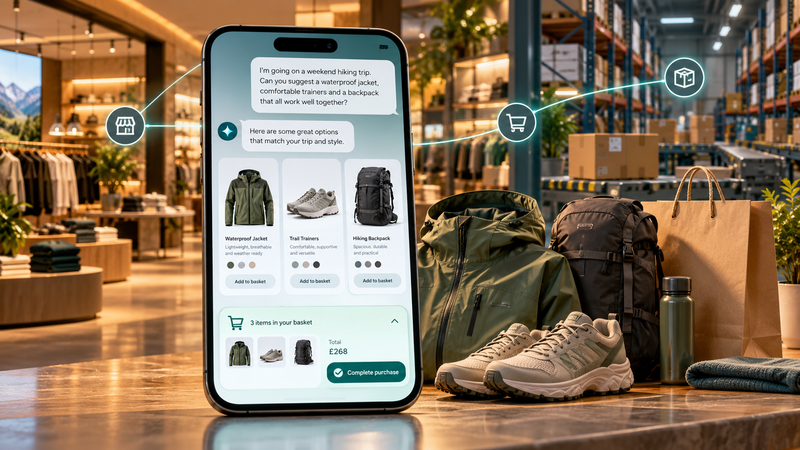
Recent announcements show how quickly this area is developing. Google and Shopify have both introduced new shopping capabilities this October, while Amazon has reported substantial customer use of its shopping assistant.
For retailers, this creates opportunities that extend beyond adding a chatbot to a website. It means understanding how customers discover products, what information AI systems use and how a business delivers on the promises made during a shopping conversation.
From Searching for Products to Explaining a Need
Traditional ecommerce often asks customers to do much of the work themselves.
Someone buying a laptop might visit several websites, interpret specifications, read reviews and check delivery options before deciding which model suits them.
A conversational shopping assistant allows a different starting point:
“I need a lightweight laptop for university, with good battery life and enough performance for video editing, within my budget.”
That request contains several connected requirements. A useful assistant can help clarify priorities, explain compromises and narrow the options.
The distinction between an assistant and an agent matters here. An assistant might explain which products appear suitable. An agent can also perform permitted actions, such as adding an item to a basket or completing a purchase.
Capabilities vary between services. Finding a product, recommending it and successfully ordering it are separate stages, each requiring reliable information and appropriate access.
Google Connects More of the Shopping Journey
On 15 October 2026, Google announced that Universal Cart was rolling out in the United States across Google Search and the Gemini app.
The cart lets shoppers save products from different retailers, return to their selections later and receive updates about price drops or items returning to stock. Google also described checkout options that allow customers either to buy through Google Pay or transfer items to the retailer’s website.
Its announcement names retailers including Nike, Sephora, Target, Ulta Beauty, Walmart and Wayfair, alongside Shopify merchants. Availability and the checkout experience depend on the participating retailer.
Research, saved products and purchasing are becoming more connected across shopping services.
For retailers, this creates another route through which customers may encounter their products. It also increases the importance of supplying current prices, availability and product details wherever those products appear.
Shopify Opens More Routes for Shopping Agents
Shopify announced another development on 13 October 2026, introducing Shop MCP to connect AI agents with product search, baskets and Shop Pay checkout.
Shopify says the connection works with more than one billion products in Shopify Catalog. In practical terms, it gives developers a more direct way to connect shopping assistants with products and purchasing services.
A retailer’s catalogue can therefore become useful beyond its familiar storefront. A customer might discover a product through an external assistant, with the retailer’s systems supporting the transaction behind the scenes.
This expands the infrastructure available for AI shopping. It does not establish how many customers will use each new experience, or how much additional revenue an individual retailer will earn.
Those outcomes still need measuring through actual trading activity.
Amazon Shows That Customers Are Already Using AI Shopping
Retailer announcements demonstrate investment and availability. Customer usage provides a different kind of evidence.
In its fourth quarter results published in February 2026, Amazon reported that more than 300 million customers had used Rufus, its AI shopping assistant.
Amazon subsequently confirmed that Rufus was renamed Alexa for Shopping on 13 May 2026.
These are company reported figures, but they demonstrate substantial use within a major retail environment.
Amazon describes capabilities including product comparisons, personalised recommendations, price tracking and authorised purchasing. Its experience illustrates how conversational support can sit within a shopping service customers already use.
It also shows why retailers should distinguish between people trying a feature, returning to it regularly and making additional purchases because of it. These measures answer different business questions.
Clear Product Information Becomes More Valuable
As shopping becomes more conversational, retailers need to consider how clearly their products answer customer needs.
Imagine someone asking for a waterproof jacket suitable for cycling to work. A retailer may sell an appropriate product, but an assistant needs dependable information about waterproofing, fit, visibility features and intended use.
Vague descriptions make meaningful comparisons harder.
Retailers can prepare by improving specifications, sizes, materials, compatibility information, care instructions and delivery details. Stock records and prices also need to remain consistent across connected channels.
This work benefits human shoppers too. Better information helps people judge suitability and can reduce avoidable enquiries or disappointing purchases.
Making a catalogue easier for AI systems to interpret begins with making it accurate and useful.
Customer Journeys Will Become More Varied
Some customers enjoy browsing. Others want a quick answer or help understanding an unfamiliar purchase.
Retailers should expect several shopping journeys to coexist.
A customer might begin with an AI recommendation, inspect the product on a retailer’s website, visit a physical shop and purchase later. Another might complete a straightforward repeat order through an assistant.
Consistency becomes essential. A product should not appear available in one channel when it cannot actually be supplied. Delivery promises, promotions and returns information should remain clear as customers move between services.
Brand experience still matters throughout. Packaging, delivery, product quality and support continue to shape the relationship after a recommendation has been made.
Better Discovery Depends on Reliable Operations
An AI agent can make finding a product easier. The retailer must still fulfil the order.
More convenient purchasing places greater demands on inventory accuracy, payment processing, delivery coordination and customer service.
Businesses need to understand what happens when an item sells out, a payment fails or a customer requests a change. They also need a clear route for resolving mistakes involving an external shopping service.
In its explanation of shopping features built around the Universal Commerce Protocol, Google states that the retailer remains the merchant of record.
That makes understanding the seller’s responsibilities essential, even when a purchase begins elsewhere. Retail AI belongs in operational planning as well as marketing discussions.
Measure Value Beyond Clicks and Traffic
New shopping channels deserve practical evaluation.
Retailers should examine whether orders generate worthwhile margins after discounts, fulfilment, returns and support costs. They should also consider whether a channel brings additional customers or moves existing purchases between platforms.
Useful measures include completed purchases, cancellations, return rates, repeat business and customer satisfaction.
A focused trial can reveal more than a broad launch with unclear objectives. Starting with a manageable product range makes it easier to identify missing information, resolve operational problems and assess customer response.
The aim is to understand where the experience improves shopping and where further work is needed.
Explore the Wider Picture in Our Updated Course
These developments form part of the changing landscape explored in our updated course, AI in Retail and Ecommerce: Smarter Customer Journeys & Business Decisions.
The course connects customer insights, personalisation, inventory planning, online store experience, operations, marketing and retail strategy. It also examines conversational shopping and AI agents within the wider realities of running a retail business.
Designed for retail leaders, managers, entrepreneurs and commercial teams, it requires no programming knowledge.
Like all our courses, it remains under regular review and is updated to keep the information as current as possible as technology, adoption and customer expectations develop.
Retailers now have more ways to reach customers through AI. Making those opportunities worthwhile requires accurate information, dependable operations and a clear understanding of what customers need.
Published: 18th October 2026.