AI can make almost anyone sound knowledgeable. Ask it about a subject you barely understand and, within seconds, you can have a clear explanation, a confident argument or a carefully written response to someone who has spent years studying it.
That can be useful. It also raises an uncomfortable question: Is AI Making Us Feel Smarter Than We Actually Are? When AI helps us produce something impressive, how much of it do we actually understand?
The Confidence of a Good Answer
Imagine being asked for your view on a complicated issue at work. You give AI the background, read its response and make a few changes before sending it on. Your reply sounds informed and persuasive. The person receiving it may assume you know the subject well.
But what happens if they ask a question the response did not anticipate? Could you explain why its conclusion is right? Would you recognise a mistake in the evidence?
There is a difference between understanding an answer and recognising that it sounds like a good one. AI can make that difference surprisingly easy to miss, especially when its writing is clearer and more confident than our own.
Borrowed Expertise
We have always used tools to help us think. Books, search engines and conversations with knowledgeable people all give us access to ideas we did not develop ourselves. AI goes further because it can turn those ideas into a finished piece of work in our voice.
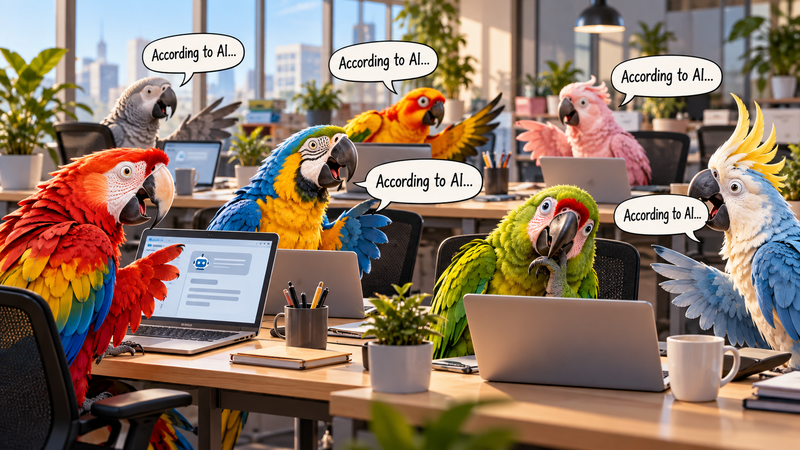
A person can now produce a business plan, a technical explanation or a detailed opinion without learning much about the subject along the way. They may even begin to feel more capable because the result is so polished.
The problem appears when confidence grows faster than understanding. If we cannot question the answer, we may accept errors simply because they are presented well. If we cannot explain our reasoning, we may struggle when a real person challenges it.
What Is Your Work Worth Without AI?
Employers may soon begin asking a difficult question of their own: how much of an employee’s impressive output reflects their knowledge and judgement, and how much comes from AI?
Using AI at work is not in itself a problem. An employee who uses it to save time, check an idea or improve a draft may be doing exactly what their employer wants. Their value lies partly in knowing what to ask, what to reject and what decision to make.
But imagine a manager discovers that someone who appears to produce expert analysis relies on AI for almost every conclusion. When asked to explain the work, they cannot defend the reasoning or identify its weaknesses. The employer may reasonably wonder what that person can contribute when the answer is uncertain, the stakes are high or the AI tool is unavailable.
This could become uncomfortable for workers and employers alike. A polished result may hide a capable professional working efficiently, or it may hide someone who has stopped developing the skills their job requires. The finished document alone may no longer reveal the difference.
The question is not simply whether an employee used AI. It is what they understood, checked and added to the work. If AI helped produce an answer, who took responsibility for deciding that it was good enough?
If AI Can Do It, Why Learn It?
This question is beginning to appear wherever people discuss education. Why spend years learning a language when AI can translate a conversation? Why learn to code when AI can write a programme? Why practise writing when a chatbot can produce a polished essay?
On the surface, these sound like practical questions about how to use our time. But taken too far, the argument amounts to giving up on learning whenever a machine can produce a good enough answer.
The purpose of learning a language is more than obtaining a translation. Learning to code involves more than producing lines of code. Writing an essay involves deciding what you think, organising an argument and finding out whether it stands up to scrutiny. The finished product matters, but so does what happens to the person making it.
If a student asks AI to write an explanation and hands it in, the words may be accurate. That tells us little about what the student has learned. Could they answer a follow-up question? Could they apply the idea to a different problem? Could they recognise when AI had got it wrong?
These questions matter because AI is often described as a way to remove the difficult parts of learning. Yet struggling to understand something, making mistakes and trying again are often the parts that build understanding. If we remove all the effort, we may also remove much of the benefit.
We Have Been Here Before With Calculators
There is a comparison with calculators, although AI takes it much further. Pocket electronic calculators became widely used during the 1970s, giving people a quick answer to arithmetic that they might previously have worked out on paper or in their heads. They made many everyday tasks easier, but their arrival also raised a familiar question: would people still learn how numbers work if a device could do the calculation for them?

Consider Trachtenberg maths. Jakow Trachtenberg developed a system of rapid mental calculation while imprisoned during the Second World War. It uses learned rules to make calculations that might initially seem difficult feel manageable. Someone using his methods develops a skill through practice. Someone using a calculator can reach the same numerical answer without learning that method at all.
That does not mean everyone should abandon calculators and learn mental arithmetic techniques. It means the answer on a screen and the ability in a person are different things. AI makes the distinction harder to spot because it can supply reasoning, explanations and persuasive language as well as an answer.
Knowing How to Ask Is Not Always Enough
Another argument is that people no longer need to know so much themselves. They only need to know how to ask AI the right questions.
Knowing how to ask good questions is valuable. But how do we know which question to ask when we have no grounding in the subject? How do we judge whether the answer is incomplete, misleading or confidently wrong?
Someone with experience can use AI to challenge their thinking and speed up parts of their work. Someone without that foundation may be unable to tell when the tool has led them astray. Both people might produce an impressive looking result, but they are in very different positions when asked to defend it.
Education should teach people to use AI well. It should also give them enough knowledge to remain more than a passenger in the process.
What Happens When AI Is Unavailable?
There is another question we rarely ask. What would happen if the AI tools we rely on were suddenly unavailable?
It need not be a dramatic global shutdown. A service could go offline for a day. An employer could restrict access. A subscription could become too expensive. A confidential task might be one that cannot be entered into an outside system at all.
Would we still be able to write the report, solve the problem or explain the decision? For some people, the answer would be yes, even if the work took longer. For others, it might reveal just how much of the thinking they had gradually handed over.
The concern is whether we are keeping enough knowledge and confidence of our own to cope when that help is missing.
A Tool That Can Teach or Conceal
AI can make us more capable when we use it to explore an idea, test our reasoning and ask questions until we understand. It can also conceal gaps in our knowledge by producing a convincing result before we have done any of that work.
The difference may be difficult to see from the outside. Two people could submit equally impressive work with AI’s help. One could explain every important choice. The other might struggle to answer the first unexpected question.
Perhaps the simplest test is this: after using AI, could we explain the main point in our own words, identify what we are unsure about and carry on if the tool disappeared?
AI gives us access to an extraordinary amount of knowledge. Whether it makes us smarter depends partly on what we do after it gives us the answer. If we decide that an answer is a substitute for learning, we may end up sounding more knowledgeable while understanding less.
At AI Tuition Hub, we believe the best use of AI is to help people learn, question and think more clearly. Our courses show how to put it to work without handing over the judgement that makes your work your own.
Published: 26th September 2026.