A new survey has found that nearly half of young people in England would trust artificial intelligence over a person to check a fact. For anyone watching how quickly AI has become part of everyday learning, the finding may not be surprising. It should still make us pause.
The survey, reported by Sky News, questioned more than 4,000 people aged 11 to 24. Nearly 87% had used an AI tool, while fewer than one in ten believed schools and universities were preparing them for a world with AI. The report’s authors argue that education is struggling to keep pace with what young people are already doing. But the finding raises a question for all of us: Are We Already Taking AI for Granted?
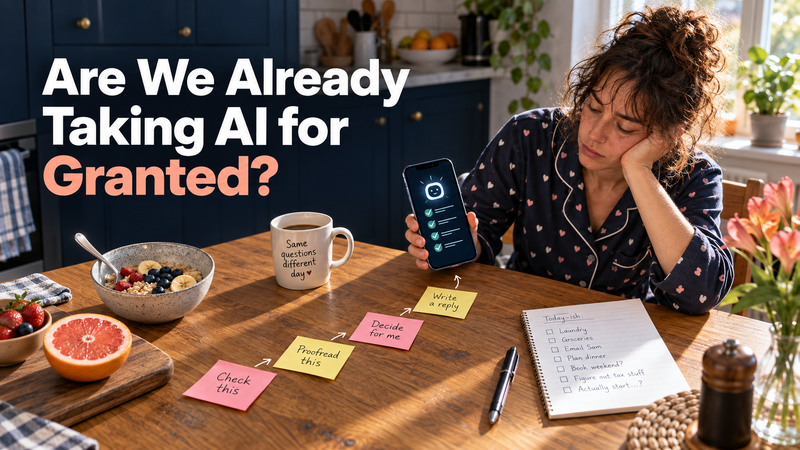
The headline raises a wider question. As AI becomes more useful and its answers sound more convincing, are people of all ages becoming too willing to believe it?
Why AI Earns Our Confidence
Most people do not begin by treating AI as an authority. They try it for something small. Perhaps it explains a word, suggests a recipe or helps write an awkward email. The answer is useful, so they try it again. After dozens of good experiences, asking AI starts to feel as ordinary as checking a calculator.
That growing confidence is understandable. AI often gives clear, helpful answers. It can explain a subject patiently, respond to follow-up questions and present information in a way that feels tailored to you. If it has helped you solve ten problems this week, you may feel less inclined to question its answer to the eleventh.
The difficulty is that its fluency stays the same even when its reliability changes. A simple explanation of a familiar topic and a claim about a recent event may arrive in the same assured tone. We can start to mistake a pleasant, confident answer for a checked one.
Trusting an Answer Is Different from Checking a Fact
Imagine seeing a claim online and asking an AI chatbot, “Is this true?” It may return a clear explanation in seconds. The matter feels settled.
But what has been checked? The AI might have found a reliable original source. It might have repeated an outdated article, confused two similar stories or supplied a convincing answer without enough evidence. Even when it provides links, those links need to be opened. A source can be real without supporting the particular claim made about it.
That is why the survey finding matters. It tells us who young people trust to check a fact. It does not tell us whether AI checked it correctly. Nor does it mean every young person accepts every AI answer without question.
AI can be an excellent starting point. It can help us understand a claim, identify what evidence would settle it and find sources to examine. But if we ask AI whether something is true and then accept its reply without looking at the evidence, have we really checked anything?
The Same Habit Can Follow Us to Work
This is not just a question for students. Someone using AI at work might ask it to summarise a regulation, check a figure or explain a client’s situation. If they are rushing to finish a task, it is tempting to copy the answer into an email or report and move on.
Checking the original source takes time. AI appears to have done that work already, even when it has not. The faster it produces polished answers, the easier it becomes to skip the step that matters most.
Many workplaces also reward speed. If AI helps someone clear a crowded inbox or finish a report before a deadline, its appeal is obvious. Yet an unchecked claim can travel from a chatbot into a document, then into a decision made by someone who assumes the information has been verified.
Are some of us beginning to treat AI as though it knows everything? Perhaps. More often, we may know it can make mistakes but decide that its answer is probably accurate enough. Each time that works out, our confidence grows. We may gradually stop noticing how much we are relying on it.
Are We Outsourcing Even the Small Things?
This habit can start with tasks that seem harmless. Many of us now ask AI to proofread a short message, improve a sentence or suggest a reply to a simple question. There is nothing wrong with getting help. A second pair of eyes can catch mistakes, and AI is particularly useful when writing is difficult or English is not someone’s first language.
But it is fair to ask whether we sometimes reach for AI before we have even read our own words back. If every short email needs a chatbot’s approval, are we becoming less confident in our own judgement?
Proofreading is a good example because it does more than catch spelling errors. When we reread what we have written, we notice whether we have explained ourselves clearly, whether the tone feels right and whether we actually mean what we are saying. If we immediately hand that process over, we may miss a useful moment of reflection.
The same applies to asking AI to think of a title, choose between two ordinary options or answer a question we could work out ourselves. Each request is small. Together, they can form a habit of asking the machine first and ourselves second.
That does not mean we must struggle through every routine task unaided. It means being aware of when a tool is saving us time and when it is doing something we would benefit from practising.
What Happens to Learning?
Young people have good reasons to use AI. It is available whenever they need it, explains the same idea in different ways and never grows impatient. A student who feels embarrassed asking a question in class may feel comfortable asking a chatbot.
Schools and universities cannot expect students to ignore a tool that is already helping them study. They can, however, teach students how to use it with more judgement.
There is a difference between asking AI to explain why your answer might be wrong and asking it to produce the answer before you have tried. One approach can build understanding. The other may leave you with a finished piece of work and little idea how you got there.
Adults face the same choice at work. If we routinely let AI research, assess and write for us, we may complete more tasks while becoming less able to spot when an answer does not make sense. That ability often comes from having done the thinking ourselves.
Keeping Ourselves in the Process
A useful habit is to decide what you want AI to do before you ask it. Do you want an explanation, a hint, a challenge to your reasoning or a finished draft? If the aim is to learn, asking for a hint may be more valuable than asking for the answer.
When AI makes a factual claim, ask where the information comes from and check the relevant source. When it proofreads your writing, look at what it changed and decide whether you agree. When it recommends a course of action, take a moment to consider what it may have missed.
That is the idea behind our new short course, Learning with AI Without Losing the Ability to Think. It is for anyone who wants AI to help them learn and work while keeping their curiosity, confidence and ability to solve problems for themselves.
AI will keep getting more capable, and trusting it for everyday help will often make sense. The skill we need to protect is knowing when an answer deserves a closer look. Young people are learning that skill now. The rest of us should make sure we are still practising it.
Source: Sky News, 22 September 2026.