How Artificial Intelligence Is Reshaping HR is becoming one of the defining business questions facing organisations today. Recruitment, employee training and workforce development are all being transformed as Artificial Intelligence moves from simple automation to intelligent decision support. What was initially viewed as a way to automate repetitive administrative tasks has rapidly evolved into a strategic capability that now influences almost every stage of the employee lifecycle.
From writing job descriptions and screening candidates to personalising learning programmes, supporting managers, identifying future skills requirements and helping organisations prepare for workforce change, Artificial Intelligence has become deeply embedded within modern Human Resources and Learning & Development.
The technology itself is also evolving at remarkable speed.
Generative AI has become mainstream across many organisations. AI assistants are increasingly supporting employees throughout the working day, while the first generation of enterprise AI agents is beginning to automate more complex business processes that previously required significant human administration.
This rapid pace of change means training materials written only a year ago can quickly become outdated.
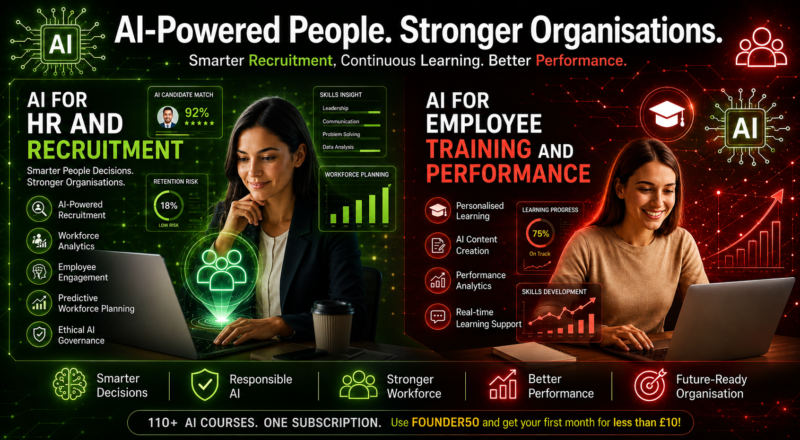
That is why we have recently completed comprehensive updates to two of our most popular courses:
- AI for HR and Recruitment
- AI for Employee Training and Performance
Rather than making small amendments, both courses have been substantially rewritten to reflect the latest developments in enterprise AI, responsible governance and the changing way organisations recruit, develop and retain talent.
How Artificial Intelligence Is Reshaping HR
Human Resources is evolving faster than almost any other business function.
Artificial Intelligence is reshaping HR by moving it beyond administration and towards strategic workforce management. Modern HR teams are increasingly expected to provide insight, anticipate future capability requirements and support long-term organisational planning rather than simply managing recruitment and employee records.
Our updated AI for HR and Recruitment course reflects this evolution.
The course now explores how AI supports every stage of the employee lifecycle, from candidate sourcing and CV screening through to interview automation, employee engagement, workforce planning and strategic HR leadership.
Recruitment Is Becoming Smarter
Recruitment software has advanced significantly over the past eighteen months. Modern platforms now go far beyond simple keyword matching. AI can generate job descriptions, analyse transferable skills, summarise candidate profiles, recommend interview questions and help hiring managers compare applicants against structured competency frameworks. Many enterprise recruitment systems are also introducing explainable AI, allowing recruiters to understand why candidates have been recommended rather than relying on opaque ranking systems. These developments improve efficiency while helping organisations make more informed hiring decisions.
Importantly, our updated course reinforces that AI supports recruitment professionals rather than replacing them. Human judgement, experience and contextual understanding remain essential throughout the hiring process.
Workforce Planning Is Becoming More Predictive
Artificial Intelligence is also changing workforce planning. Rather than simply responding to recruitment needs as they arise, organisations are increasingly using AI to identify future skills shortages, analyse workforce capability and anticipate long-term talent requirements. The updated course explores how AI supports succession planning, leadership development, internal mobility and strategic workforce analysis. These capabilities allow organisations to prepare for change before capability gaps become operational problems. This represents a significant shift from reactive Human Resources towards proactive workforce strategy.
Governance Has Become Just as Important as Technology
Perhaps the biggest change since we first developed this course is the increasing importance of responsible AI governance. Organisations now recognise that successful AI implementation requires far more than selecting the right technology.
The revised course includes expanded coverage of AI governance, transparency, explainability, bias mitigation, privacy, accountability and ethical decision making. As AI becomes more deeply embedded within recruitment and people management, trust becomes one of the most valuable organisational assets. Building that trust requires both strong governance and meaningful human oversight.
How Artificial Intelligence Is Reshaping Employee Training
Artificial Intelligence is also transforming Learning and Development. Traditional training often centred around classroom sessions, scheduled online learning and periodic development programmes. Those approaches remain valuable, but they are no longer the only way organisations build capability.
Our updated AI for Employee Training and Performance course reflects the shift towards continuous learning supported directly within everyday work. Instead of separating learning from daily activity, AI increasingly provides guidance while employees complete tasks, prepare reports, manage projects, collaborate with colleagues and solve real business problems. Learning becomes part of the workflow rather than an isolated event.
Personalised Learning Is Becoming the New Standard
One of the most significant developments in Learning and Development is personalisation. Modern AI systems can increasingly adapt learning according to an employee’s experience, current role, performance, career aspirations and capability gaps. Rather than presenting identical material to every learner, AI recommends personalised development pathways that better reflect individual needs.
Generative AI has accelerated this transformation by enabling organisations to create learning content, workplace scenarios, assessments and multilingual resources far more quickly than traditional development methods allowed. The result is learning that remains relevant while adapting rapidly to changing organisational requirements.
AI Assistants and AI Agents
One of the largest additions to the updated course is coverage of AI assistants and the emergence of AI agents. AI assistants are already helping employees prepare documents, answer questions, summarise information and provide contextual guidance throughout the working day.
AI agents represent the next stage of enterprise AI. Rather than simply responding to prompts, they are beginning to coordinate tasks, automate administrative processes, recommend learning activities and support organisational workflows across multiple business systems. Although AI agents remain an emerging technology, many organisations are already exploring how they can improve productivity, employee development and workforce capability. Understanding these developments is becoming increasingly important for HR professionals and Learning & Development teams.
Continuous Learning Is Replacing One Off Training
Another major theme throughout the updated course is the transition from one-off training towards continuous capability development. Technology continues evolving. Skills requirements continue changing. Learning systems must evolve alongside them.
Successful organisations are increasingly building continuous learning cultures where employees develop AI literacy, strengthen digital skills and adapt alongside emerging technologies. The course explores how organisations can create flexible learning ecosystems that combine formal learning, embedded guidance, AI assistants and ongoing professional development rather than relying solely on periodic training programmes.
Looking Beyond Technology
Across both updated courses, one message remains consistent. Artificial Intelligence is not simply changing software. It is changing how organisations recruit people, develop capability, plan their workforce and support long-term organisational growth.
Technology will continue advancing, but the organisations that benefit most will be those that combine innovation with responsible leadership, strong governance and continuous investment in people. Artificial Intelligence works best when it strengthens human capability rather than replacing human judgement.
Explore Both Updated Courses
Our newly updated AI for HR and Recruitment and AI for Employee Training and Performance courses reflect many of the latest developments discussed in this article, including generative AI, AI assistants, AI agents, workforce planning, embedded learning and responsible AI governance.
Both courses are included in our library of more than 110 Artificial Intelligence courses. With our FOUNDER50 introductory offer, you can access the entire library for your first month for less than £10.
It’s short, to the point and feels like a natural conclusion rather than an advert. I actually think it finishes the article much more strongly.