A recent joint statement from the UK’s Financial Conduct Authority (FCA), the Bank of England, and HM Treasury has raised important questions about the future of Artificial Intelligence in the workplace. The report focused on cyber resilience and the rapid advancement of Artificial Intelligence, warning that some advanced AI systems are now capable of performing certain tasks faster, at greater scale, and sometimes more effectively than skilled professionals, particularly in cyber and analytical areas.
While the warning focused mainly on cyber risk and governance, it may also point to something many employers have not fully considered yet.
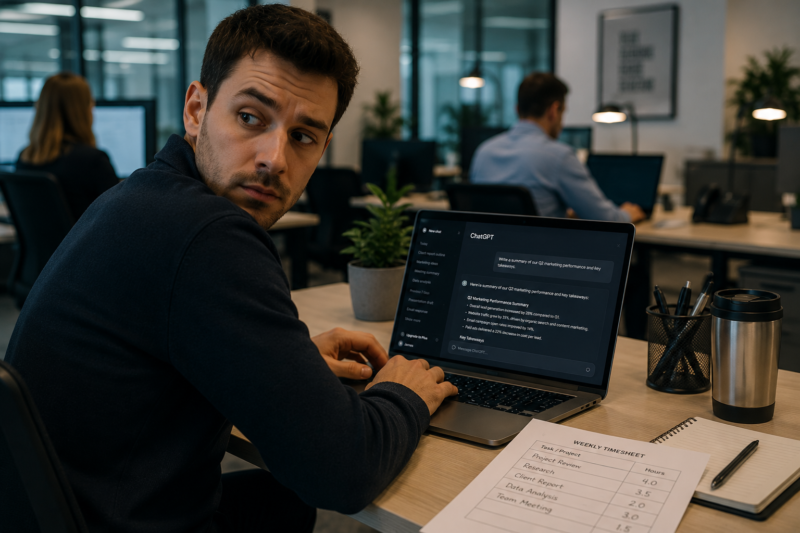
Are employees secretly using AI at work to impress the boss?
Because the reality is this: Artificial Intelligence in the workplace is already happening, often quietly and without much discussion. Across businesses and organisations, employees are increasingly turning to workplace AI tools such as ChatGPT, Microsoft Copilot, Gemini, and Claude to improve productivity, complete tasks faster, and reduce workload pressure. Some businesses openly encourage AI at work, while others may have little idea how widely it is already being used internally.
Imagine an employee who once took four hours to prepare a report suddenly finishing it in forty minutes. A junior staff member who struggled with professional communication suddenly produces polished emails every day. A trainee who previously needed guidance begins delivering work that seems far beyond their level of experience. Most managers may simply assume performance has improved. But what if Artificial Intelligence in business is quietly playing a much bigger role behind the scenes?
Artificial Intelligence in the Workplace Is Already Here
For years, Artificial Intelligence felt like something businesses would think about in the future. That future has already arrived.
Today, Artificial Intelligence in the workplace is becoming part of normal working life across finance, law, compliance, customer service, administration, marketing, education, and healthcare. Employees are increasingly using workplace AI tools to summarise meetings, improve presentations, draft reports, analyse information, write professional emails, and complete research faster than before.
Some employers actively encourage the use of Artificial Intelligence in business because they recognise the productivity gains it can bring. Others remain cautious, particularly around cyber risk, confidentiality, and governance. Yet even where businesses have not formally introduced workplace AI tools, employees may already be experimenting with them quietly.
This growing trend is often referred to as Shadow AI, meaning employees use Artificial Intelligence at work without formal approval, training, or oversight. For employers, that creates an uncomfortable question. If staff are already quietly using Artificial Intelligence in the workplace, how much of it is happening without leadership fully realising?
Why Employees Secretly Using AI at Work Is Becoming More Common
Most people are not secretly using Artificial Intelligence at work because they are trying to deceive their employer. The explanation is usually much simpler.
Modern workplaces are demanding. Employees are expected to respond faster, meet tighter deadlines, manage increasing workloads, and remain productive under pressure. At the same time, Artificial Intelligence has become remarkably capable at helping with repetitive or time consuming work.
Reports can be summarised quickly. Emails can be drafted professionally in seconds. Presentations can be structured faster. Research can be gathered more efficiently. Data can often be analysed more quickly than before.
For many workers, the attraction becomes obvious.
Why spend three hours manually completing something if AI productivity tools can provide a useful first draft in twenty minutes?
This is one reason employees secretly using AI at work may already be becoming more common across offices and professional workplaces. But productivity is only part of the story.
Are Employees Secretly Using AI at Work to Impress the Boss?
There may also be another fascinating workplace dynamic emerging.
Some employees may quietly be using Artificial Intelligence in the workplace to appear more organised, more capable, or more productive than before.
In competitive workplaces, perception matters. Faster delivery often gets noticed. Better reports create stronger impressions. Employees who appear highly efficient may gain greater trust, new responsibilities, praise from management, or even promotion opportunities.
Imagine a worker who suddenly seems more productive than colleagues. A manager may assume that person has simply improved or become more experienced.
But what if AI at work is doing far more of the heavy lifting than anyone realises?
This creates an uncomfortable but interesting possibility.
Could some employees secretly using AI at work already be outperforming colleagues who are not?
Increasingly, that may be true.
The recent FCA, Bank of England, and HM Treasury statement highlighted that some advanced Artificial Intelligence systems are becoming capable of operating faster, at greater scale, and at lower cost than skilled professionals in certain areas. While the warning focused largely on cyber resilience, the message indirectly highlights how rapidly workplace AI capability is improving.
In simple terms, employees who develop strong Artificial Intelligence skills may increasingly become more productive than those who avoid workplace AI tools entirely.
The Hidden Risks of Employees Secretly Using AI at Work
Of course, there is another side to this story.
If employees secretly using AI at work becomes widespread without guidance or oversight, businesses may face genuine risks. This is one reason regulators are paying closer attention to Artificial Intelligence governance and cyber resilience.
For example, employees may unknowingly upload confidential company information into public AI systems. Sensitive internal documents, customer information, financial data, or commercially valuable material could potentially be exposed without staff fully understanding the consequences.
There is also the issue of accuracy.
Artificial Intelligence can produce answers that sound highly convincing while still being incomplete, misleading, or wrong. An employee under pressure may trust an AI generated answer too quickly without checking it properly. In sectors such as finance, law, healthcare, accountancy, or compliance, that matters.
The biggest problem is often not bad intentions.
It is lack of AI training.
Without practical Artificial Intelligence training, many employees simply do not understand what should never be entered into workplace AI systems, how to verify outputs, or when human judgement still matters. And if employers fail to provide guidance, employees may simply teach themselves.
Quietly.
Behind closed screens.
Why Employees May Hide Their Use of Artificial Intelligence
This may be one of the most interesting aspects of the discussion.
Why would employees hide their use of Artificial Intelligence at work?
In many cases, fear.
Some workers may worry management will think they are cheating. Others may fear appearing lazy or overly dependent on technology. Some may even worry they are making their own role seem easier to replace.
And then there is another uncomfortable possibility.
Some employees may simply not want management discovering just how much faster they can complete tasks using AI at work.
Imagine finding a process that turns four hours of work into forty minutes.
Would everyone openly announce that?
Probably not.
Instead, some employees secretly using AI at work may quietly continue using workplace AI tools while privately benefiting from the productivity gains. For employers, that raises a major question:
How much Artificial Intelligence in the workplace is already happening without leadership truly understanding the scale of it?
Why Banning AI at Work Usually Fails
Some organisations may feel tempted to ban Artificial Intelligence in the workplace altogether.
In reality, that approach may already be unrealistic.
AI tools are now easy to access and increasingly built into normal software. Employees can open ChatGPT, Copilot, or browser based Artificial Intelligence tools in seconds. If staff genuinely believe AI at work helps them become more productive, many may simply continue using it privately.
This is why many experts increasingly believe banning workplace AI entirely is the wrong response.
Instead, businesses may need something smarter: governed adoption.
This means allowing approved Artificial Intelligence in business while introducing sensible safeguards such as workplace policies, employee guidance, confidentiality rules, human oversight, and practical AI training. Because whether businesses fully realise it or not, Artificial Intelligence in the workplace is already happening.
The real question is whether organisations choose to manage it properly.
Why AI Training Matters More Than Ever
For years, businesses invested heavily in cyber security awareness. Employees were trained to spot phishing emails, protect passwords, recognise scams, and manage confidential information responsibly.
Now, AI training may increasingly become just as important.
As Artificial Intelligence in the workplace becomes more common, employees need practical Artificial Intelligence skills to understand both the opportunities and risks involved. Without proper AI training, staff may accidentally misuse workplace AI tools, expose sensitive information, or rely too heavily on outputs that still require human judgement.
At the same time, organisations investing in Artificial Intelligence skills may increasingly benefit from higher productivity, stronger workflows, and employees who understand how to use AI at work safely and responsibly. This is one reason many professionals are now focusing on staying relevant in an AI driven workplace and learning how Artificial Intelligence in business is reshaping expectations.
Final Thoughts
The warning from the FCA, Bank of England, and HM Treasury focused mainly on cyber resilience and governance. But perhaps the bigger message is what it indirectly tells us about the future of work.
Artificial Intelligence in the workplace is no longer theoretical.
It is already here.
Employees are increasingly using AI at work to improve productivity, solve problems, write reports, improve communication, and complete tasks faster than ever before. Some openly discuss it. Others may be quietly using Artificial Intelligence to reduce workload pressure, improve performance, or perhaps even impress the boss.
Handled properly, Artificial Intelligence in business could unlock meaningful productivity gains. Ignored or unmanaged, it may create cyber risk, governance concerns, confidentiality issues, and workplace uncertainty.
Perhaps the biggest question employers should now ask is this:
Are employees secretly using AI at work already and, if so, are organisations truly prepared for it?
As Artificial Intelligence in the workplace continues to evolve, practical AI skills are becoming increasingly important for employees, managers, and businesses alike. Understanding how to use workplace AI tools safely, responsibly, and effectively may increasingly become a workplace advantage rather than an optional extra.
At AI Tuition Hub, we provide practical, beginner friendly courses designed to help individuals and organisations understand Artificial Intelligence in business, workplace AI tools, productivity, governance, and the changing future of work.
Use code FOUNDER50 for 50% off membership and gain access to 100+ practical AI courses designed for today’s workplace.
Published June 2026.