Artificial Intelligence is becoming increasingly common within modern workplaces. Across industries such as finance, office administration, customer service, hospitality, healthcare, education, retail, and business operations, AI tools are now being integrated into everyday working environments.
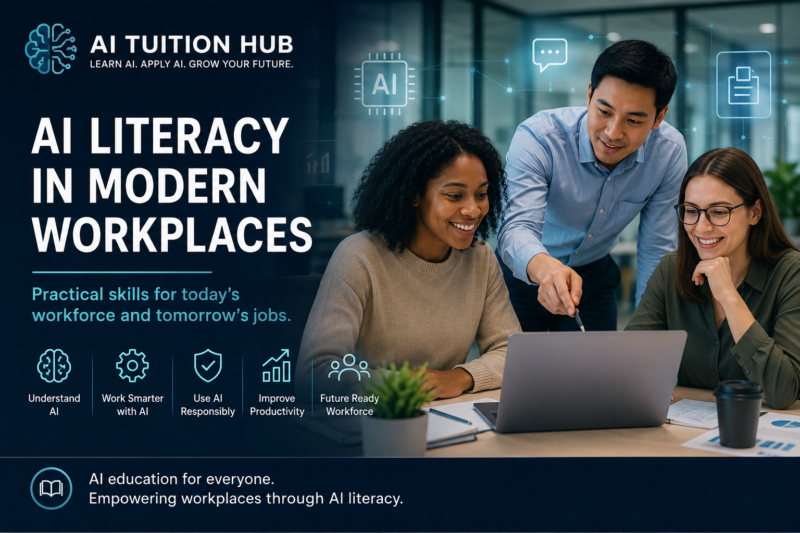
As businesses continue adopting digital technologies and automation systems, AI literacy is becoming an increasingly important workplace skill for employees, managers, and organisations alike.
This article forms Part 2 of the AI Tuition Hub overview series and explores why practical AI literacy is becoming increasingly valuable within modern professional environments.
What Is AI Literacy?
AI literacy refers to a person’s understanding of Artificial Intelligence, how AI systems work, where AI tools are being used, and what the strengths and limitations of AI may be.
AI literacy does not necessarily require advanced programming knowledge or highly technical expertise. Instead, practical AI literacy focuses on helping individuals understand how AI technologies may affect modern workplaces and professional responsibilities.
Practical AI literacy may include:
- understanding common AI tools
- recognising AI generated content
- understanding workplace automation
- improving productivity with AI systems
- identifying limitations within AI outputs
- understanding responsible AI usage
As AI technology becomes increasingly widespread, practical AI literacy is becoming relevant across many industries and professions.
AI Is Already Changing Modern Workplaces
Many organisations are already integrating Artificial Intelligence into their daily operations. Businesses increasingly use AI tools for:
- document drafting
- workflow automation
- reporting
- scheduling
- customer communication
- research
- data analysis
- summarisation
- productivity support
- digital assistance
Some businesses use AI to improve efficiency and reduce repetitive administrative tasks. Others are exploring how automation may reshape existing workflows and workplace structures over time.
As a result, employees who understand workplace AI systems and digital tools may become increasingly valuable within evolving business environments.
Why Practical AI Skills Matter
One of the biggest misconceptions surrounding Artificial Intelligence is the belief that only software developers or technical specialists need AI knowledge.
In reality, many AI tools are now designed for ordinary workplace users rather than programmers or engineers.
Employees increasingly encounter AI systems within:
- office software
- email platforms
- search tools
- customer service systems
- communication platforms
- productivity applications
- scheduling systems
This means many workers may benefit from understanding:
- how AI generated information should be checked
- where AI systems may make mistakes
- how AI can improve workplace productivity
- how automation may affect tasks and workflows
- how AI tools should be used responsibly
Practical AI literacy is therefore becoming increasingly important for non technical workers across many sectors of the economy.
AI Literacy and Future Employment
As Artificial Intelligence continues developing, many organisations are reviewing how AI systems and automation technologies may influence future workplace structures.
Some jobs may evolve significantly as businesses adopt more digital tools and automated systems. At the same time, new opportunities may emerge for workers who understand how to work effectively alongside AI technologies.
This does not necessarily mean AI will completely replace large numbers of employees overnight. However, organisations may increasingly value workers who can adapt to technological change and understand how AI tools can be used responsibly within professional environments.
AI literacy may therefore become an increasingly important employability skill within future workplaces.
Responsible AI Use in Professional Environments
Responsible AI usage is becoming another important part of workplace AI literacy.
Businesses increasingly need employees who understand issues such as:
- misinformation
- AI hallucinations
- bias within AI outputs
- data privacy
- responsible content generation
- verification of AI generated information
- over reliance on automation systems
As AI adoption increases, organisations may place greater emphasis on AI governance, responsible usage policies, and digital awareness training.
Workers who understand both the opportunities and limitations of AI systems may therefore become increasingly valuable within modern workplaces.
Continuous Learning and Workplace AI Education
AI technologies continue evolving rapidly, and workplace expectations may continue changing as digital transformation expands across industries.
As a result, continuous learning and workplace AI education may become increasingly important for both employees and employers.
Practical AI education can help individuals:
- improve digital confidence
- understand changing workplace technologies
- adapt to automation trends
- strengthen workplace productivity skills
- develop AI awareness
- prepare for evolving professional environments
Many workers are now seeking practical AI learning that focuses on real workplace applications rather than highly technical software engineering or programming topics.
AI Tuition Hub and Practical AI Learning
AI Tuition Hub focuses on practical workplace AI education designed to help learners better understand how Artificial Intelligence is influencing modern industries and professional environments.
The platform provides workplace focused AI courses covering topics such as:
- AI literacy
- workplace automation
- productivity tools
- responsible AI use
- digital transformation
- future workplace skills
- industry specific AI developments
AI Tuition Hub aims to make AI education more accessible for non technical learners while helping individuals develop practical understanding of workplace AI systems and emerging technologies.
Readers interested in exploring the growing AI Tuition Hub course library can browse workplace AI courses covering practical AI skills, AI literacy training, and modern workplace applications of Artificial Intelligence.
Final Thoughts
Artificial Intelligence is increasingly becoming part of everyday working life across many industries and professional sectors.
As businesses continue adopting AI systems, automation tools, and digital technologies, practical AI literacy may become an increasingly important workplace skill for employees and organisations alike.
Understanding how AI works, where it can improve productivity, where limitations may exist, and how AI tools should be used responsibly may become increasingly valuable knowledge within future workplace environments.
This article forms Part 2 of the AI Tuition Hub overview series exploring workplace AI education, practical AI skills, and the growing importance of AI literacy in modern professional environments.