Artificial Intelligence is increasingly becoming part of everyday office work across many industries. From administration and communication to scheduling, reporting, customer service, and productivity tools, AI technologies are beginning to reshape how many workplaces operate.
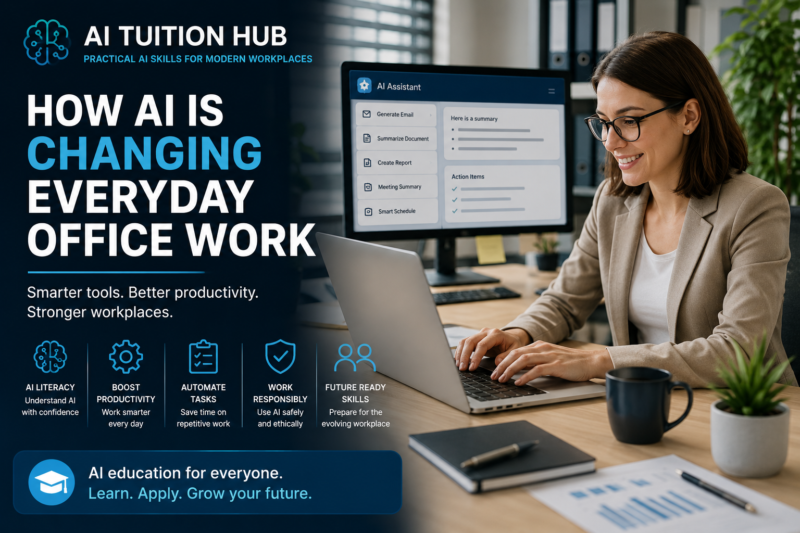
For many businesses, Artificial Intelligence is no longer something experimental or futuristic. AI tools are increasingly being integrated into software systems that employees already use every day.
This article forms Part 3 of the AI Tuition Hub overview series and explores how AI is changing everyday office work, workplace productivity, and administrative tasks within modern professional environments.
How AI Is Already Changing Office Work
Many office environments are already beginning to adopt Artificial Intelligence in practical ways. Rather than completely replacing employees, many AI systems are currently being used to support daily tasks, reduce repetitive work, and improve efficiency.
Businesses increasingly use AI for:
- drafting emails
- creating reports
- summarising meetings
- organising schedules
- managing customer enquiries
- analysing information
- generating workplace documents
- improving communication
- supporting research
- streamlining repetitive administrative tasks
For many organisations, AI tools are becoming digital assistants that support workplace productivity rather than replacing entire teams.
AI Tools Employees Are Already Using
Many workers may already be using Artificial Intelligence without fully realising it.
AI features increasingly appear inside:
- email platforms
- office productivity software
- online search tools
- communication systems
- scheduling platforms
- customer relationship management software
- workplace collaboration tools
Features such as predictive text, smart scheduling, automated summaries, virtual assistants, document generation, and intelligent search functions increasingly rely on AI technologies behind the scenes.
As workplace software continues evolving, AI may become an even more common part of everyday office environments.
Can AI Improve Workplace Productivity?
One of the main reasons organisations are adopting Artificial Intelligence is the potential to improve workplace productivity.
AI tools may help employees:
- reduce repetitive manual tasks
- process information more quickly
- generate first drafts of documents
- summarise large amounts of information
- improve scheduling and organisation
- automate routine administrative processes
- assist with communication
This does not necessarily mean employees become less important. In many situations, AI may simply allow workers to spend more time on decision making, problem solving, communication, and higher value responsibilities.
Many organisations are still exploring where AI adds value and where human oversight remains essential.
How AI May Change Administrative Tasks
Office administration is one area where Artificial Intelligence may increasingly influence workplace responsibilities.
Administrative professionals may increasingly encounter AI tools that assist with:
- calendar management
- meeting summaries
- document drafting
- workflow automation
- information organisation
- customer communication
- reporting tasks
Some repetitive activities may become faster or partially automated. At the same time, many organisations may increasingly value administrative workers who understand how to supervise AI outputs and use workplace technologies responsibly.
This means AI literacy may become increasingly valuable within office based roles.
Why Human Skills Still Matter
Although Artificial Intelligence may improve productivity in many workplaces, human skills are still likely to remain highly important.
AI systems may assist with speed and automation, but many workplace responsibilities still depend heavily on human judgement, including:
- relationship building
- emotional intelligence
- decision making
- communication
- leadership
- critical thinking
- problem solving
- professional judgement
AI systems may sometimes produce inaccurate information, misunderstand context, or generate misleading outputs. Human oversight therefore remains extremely important in many professional environments.
Rather than replacing all workplace skills, AI may increasingly change how certain skills are applied.
Responsible AI Use in Office Environments
As AI becomes more common within workplaces, responsible usage is becoming increasingly important.
Employees may need to understand issues such as:
- data privacy
- confidentiality
- misinformation
- AI hallucinations
- responsible document generation
- checking AI generated information
- over reliance on automation
Businesses increasingly need employees who understand how AI should be used safely, responsibly, and professionally within workplace settings.
AI Tuition Hub and Workplace AI Learning
AI Tuition Hub focuses on practical workplace AI education designed to help learners understand how Artificial Intelligence is influencing office work, workplace productivity, administration, and professional environments.
The platform provides workplace focused AI learning covering areas such as:
- office administration
- workplace productivity
- AI literacy
- digital transformation
- workplace automation
- responsible AI use
- future workplace skills
AI Tuition Hub aims to make practical AI learning more accessible for non technical learners who want to better understand how modern workplace technologies may continue evolving.
Readers interested in exploring workplace focused AI learning can browse the growing AI Tuition Hub course library covering practical AI skills and modern professional environments.
Final Thoughts
Artificial Intelligence is increasingly becoming part of everyday office work across many industries and professional sectors.
As businesses continue adopting AI systems and workplace technologies, employees who understand how to work alongside AI tools may become increasingly valuable.
Rather than replacing all office work, Artificial Intelligence may increasingly reshape how everyday tasks are completed while creating greater demand for workers who combine practical AI literacy with strong human skills.
This article forms Part 3 of the AI Tuition Hub overview series exploring workplace AI education, practical AI skills, and how Artificial Intelligence is influencing modern professional environments. Readers who missed earlier articles in this series can also explore Part 1: AI Tuition Hub: An Overview and Part 2: AI Tuition Hub: AI Literacy in Modern Workplaces.