For many years, software engineering was regarded as one of the safest and most future-proof careers available. It was a profession that demanded years of education, technical expertise and practical experience before developers could contribute to large, complex software projects.
Today, AI software engineering is changing that landscape faster than almost anyone expected.
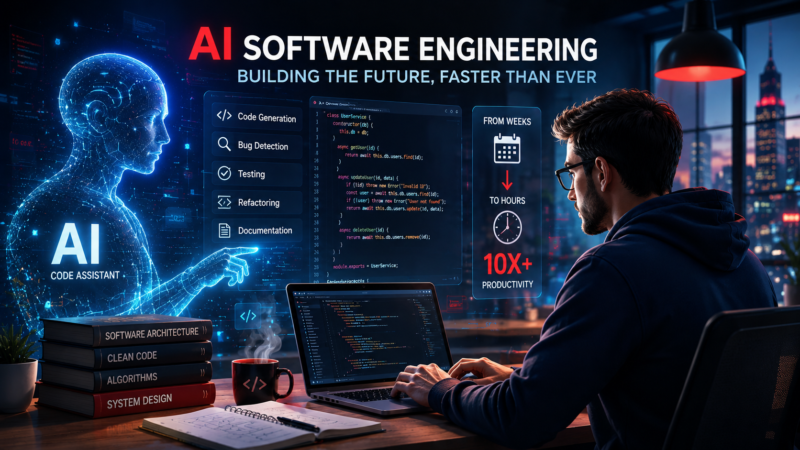
Artificial intelligence has evolved from being a simple coding assistant into a technology capable of performing increasingly sophisticated software engineering tasks. Work that once occupied experienced developers for days or even weeks can now, in some cases, be completed in hours.
The pace of progress is remarkable, and it raises an important question: what does the future of software engineering now look like?
Becoming a Software Engineer
Traditionally, becoming a software engineer required a significant investment in education and training.
Many developers completed a three or four-year degree in Computer Science, Software Engineering or Information Technology. During that time they learned programming languages such as Python, Java, C++ and C#, alongside subjects including databases, algorithms, networking, operating systems, software architecture, mathematics and cybersecurity.
Graduating was only the beginning.
New developers typically entered junior roles where they spent several years fixing bugs, writing features, testing applications and learning from more experienced colleagues. As their knowledge grew, they gradually progressed to designing systems, leading projects and solving increasingly complex technical problems.
For decades, this pathway remained largely unchanged.
Experience was gained by writing code.
How AI Software Engineering Has Evolved
The first generation of AI coding tools was relatively modest.
Developers used AI to generate small sections of code, explain programming concepts or suggest improvements. It acted much like an intelligent assistant sitting beside an experienced programmer.
That changed remarkably quickly.
Modern AI software engineering systems can now generate complete applications, write documentation, create automated software tests, identify security vulnerabilities, debug complex code and explain unfamiliar software almost instantly.
Rather than simply helping programmers write code faster, AI is increasingly capable of performing substantial parts of the software engineering process itself.
AI Software Engineering Is Advancing At Extraordinary Speed
One of the clearest examples of this progress comes from the MirrorCode benchmark, a challenging assessment designed to measure how well AI can recreate real software projects simply by observing how they behave.
Unlike traditional coding tests, this benchmark requires AI to analyse software, understand how it works and reproduce its functionality without copying the original source code.
Using this benchmark, Claude Opus 4.7 demonstrated just how far AI software engineering has progressed. Researchers estimated that it completed software engineering tasks that would normally require between two and seventeen weeks of human engineering effort in approximately fourteen hours while passing almost all automated verification tests.
Remarkably, only a few weeks later, Claude Opus 4.8 was released with further improvements in coding, reasoning and software engineering performance.
The benchmark itself is important, but perhaps even more significant is the speed at which these models continue to improve.
What Does AI Software Engineering Mean For Jobs?
These advances do not mean software engineers suddenly become obsolete.
Software projects still require human judgement, business understanding, security expertise, system architecture and communication with clients and stakeholders. Experienced engineers remain essential.
However, AI software engineering is dramatically increasing productivity.
If a team of ten software engineers previously needed three months to complete a project, AI may eventually allow that same project to be delivered by fewer developers or completed much more quickly by the same team.
That has significant implications for recruitment.
Many technology companies are already placing greater emphasis on developers who can supervise AI, validate AI-generated code and solve complex engineering problems, while routine coding tasks become increasingly automated.
The role is gradually shifting from writing every line of software towards directing intelligent development systems.
AI Software Engineering May Only Be The Beginning
Software engineering is one of the first professions to experience this transformation because programming is fundamentally based on language, logic and structured problem-solving, all areas where modern AI models perform exceptionally well.
Yet software engineering is unlikely to be the last.
The same pattern is beginning to emerge across accounting, finance, legal research, marketing, customer service and many other knowledge-based professions.
As AI capabilities continue to improve, professionals across multiple industries are likely to spend less time performing routine work and more time supervising, validating and directing increasingly capable AI systems.
The Future Is Arriving Faster Than Expected
Only a few years ago, software engineering was considered one of the most secure and technically demanding professions in the world. It required years of education, extensive practical experience and thousands of hours of coding before engineers became truly proficient.
Today, AI software engineering is demonstrating that some of those same engineering tasks can be completed in hours rather than weeks.
That does not mean software engineers will disappear, but it does suggest the profession is changing far faster than many people expected.
For students considering a career in technology, experienced developers already working in the industry and organisations investing in digital transformation, one conclusion is becoming increasingly clear.
Learning to work alongside AI may soon become just as important as learning to write code itself.
At AI Tuition Hub, we believe the most valuable skill is no longer simply learning to code, but learning how to work effectively alongside AI. Whether you’re a software developer, finance professional, marketer, teacher or complete beginner, understanding AI is rapidly becoming a career advantage rather than a specialist skill.
Our growing library of practical AI courses is designed to help individuals and organisations develop the knowledge and confidence to use AI responsibly, improve productivity and prepare for a workplace that is changing faster than ever before.