AI Across Modern Healthcare is no longer simply a vision of the future. It is becoming an increasingly important part of today’s healthcare systems, supporting medical research, diagnostic imaging, hospital operations and surgical care. Rather than replacing healthcare professionals, AI is helping them analyse growing volumes of information, improve efficiency and make more informed decisions in an environment where demand for healthcare continues to rise.
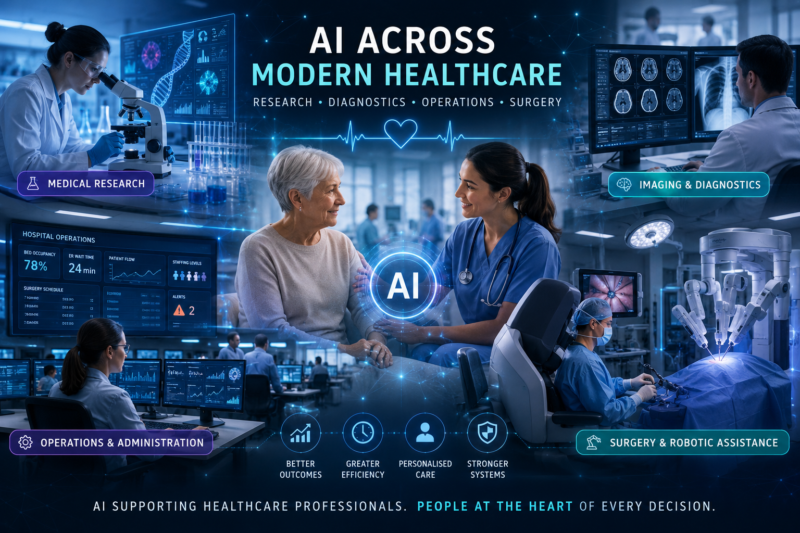
Healthcare systems around the world face significant challenges. Populations are ageing, people are living longer with multiple long-term conditions, demand for medical services continues to increase, and many countries face shortages of skilled healthcare professionals. At the same time, medicine is generating unprecedented amounts of data through imaging, genomics, laboratory testing, wearable technologies and electronic health records.
These challenges cannot be solved by technology alone, but AI is increasingly becoming an important part of the solution. While adoption varies considerably between countries and healthcare organisations, AI Across Modern Healthcare is expanding at a remarkable pace, with new applications emerging across almost every area of medicine.
Healthcare and Medical Research
One of the most exciting developments in AI Across Modern Healthcare is its growing role in medical research.
Biomedical research now produces enormous volumes of scientific data, from genomic sequencing and molecular biology to clinical trial results and population health studies. Processing this information manually is becoming increasingly difficult, making AI an invaluable analytical tool for researchers.
Machine learning models are helping scientists identify potential drug candidates, analyse complex biological data, improve clinical trial design and uncover patterns that may have taken years to identify using traditional methods. AI can also process huge collections of published scientific literature, allowing researchers to identify emerging discoveries and potential areas for further investigation more efficiently.
Healthcare innovation is also becoming increasingly competitive. The United States continues to invest heavily in biomedical research, pharmaceutical development and AI technologies, while China has rapidly expanded its capabilities in healthcare AI, genomics and medical innovation. Across Asia, Europe and many other parts of the world, governments, universities and private organisations are investing billions into life sciences as they compete to accelerate medical discovery and improve healthcare outcomes.
As populations continue to age, demand for faster research, earlier diagnosis and more personalised medicine will only increase. AI is expected to become an increasingly valuable research partner while leaving scientific interpretation and clinical judgement firmly in human hands.
Medical Imaging and Diagnostics
Medical imaging is one of the most advanced examples of AI Across Modern Healthcare.
Every day, hospitals generate millions of X-rays, CT scans, MRI examinations, ultrasound studies and nuclear medicine images. Reviewing this enormous volume of information requires exceptional expertise, concentration and consistency.
AI is increasingly supporting radiologists by assisting with image classification, anatomical segmentation, quantitative measurements and the identification of abnormalities that may require closer examination. Intelligent systems can also compare current scans with previous examinations, prioritise urgent cases and support more structured reporting.
Recent advances in multimodal AI are allowing imaging systems to combine medical images with selected clinical information and historical examinations, providing richer context that supports diagnosis and clinical decision making.
Importantly, AI remains an assistive technology rather than an independent decision maker. Radiologists continue to interpret findings, communicate results and remain fully responsible for every diagnosis.
Healthcare Operations and Administration
While clinical applications often receive the greatest attention, AI Across Modern Healthcare is also transforming hospital operations.
Modern hospitals are among the most complex organisations in society. Every day they coordinate thousands of patients, staff, appointments, operating theatres, beds, medicines and medical supplies while responding to constantly changing clinical demand.
AI is helping healthcare organisations forecast patient admissions, improve workforce planning, optimise scheduling, manage patient flow and strengthen operational command centres through predictive analytics and real-time monitoring.
These capabilities are becoming increasingly valuable as ageing populations place greater pressure on healthcare systems and workforce shortages continue across many countries.
Rather than making decisions independently, AI provides healthcare leaders with clearer operational insight that supports more effective planning, resource allocation and service delivery.
Surgery and Robotic Assistance
Perhaps no area captures the public imagination more than robotic surgery.
However, AI Across Modern Healthcare is not about replacing surgeons with machines. Modern robotic systems remain entirely under the control of highly trained surgical teams, with AI providing intelligent assistance throughout the surgical pathway.
Before surgery begins, AI can support pre operative planning by analysing medical imaging, generating three-dimensional anatomical models and assisting with surgical simulation. During procedures, computer vision systems help recognise anatomical structures, track surgical instruments and provide real-time visual guidance that supports surgical precision.
AI also contributes to surgical training, simulation and post operative performance analysis, helping surgeons continually refine techniques and improve consistency.
Future developments are expected to strengthen collaboration between surgeons and intelligent systems even further, while ensuring that professional judgement, ethical responsibility and patient safety remain central to every procedure.
A Rapidly Evolving Landscape
The continued expansion of AI Across Modern Healthcare demonstrates that artificial intelligence is no longer confined to one specialist discipline. It is becoming part of a much broader healthcare ecosystem that spans scientific research, diagnostics, hospital management and surgical care.
Progress, however, is not uniform. Different countries, healthcare systems and organisations are adopting AI at different speeds depending on investment, digital infrastructure, regulation, workforce readiness and clinical priorities. Some regions are already integrating sophisticated AI systems into routine practice, while others remain at much earlier stages of development.
For this reason, AI should be viewed as a rapidly evolving field rather than a finished technology. New breakthroughs continue to emerge, but responsible implementation, validation and human oversight remain essential.
The Future of AI Across Modern Healthcare
As healthcare continues to evolve, AI is expected to become an increasingly valuable partner for healthcare professionals rather than a replacement for them.
Growing demand from ageing populations, advances in biomedical science and the increasing complexity of healthcare will continue driving innovation across research laboratories, hospitals and operating theatres. While no one can predict exactly how quickly these technologies will develop, AI Across Modern Healthcare is clearly becoming one of the defining technological transformations of modern medicine.
Learn More with AI Tuition Hub
For anyone interested in understanding AI Across Modern Healthcare in greater depth, AI Tuition Hub offers four dedicated courses covering:
- AI in Healthcare and Medical Research
- AI in Medical Imaging and Diagnostics
- AI in Healthcare Operations and Administration
- AI in Surgery and Robotic Assistance
These courses are designed for educational and informational purposes, providing balanced overviews of current technologies, emerging trends and real-world applications while recognising that AI adoption varies considerably around the world and continues to evolve.
These four healthcare courses form part of a library of more than 110 AI courses, all available through a single monthly subscription. New members can currently access the complete catalogue for less than £10 for their first month by using the introductory discount code FOUNDER50.