Trust and company administration has traditionally been regarded as one of the more structured and process intensive areas of offshore finance.
Built around governance, confidentiality, compliance, and careful oversight, it is not an industry typically associated with rapid operational change. Fiduciary services across offshore finance centres such as Jersey, Guernsey, the Cayman Islands, Luxembourg, Singapore, and Dubai have historically evolved steadily rather than suddenly.
Yet quietly, across parts of the sector, something appears to be shifting.
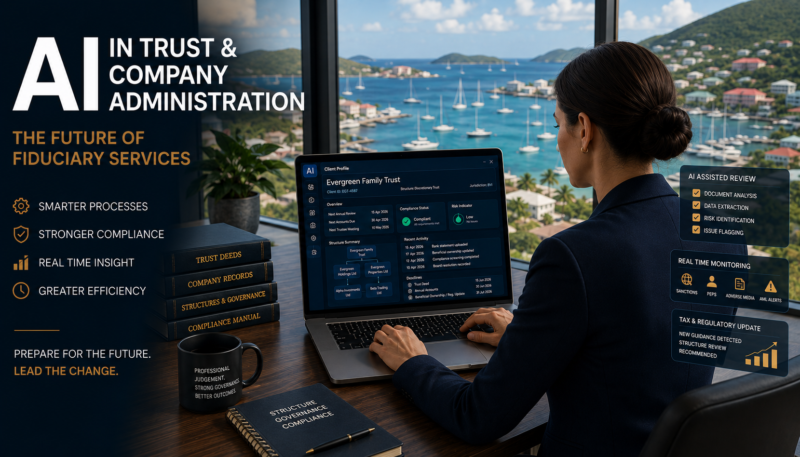
Artificial intelligence is beginning to move beyond experimentation and into practical use. While adoption remains uneven and many firms continue to rely heavily on established systems and traditional workflows, there is growing evidence that AI in Trust and Company Administration is beginning to influence how some work is carried out.
This is not a story of sudden disruption or wholesale replacement.
Rather, it may prove to be a gradual but meaningful operational change.
Why Trust and Company Administration May Be Particularly Suited to AI
Unlike some professions where outcomes are highly unpredictable, trust and company administration often relies upon structured processes, recurring obligations, documentation, and large volumes of organised information.
Annual reviews, onboarding requirements, compliance monitoring, governance records, reporting obligations, payments, and client communication all sit within carefully managed operational frameworks.
These environments naturally create opportunities for technology to improve efficiency.
That does not necessarily mean replacing professionals.
Instead, artificial intelligence appears increasingly capable of reducing the time spent on repetitive administrative activity, information gathering, and document preparation, allowing professionals to focus more heavily on review, judgement, and client matters.
For offshore finance centres where fiduciary administration forms an important part of the local economy, the implications may prove significant over time.
From Administration to Monitoring: Where AI Is Already Starting to Appear
Within many professional services environments, artificial intelligence is increasingly moving from theoretical discussion to practical support.
In trust and company administration, this shift is beginning to emerge in several areas.
Documentation that previously required lengthy preparation may increasingly be drafted more quickly. Information spread across multiple systems can be surfaced faster. Routine correspondence, onboarding summaries, annual review preparation, and reporting may increasingly benefit from automation or AI assisted support.
Perhaps more notably, compliance functions may also begin evolving.
Traditionally, many compliance obligations relied heavily on periodic reviews and manual checks.
Artificial intelligence increasingly creates the possibility of more continuous visibility.
Monitoring linked to sanctions, politically exposed person status, adverse media, unusual transactional behaviour, and documentation gaps can increasingly be reviewed more dynamically than in the past.
Rather than relying exclusively upon annual review cycles, some organisations are beginning to explore how AI supported systems may strengthen awareness between formal review periods.
A More Continuous View of Tax and Regulatory Change
Trust and company structures are often established for very specific purposes.
These may include succession planning, governance, investment holding, international operations, or tax efficiency.
However, the international regulatory environment rarely stands still.
Tax frameworks evolve. Reporting obligations change. Substance requirements develop. Jurisdictions adjust how structures are treated.
Historically, identifying the implications of these developments often depended heavily upon periodic review and professional interpretation.
Increasingly, more sophisticated systems are beginning to assist by identifying changes that may warrant additional attention.
In some environments, artificial intelligence is already helping surface situations where developments in taxation, compliance, sanctions, or regulatory treatment may affect whether a structure continues to operate as originally intended.
For fiduciary firms managing cross border arrangements, this could support a more responsive approach to monitoring over time.
Conversations Within the Industry Suggest Work Is Already Accelerating
One of the more interesting observations emerging from conversations connected to professional services is how quickly attitudes appear to be evolving.
Individuals working within areas linked to fiduciary administration increasingly describe artificial intelligence less as a future concept and more as a practical efficiency tool.
The message is often similar.
Work involving documentation, research, reporting, and information gathering appears to be speeding up.
Processes that once required substantial manual effort may increasingly be completed in materially less time.
This does not necessarily simplify the work itself.
Trust and company administration remains highly regulated, complex, and dependent upon careful oversight.
However, it increasingly appears that parts of the role are beginning to evolve through greater speed, stronger visibility, and easier access to information.
A Growing Governance Question
Alongside opportunity comes risk.
One issue receiving increasing attention across professional services concerns the use of public artificial intelligence tools without clear organisational oversight.
Imagine an employee attempting to speed up a complex task by uploading documentation into an external AI platform to summarise information or assist with drafting.
In many industries, this has already become a growing concern.
Within trust and company administration, the issue may be particularly sensitive given the confidential nature of fiduciary information.
Depending upon the structure involved, information may relate to ownership arrangements, governance material, financial data, trust documentation, or private client matters.
As a result, many firms appear increasingly likely to explore stricter governance around AI use, internal systems, and clearer organisational policies designed to balance efficiency with confidentiality obligations.
Could Offshore Finance Roles Look Different by 2030?
It would be premature to suggest that artificial intelligence will fundamentally reshape trust and company administration overnight.
Equally, it may no longer be realistic to assume the sector remains entirely unchanged.
Many commentators already predict that artificial intelligence could alter parts of white collar work over the coming decade.
Within fiduciary environments, the reality is likely to be more nuanced.
Some routine work may continue becoming faster. Certain administrative functions may gradually require fewer hours. Teams may increasingly operate with broader visibility supported by stronger technology.
At the same time, professional judgement, relationship management, governance, discretion, and technical expertise are unlikely to lose importance.
Indeed, these qualities may become more valuable.
The more realistic possibility may not be replacement, but evolution.
Understanding the Direction of Travel
For professionals working in offshore finance, the most useful question may no longer be whether artificial intelligence will influence trust and company administration.
In many respects, early signs suggest it already is.
The more important question may be how quickly adoption progresses and which parts of the role change first.
For some firms, the transition may remain gradual.
For others, competitive pressure, operational efficiency, and rising regulatory complexity may accelerate adoption more quickly than expected.
Either way, the direction of travel increasingly appears difficult to ignore.
Learn More About AI in Trust and Company Administration
For those interested in exploring these developments further, our course AI in Trust and Company Administration: The Future of Fiduciary Services examines these themes in substantially greater depth.
The course explores how artificial intelligence is beginning to influence annual reviews, compliance monitoring, onboarding, documentation, reporting, confidentiality risks, taxation changes, and the possible future direction of fiduciary services as the industry moves toward 2030.
At AI Tuition Hub, we currently offer more than 20 finance related AI courses, alongside over 100 AI courses covering business, productivity, education, governance, and emerging technologies.
Using our FOUNDER50 offer, full platform access is currently available for an introductory price of less than £10 for your first month.
Published June 2026