Science has always advanced through human curiosity, experimentation and painstaking calculation. What is changing is the speed at which researchers can now explore possible answers and work through quantities of scientific information that would once have overwhelmed entire teams.
Science at Machine Speed with AI: From Advanced Physics to Space Exploration describes a new period in which AI is helping researchers test potential formulae, identify hidden patterns and investigate questions that might previously have taken months or years to explore.
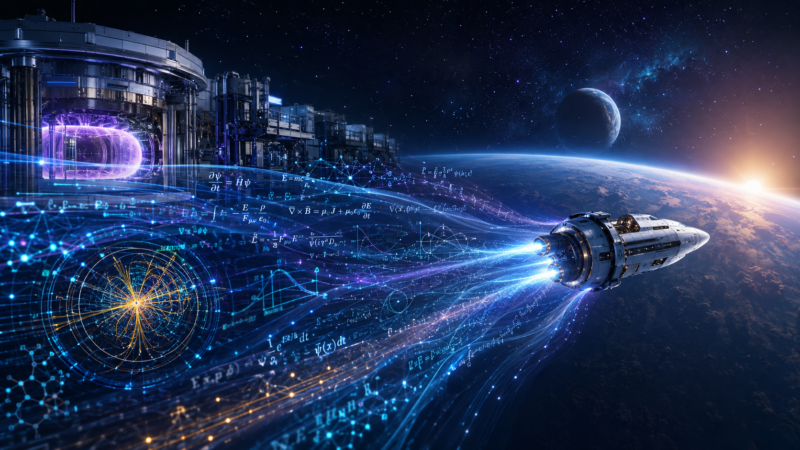
AI is already being used to search particle collisions for unknown physics, control unstable fusion plasma and guide spacecraft across the surface of Mars. It can explore enormous numbers of possibilities, reject unsuccessful approaches and direct scientists towards the results most deserving of human attention.
Scientists still design the experiments, verify the evidence and determine whether a finding is genuine. However, AI is providing a level of analytical speed and scale that could push physics and space exploration into an entirely new period of discovery.
Billions Are Being Committed to AI and Science
Governments and research institutions increasingly believe AI could transform the speed at which scientific work takes place.
The European Commission plans to increase annual Horizon Europe investment in AI to more than €3 billion, including additional support specifically for AI in science. It has also proposed €600 million to give researchers greater access to advanced computing facilities.
The wider European InvestAI initiative aims to mobilise €200 billion for AI investment and includes plans for major computing facilities capable of supporting the development of highly advanced models.
In the United States, the Department of Energy has launched the Genesis Mission to combine AI, supercomputers, research facilities and extensive scientific datasets. A US and Japan partnership worth $1 billion is supporting the programme’s ambition to increase the productivity and impact of science and engineering.
These figures do not guarantee scientific breakthroughs. They demonstrate the scale of the belief that AI can accelerate research in physics, energy, materials, chemistry and space exploration.
Working Through Formulae at Machine Speed
Physics depends heavily on discovering mathematical relationships that explain how a system behaves. Researchers traditionally develop a theory, construct an equation and compare its predictions with experimental evidence.
AI introduces another powerful approach known as symbolic regression. This allows a system to examine scientific data and search for a mathematical expression that could explain the pattern.
The number of possible formulae is effectively enormous. Researchers can manually investigate only a small proportion of them, while AI can rapidly generate, test and reject large numbers of possible relationships.
The objective is not simply to produce a numerical prediction. Scientists want an understandable equation that can be examined, challenged and tested under different conditions.
This could reduce the time required to identify a promising scientific explanation. However, a formula that fits one set of information is not automatically a new law of physics. It may fail when tested against new evidence or merely reproduce a coincidence within the original data.
Entering Research Level Mathematics
AI is also moving beyond solving familiar mathematical exercises and towards assisting with genuine research questions.
In 2026, Google DeepMind reported that its Gemini Deep Think system was being used under the direction of mathematicians, physicists and computer scientists to tackle professional research problems. The system generates possible solutions, checks them for flaws and then attempts to revise or replace unsuccessful approaches.
DeepMind describes the technology as a scientific companion rather than an independent researcher.
This ability to generate, verify and improve possible solutions could shorten parts of the research process considerably. AI does not become tired after working through thousands of unsuccessful possibilities.
It can still make convincing mistakes. Expert verification remains essential, particularly in advanced areas where reliable training information may be limited.
AI Is Already Driving on Mars
The value of AI becomes particularly clear when a machine is operating millions of miles away.
Depending on the positions of the planets, a radio signal can take more than 20 minutes to travel between Earth and Mars. A rover cannot wait for a human operator to direct every movement or help it avoid every rock.
NASA reports that most of the driving completed by its Perseverance rover has been autonomous. The rover uses cameras and onboard computing to examine the terrain, recognise hazards and navigate around obstacles. NASA’s work with AI demonstrates that autonomous space exploration is already taking place.
Scientists still choose the rover’s destination and research priorities. AI works out how it can travel safely between those human decisions.
NASA has also used AI to help identify minerals within Martian rocks. This allows the rover to recognise potentially interesting material and helps researchers decide which targets deserve closer examination.
As missions travel farther from Earth, spacecraft will require even greater independence. They may need to select valuable information, respond to equipment problems and make limited navigational decisions before instructions can arrive.
Searching for Unknown Particles
Experiments at CERN’s Large Hadron Collider produce billions of particle collisions. Only a tiny proportion may contain evidence capable of changing our understanding of physics.
Researchers traditionally search for a particular type of particle predicted by an existing theory. The challenge is finding something that no theory has accurately described.
The ATLAS and CMS collaborations have used AI to identify collisions that look significantly different from the expected background. CERN explains how these systems can search for unexpected events without being told exactly what a new particle should look like.
AI does not announce that a discovery has been made. It narrows billions of events to a smaller group that physicists can investigate properly.
An unusual result could represent new physics, a problem with the detector or an ordinary event that happens to look different. Scientists must eliminate those alternative explanations before making any claim.
Controlling the Energy That Powers the Sun
Fusion experiments attempt to reproduce the type of process that powers stars. This requires plasma to be controlled at extreme temperatures using powerful magnetic fields.
Plasma can become unstable within a very short period. Researchers cannot manually interpret hundreds of sensor readings and adjust every control quickly enough to prevent every disruption.
The US Department of Energy has reported experiments in which AI monitored information from hundreds of sensors and adjusted magnetic confinement fields in real time. The system was used to prevent a particular type of plasma instability before it fully developed.
This does not mean AI has solved fusion energy. Commercial fusion still faces immense engineering, scientific and financial barriers. It shows that AI can assist with a physical process that changes too quickly and produces too much information for direct human management.
Seeing Physics That Instruments Cannot Capture
Scientific instruments have physical limitations. Some events occur too quickly or at a scale that existing sensors cannot record completely.
In 2026, researchers developed an AI model that reconstructed higher resolution measurements from fusion experiments. It produced synthetic information showing rapidly developing plasma behaviour that existing diagnostic equipment could not capture fully.
The research was intended to improve understanding of fusion physics and recover information when a diagnostic instrument is limited or fails.
This capability must be treated carefully. AI is estimating the missing information rather than observing it directly.
Researchers must clearly distinguish between a physical measurement and an AI reconstruction. Otherwise, a convincing model could create the appearance of evidence that was never actually recorded.
Discovering Materials for Future Spacecraft
Future spacecraft and off Earth habitats will require materials capable of withstanding radiation, severe temperature changes and long periods without maintenance.
AI can compare possible molecular structures and predict which materials may offer useful strength, conductivity or heat resistance. This narrows the number of candidates that must be produced and tested inside a laboratory.
Advanced models are also helping scientists calculate the behaviour and energy of atoms and molecules using quantum physics. These calculations become extraordinarily complicated as more particles are introduced.
A promising computer prediction remains only the beginning. The material must still be manufactured, physically tested and shown to work under realistic conditions.
Nevertheless, reducing the number of unsuccessful experiments could save considerable time and allow scientists to investigate possibilities that would otherwise remain unexplored.
Accelerating the Journey Beyond Earth
The connection between AI, advanced physics and space exploration is becoming increasingly important.
AI may help develop lighter materials, improve energy systems, guide autonomous spacecraft and analyse the geology of distant worlds. It could also support robotic construction, life support and the search for usable resources beyond Earth.
None of this means enormous settlements on Mars are about to appear. AI cannot remove radiation, shorten astronomical distances or overturn the laws of physics.
What it can do is reduce the time scientists spend searching through unsuccessful possibilities. It can examine vast datasets, test potential formulae and identify patterns that people might never notice unaided.
Human beings still ask the questions, design the experiments and decide whether the answers are credible. AI provides speed and analytical scale, but science still requires physical evidence, scepticism and human judgement.
Our course, AI in Space Exploration and Off-Earth Civilisation, examines how these capabilities could support spacecraft, habitats, energy systems, transport and governance as humanity considers a future beyond its original planetary home.
Published: 26th August 2026.