Modern warfare is being transformed at a speed few defence planners could have imagined a decade ago. AI in War is no longer a discussion about distant possibilities or machines that might appear in the future. It is already influencing how intelligence is analysed, drones are detected, cyberattacks are identified and military decisions are made.
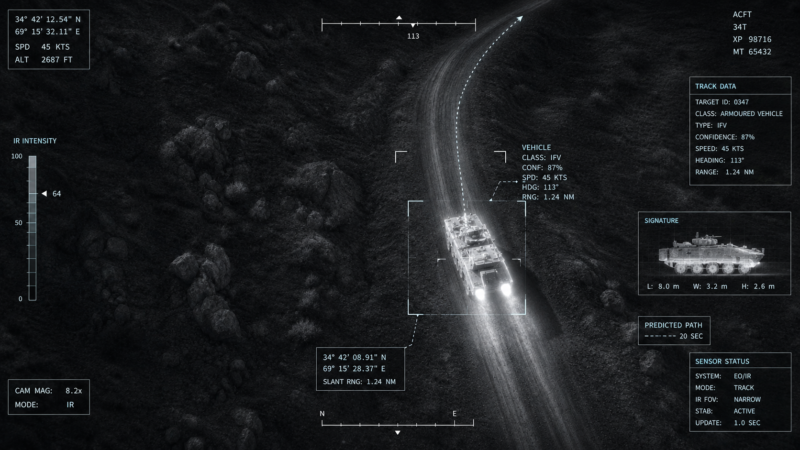
Recent conflicts have become testing grounds for technologies combining AI, low cost drones, satellite information, electronic surveillance and connected battlefield systems. The result is not a fully automated battlefield without human involvement. It is something more complicated: people working alongside machines that can process information and identify threats at a scale no human team could match.
Warfare Is Becoming a Contest of Information
Military strength was once measured mainly through troop numbers, aircraft, ships and heavy equipment. These remain essential, but information has become just as important.
Modern forces receive continuous data from:
- Satellites
- Drones
- Radar systems
- Ground sensors
- Cyber networks
- Open source intelligence
- Electronic communications
Collecting this information is only the beginning. The real advantage comes from interpreting it quickly enough to influence what happens next.
AI can examine thousands of images, compare movement across several locations and highlight unusual activity for human analysts. It can connect a change detected by a satellite with communications activity, drone footage or reports from personnel on the ground.
This is changing the speed of military awareness. Commanders may receive a far more complete picture of an unfolding situation, but they must also decide how much confidence to place in the technology producing it.
Lessons Are Moving Between Conflicts
One of the clearest developments is the speed at which battlefield tactics now spread from one conflict to another.
The war in Ukraine has demonstrated how relatively inexpensive drones can be used for surveillance, targeting, logistics and attacks. Those lessons are now influencing military planning elsewhere.
A recent report examining Iran’s adaptation of drone tactics described how Iranian forces had studied methods emerging from Ukraine. In one reported operation, several drones transmitted the location, direction and speed of a US aircraft to commanders on the ground. The aircraft was subsequently targeted using a separate air defence system.
This does not mean that the drones independently made every decision. It demonstrates how connected sensors and uncrewed systems can strengthen human targeting and coordination.
The wider lesson is that military innovation no longer remains confined to the country where it first appears. Footage, tactics and technical knowledge can circulate globally, allowing others to study what worked, identify weaknesses and develop their own versions.
Cheap Drones Are Challenging Expensive Defences
Drones have changed the economics of warfare.
A relatively inexpensive aircraft can force an opponent to use a far more costly missile or defensive system. Large numbers of drones may also place pressure on radar, communications and air defence networks.
A Reuters assessment of the continuing conflict involving Iran reported that the country retained significant drone and missile capability despite extensive damage to its military infrastructure. These systems have continued to threaten shipping and military installations across the region.
This creates a difficult calculation.
Using an expensive interceptor against every small drone may not be sustainable. Allowing one through could place personnel, infrastructure or equipment at risk.
Defence organisations are consequently developing layered responses. AI can help detect and classify a possible drone, electronic warfare can attempt to disrupt it and conventional weapons may provide a final layer of protection.
The US Air Force has recently been testing layered counter-drone defences that use AI to distinguish small drones from birds, aircraft and other harmless objects before deciding how to respond.
AI is valuable here because a false alarm can waste resources, while a missed detection can have serious consequences.
AI Does Not Make Every Drone Autonomous
It is easy to assume that every modern drone is controlled by AI. That is not the case.
Some are remotely operated by people. Others follow programmed routes or use basic automated navigation. More advanced systems may recognise objects, avoid obstacles, adjust their route or coordinate with other platforms.
Autonomy therefore exists at different levels.
A drone may navigate independently while a person controls its mission. AI may identify a possible object without deciding whether it should be attacked. A defensive system may track an incoming threat but still require human authorisation before taking action.
These distinctions matter because they determine where responsibility lies and how much control a human operator genuinely retains.
The most important development is not the sudden arrival of one completely independent machine. It is the steady addition of autonomous functions across hundreds of different systems.
The Battlefield Now Extends Into Cyberspace
Modern conflict is no longer restricted to military bases, borders or physical battlefields.
Cyber operations can target communications, transport, energy, water supplies and government systems thousands of miles from the fighting.
In August 2026, Iran linked hackers were blamed for a cyberattack on a UK power plant. The small facility was shut down temporarily, although the incident did not disrupt the wider electricity network.
It nevertheless demonstrated how geopolitical conflict can reach civilian infrastructure in another country.
AI is becoming important on both sides of this contest.
Defenders use it to monitor networks, identify unusual behaviour and prioritise possible threats. Attackers can use it to automate reconnaissance, discover vulnerabilities and produce convincing phishing messages or false instructions.
Emerging AI agents may go further by investigating alerts and taking limited defensive action. This could reduce response times, but it also introduces risk. An AI agent with access to important systems could cause disruption if it misunderstands a situation or is deliberately manipulated.
Machine speed cyber defence therefore requires strict permissions, continuous monitoring and clear human authority.
Human and Machine Teaming Is Becoming Central
Much of the real transformation involves human and machine teaming rather than human replacement.
AI is effective at:
- Processing large quantities of data
- Detecting patterns
- Monitoring systems continuously
- Comparing possible scenarios
- Performing repetitive analysis
People contribute:
- Context
- Strategic intent
- Ethical judgement
- Understanding of uncertainty
- Responsibility for decisions
The difficulty lies in designing this relationship properly.
An operator may be expected to supervise several drones, assess numerous alerts and remain prepared to intervene immediately. If too much information is presented at once, automation can increase workload instead of reducing it.
There is also a danger known as automation bias. When a system has produced reliable results repeatedly, people may begin accepting its recommendations without sufficient scrutiny.
An AI assessment can appear confident and precise while still being wrong. Poor data, damaged sensors, unfamiliar surroundings or deliberate deception may all influence its output.
Human oversight must therefore be meaningful. The person supervising the system needs enough information, time and authority to challenge what it recommends.
Autonomous Weapons Are Forcing an International Debate
The growing use of AI in military systems has intensified the debate over autonomous weapons.
On 25 August 2026, the UN Secretary General and the President of the International Committee of the Red Cross renewed their call for international rules governing autonomous weapons. They warned that the world is moving dangerously close to a moral boundary involving machines autonomously targeting human beings.
Existing international humanitarian law still applies. Military operations must distinguish between legitimate targets and civilians, consider proportionality and take feasible precautions to reduce civilian harm.
The unresolved question is whether existing law provides sufficient protection when a system can select and engage a target without further human intervention.
Some states support new restrictions or prohibitions. Others argue that current international law remains adequate and that carefully controlled autonomous systems may improve precision or provide rapid defence against incoming threats.
After years of discussion, there is still no comprehensive international agreement.
Technology is moving forward while governments continue debating where the boundaries should be drawn.
Faster Decisions Can Create Greater Risk
AI can shorten the time required to detect and respond to a threat.
That may save lives during a cyberattack, missile launch or drone incursion. It can also reduce the time available for human reflection.
If opposing systems detect one another, classify activity and recommend responses within seconds, political and military leaders may feel pressure to act before the information has been properly verified.
A false warning or incorrect classification could escalate a situation unnecessarily.
Faster does not always mean safer.
Defence organisations need pause conditions, approval thresholds and procedures for handling uncertain information. The most dangerous moment may occur when an AI system is highly capable but its operators place more confidence in it than the evidence justifies.
The Arms Race Is About More Than Weapons
Competition in military AI extends far beyond drones and autonomous platforms.
Countries and alliances are investing in:
- Advanced semiconductors
- Secure cloud infrastructure
- Battlefield data
- Cybersecurity
- Satellite systems
- Software development
- Specialist personnel
NATO has moved towards wider operational testing of AI and uncrewed systems. Its Task Force X programme brought together more than 100 uncrewed systems operating across air, land, surface and underwater environments. The exercise examined how different platforms could work together while remaining under ultimate human control.
The UK has also established a £100 million Rapid AI Delivery Taskforce to accelerate the deployment of AI, autonomy and related technologies across the Armed Forces.
The race is no longer simply to invent new technology. It is to test it, manufacture it and integrate it into existing forces before an opponent does.
Warfare Has Changed, but Responsibility Has Not
AI can improve surveillance, strengthen cyber defence and help protect personnel from dangerous environments.
It can also create distance between a human decision and its consequences.
A recommendation may pass through sensors, models, software providers and military systems before reaching an operator. If something goes wrong, responsibility must not disappear within that technical chain.
An algorithm cannot be held legally or morally accountable.
Commanders, operators, developers and institutions must understand what each system is authorised to do, where its limitations lie and who remains responsible for its use.
Recent conflicts are showing us that the future battlefield will be more connected, automated and dependent on data. They are also demonstrating that older principles of judgement, restraint and accountability have become more important rather than less.
Learn More About AI in Military and Defence
We have fully updated our course, AI in Military and Defence: Strategy, Ethics and Global Security, to reflect the rapid changes taking place throughout 2026.
The course examines intelligence and surveillance, autonomous systems, human and machine teaming, cyber defence, international law, ethical responsibility and the global competition shaping future security.
It is designed for learners who want to understand how AI is changing defence without becoming lost in unnecessary technical language.
AI Tuition Hub membership costs just £9.95 per month and provides access to our complete course collection. Members can study at their own pace, revisit lessons whenever they wish and follow regular updates as AI continues to develop.
Explore our courses and build the practical understanding needed to follow one of the most important technological changes taking place in the modern world.
Published: 27th August 2026.