Businesses have always competed on price, quality and customer service. Today, artificial intelligence is giving early adopters a powerful new advantage. Organisations that embrace AI are responding to customers more quickly, reducing costs, increasing productivity and bringing new products and services to market faster than ever before.
The Real Threat Isn’t AI.
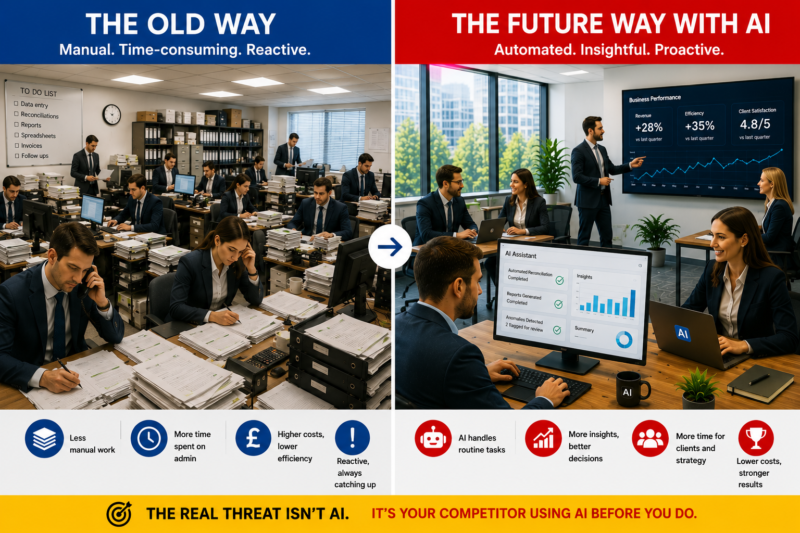
The real threat is your competitor using AI before you do. As more businesses adopt artificial intelligence, those that fail to keep pace risk losing their competitive advantage, not because AI has replaced them, but because competitors are using it to work smarter, faster and more efficiently.
As we have covered in previous blogs, AI agents represent the next major shift in artificial intelligence. Rather than assisting with individual tasks, these autonomous systems will increasingly complete entire business processes from start to finish. Businesses that adopt them early are likely to gain an even greater competitive advantage over those that delay.
The accounting profession provides a good example of how this transformation is already beginning. Many bookkeeping tasks, bank reconciliations, invoice processing, expense categorisation and even elements of financial reporting can now be completed in a fraction of the time they once required. Accountants are still needed to review the work, apply professional judgement and provide strategic advice, but firms using AI can often complete routine work much faster than those relying entirely on manual processes. There is already growing evidence that some clients expect AI driven efficiencies to be reflected in the fees they pay, particularly where artificial intelligence is carrying out much of the high volume transactional work that previously consumed significant staff time. As more firms adopt these technologies, competition is likely to increase, placing growing pressure on pricing while encouraging practices to focus more heavily on the higher value advisory services that clients cannot easily replace with AI.
The same pattern is emerging across many industries. Businesses that embrace AI can complete work more quickly, respond to customers almost immediately and reduce the time employees spend on repetitive tasks. Those improvements create a competitive advantage that organisations ignoring AI may find increasingly difficult to overcome.
That competitive advantage can quickly translate into higher profits, lower prices or a better customer experience. Businesses that delay adopting AI may find themselves struggling to compete with organisations that are simply able to do more with the same resources.
AI Never Sleeps
One of the biggest advantages of artificial intelligence is that it never stops working. AI powered systems can answer customer enquiries, schedule appointments, prepare quotations, summarise documents and provide support around the clock.
Customers increasingly expect immediate responses rather than waiting until the next business day. Businesses that can provide almost real time service are far more likely to win enquiries and retain customers than those relying entirely on traditional office hours.
This does not replace people. Instead, AI handles many of the routine and repetitive tasks, allowing employees to focus on work that requires experience, creativity and human judgement.
Every Employee Becomes More Productive
Artificial intelligence is changing how work gets done.
A proposal that once took two hours to prepare may now take twenty minutes. A lengthy report can be summarised in seconds. Large volumes of information can be analysed almost instantly, allowing employees to spend more time making decisions rather than searching for information.
The employee remains responsible for reviewing the output and making the final judgement, but AI removes much of the repetitive work that slows organisations down. Multiply those time savings across an entire business and the productivity gains become significant.
Perhaps one of the most overlooked advantages of AI is its ability to help businesses innovate. Instead of spending weeks researching new ideas, analysing customer feedback or developing initial concepts, AI can complete much of this groundwork in minutes. Businesses can generate product ideas, test different approaches, identify market opportunities and refine their offerings far more quickly than before. In competitive markets, bringing a new product or service to customers even a few weeks ahead of competitors can make a significant difference, making AI not just a tool for efficiency, but a catalyst for innovation.
Lower Costs Create a Competitive Advantage
Every hour saved through automation reduces operating costs.
Those savings give businesses greater flexibility. Some will choose to improve customer service, others will invest in new products or technology, while many will simply strengthen their profitability. Businesses that become more efficient can often deliver the same quality of service at a lower cost than competitors still relying on traditional working methods.
Competition has always rewarded organisations that embrace innovation. Artificial intelligence is rapidly becoming the latest example.
The Next Step Is AI Agents and Swarm AI
The competitive advantage offered by AI is only just beginning.
We have touched on this in earlier blogs when discussing AI agents and swarm AI. Instead of a single AI assistant helping with one task, multiple AI systems can work together to complete increasingly complex workflows. One AI may communicate with customers, another may prepare quotations, another may analyse business data, while another generates reports or manages schedules.
As these technologies continue to develop, businesses will increasingly be able to automate entire processes rather than individual tasks. This will allow organisations to operate closer to real time, respond to customers more quickly and improve efficiency even further.
Standing Still Is Becoming the Biggest Risk
The Real Threat Is Not AI, It’s Your Competitor Using AI.
Artificial intelligence will not guarantee success. Businesses still need good leadership, excellent products and outstanding customer service. However, when two organisations offer similar products at similar prices, the one using AI effectively is increasingly likely to become faster, more efficient and more responsive to customer needs.
The question is no longer whether AI will influence business competition. It already is. The real question is whether your competitors are learning to use it before you do.
AI Skills Will Become a Competitive Advantage
As businesses continue to adopt AI, the skills they expect from employees will inevitably change. Organisations that invest in artificial intelligence will increasingly look for people who can use these tools effectively to improve productivity, automate routine work and solve problems more efficiently. In many industries, AI skills are likely to become as valuable as proficiency with Microsoft Office or other everyday business software.
The competitive advantage will not only belong to businesses using AI but also to the employees who know how to use it well. Those who embrace AI will be able to produce more, work more efficiently and contribute greater value to their organisations. As AI becomes embedded across more industries, developing these skills will increasingly become an investment in long term career resilience.
Learn How AI Can Give Your Business a Competitive Edge
At AI Tuition Hub, we offer more than 110 practical AI courses covering business, finance, education, marketing, healthcare, compliance and many other professions. For less than £10, you can enjoy unlimited access to every course for a full month and discover how AI can help you stay ahead of the competition.
Our AI for Business Efficiency and Cost Reduction course explains how AI can improve productivity, streamline operations, reduce costs and strengthen decision making across modern organisations. We also offer a growing library of industry specific AI courses covering finance, compliance, customer service, human resources, cybersecurity, education, hospitality, sales, marketing and many other sectors. Each course is tailored to the day to day work carried out within that profession, helping organisations build the knowledge and confidence needed to remain competitive in an increasingly AI driven economy.
Further reading – The State of Organizations 2026: Three tectonic forces that are reshaping organizations
Published 28th July 2026.