AI in Banking is accelerating faster than ever. Not long ago, artificial intelligence was largely confined to pilot projects and innovation labs. Today, it is helping banks detect fraud in milliseconds, answer customer enquiries, assess credit risk, support relationship managers and automate countless operational processes behind the scenes. In many cases, customers are already interacting with AI without even realising it.
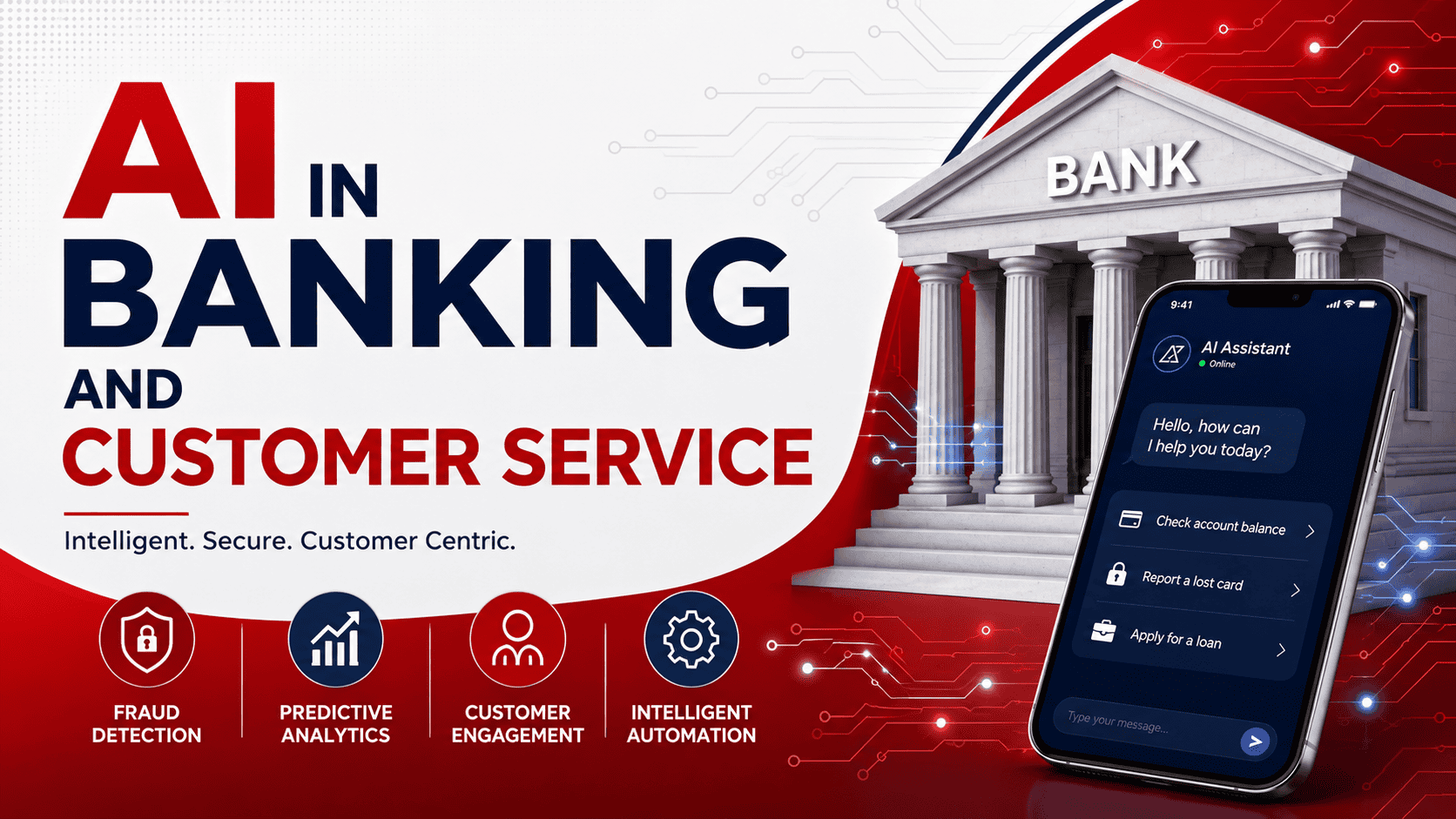
Because the industry is evolving so quickly, we’ve recently refreshed our AI in Banking and Customer Service course to ensure it reflects where the technology stands today. We’ve expanded the course to include the latest developments in Large Language Models, generative AI, AI copilots, conversational banking, predictive analytics and responsible AI governance, ensuring learners are studying current trends rather than outdated concepts.
AI Is Already Changing Everyday Banking
For many people, artificial intelligence has quietly become part of everyday banking.
Whether you’re checking your account balance through a virtual assistant, receiving an instant fraud alert, applying for a loan online or getting personalised spending insights in your banking app, AI is increasingly working behind the scenes.
Banks are using AI to process enormous volumes of information every second, helping them make faster decisions while improving customer service and strengthening security. The result is a banking experience that feels quicker, more responsive and increasingly personalised.
What makes this particularly fascinating is that many customers may never even realise AI was involved.
The Rise of Generative AI
Perhaps the biggest development over the past year has been the rapid adoption of Large Language Models (LLMs) and generative AI.
Banks are no longer simply experimenting with these technologies. They are embedding them into day to day operations.
Modern AI can now:
- Assist customer service teams.
- Summarise lengthy customer conversations.
- Explain complex financial products.
- Search internal knowledge bases.
- Help relationship managers prepare for meetings.
- Support compliance professionals navigating regulations.
- Draft internal documentation.
Many institutions are also deploying Retrieval Augmented Generation (RAG), allowing AI to retrieve information directly from approved internal documentation instead of relying solely on its original training. This helps improve accuracy while protecting sensitive business information.
AI Is Transforming Customer Service
Customer expectations have changed dramatically.
People increasingly expect immediate answers, seamless digital experiences and personalised financial support whenever they contact their bank.
Artificial intelligence is helping banks deliver exactly that.
Today’s AI powered customer service includes intelligent chatbots, virtual assistants and conversational banking platforms capable of understanding natural language and maintaining context throughout an entire conversation.
Instead of forcing customers through endless menus or requiring them to repeat the same information, AI is making interactions feel far more natural.
Importantly, these technologies are designed to support human advisers rather than replace them. Complex situations still require empathy, professional judgement and experience, while AI handles many of the repetitive enquiries that previously consumed valuable staff time.
Fighting Financial Crime With AI
One of the most valuable applications of AI in Banking remains fraud detection.
Financial criminals are becoming increasingly sophisticated, with many now using AI themselves to launch convincing phishing attacks, deepfake scams and highly targeted fraud campaigns.
Banks are responding by deploying equally advanced AI systems.
Machine learning models continuously analyse customer behaviour, transaction history, device information, payment patterns and countless other variables to identify suspicious activity within milliseconds.
Modern fraud detection is no longer based solely on fixed rules.
Instead, AI looks for subtle behavioural changes that may indicate fraud before significant losses occur.
The result is stronger protection for customers and fewer false alarms than traditional rule based systems alone.
AI Copilots Are Supporting Banking Professionals
One of the fastest growing trends in financial services is the emergence of AI copilots.
Unlike customer facing chatbots, these secure assistants are designed for employees.
AI copilots can help staff:
- Search internal policies.
- Retrieve product information.
- Summarise reports.
- Draft customer communications.
- Explain regulatory guidance.
- Prepare client meetings.
Rather than replacing banking professionals, these tools allow them to spend less time searching for information and more time helping customers solve complex financial challenges.
Many experts believe AI copilots will soon become as common in banking as email and spreadsheets.
Intelligent Decision Making
Artificial intelligence is also helping banks become more proactive.
Instead of simply analysing what has already happened, AI can identify patterns that suggest what may happen next.
Banks increasingly use predictive analytics to support:
- Credit assessments.
- Cash flow forecasting.
- Customer retention.
- Liquidity planning.
- Operational efficiency.
- Personalised financial recommendations.
These systems do not make final decisions on their own. Instead, they provide valuable insights that support experienced professionals while maintaining appropriate governance and oversight.
Modern Banking Requires Responsible AI
As AI becomes more deeply embedded across financial services, responsible deployment has become just as important as technological innovation.
Banks must ensure AI systems remain:
- Fair.
- Transparent.
- Explainable.
- Secure.
- Reliable.
- Properly governed.
Customers need confidence that AI is supporting better decisions without compromising privacy, security or regulatory compliance.
For that reason, we have significantly expanded our coverage of AI governance, explainability, human oversight and responsible AI deployment throughout the course.
Understanding the technology is only part of the picture. Understanding how to use it responsibly is equally important.
What We’ve Updated
To reflect how rapidly AI in Banking is evolving, we’ve refreshed the course with expanded coverage of:
- Large Language Models and generative AI.
- AI chatbots and conversational banking.
- AI copilots for banking professionals.
- Omnichannel customer engagement.
- Fraud detection and behavioural analytics.
- Predictive analytics and decision intelligence.
- Intelligent back office automation.
- Responsible AI governance.
- Legacy banking systems and cloud integration.
The aim is simple: to ensure learners are studying the technologies that banks are deploying today, not those that dominated the conversation a year or two ago.
The Pace of Change Is Only Increasing
If there is one clear message emerging from the banking sector, it is that AI in Banking is accelerating faster than ever.
Every month brings new announcements from major financial institutions investing in generative AI, intelligent automation, AI powered customer service and enterprise AI platforms. Technologies that recently felt experimental are quickly becoming part of everyday banking operations.
For anyone working in banking, financial services or fintech, keeping pace with these developments is becoming an essential professional skill rather than an optional extra.
At AI Tuition Hub, we continuously review and refresh our courses as artificial intelligence evolves, ensuring our learners always have access to current, practical and relevant content.
We now offer around 20 AI courses dedicated to the finance industry, covering banking, financial services, accounting, auditing, governance, compliance, risk management, fintech and much more.
For a limited time, you can access every course using our FOUNDER50 discount code, giving you 50% off your first month and unlimited access to our growing AI learning library.