Artificial Intelligence has become one of the biggest talking points in the accounting profession. The AI firms competing to replace accountants are now transforming bookkeeping, auditing and financial analysis at an unprecedented pace. Every week seems to bring another story about AI improving productivity, reducing administrative work or helping accountants deliver better services to clients. Yet most of the discussion has focused on one familiar question: Will AI replace accountants?
Perhaps that is no longer the right question.
A much bigger battle appears to be taking place behind the scenes. Rather than asking whether AI will replace accountants, we should perhaps be asking which company is trying to build the world’s leading AI accountant. Looking across the finance industry during 2026, the evidence suggests that many of the world’s largest technology companies and accounting software providers are now competing to automate more of the accounting process than ever before.
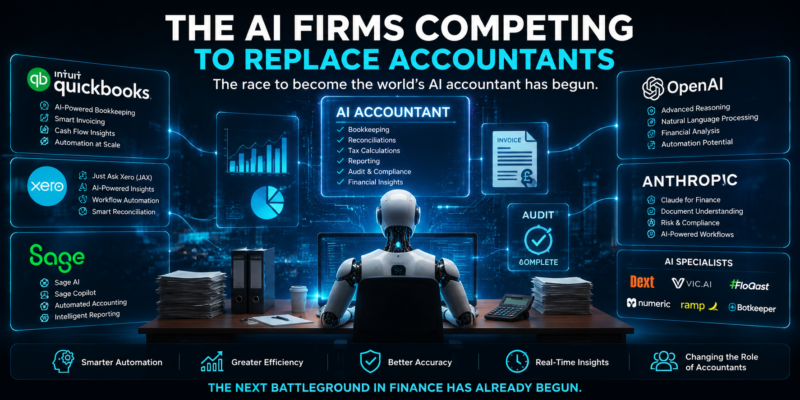
Individually, these announcements appear to be product improvements. Viewed together, they tell a much bigger story. Every company is pushing Artificial Intelligence further into work that has traditionally been carried out by accountants. The question is no longer whether AI will change accounting. It is whether becoming the trusted AI accountant has become the next battleground in financial technology.
The AI race is accelerating
The pace of innovation during 2026 has been remarkable. Intuit continues expanding AI throughout QuickBooks, positioning its platform as an intelligent financial assistant capable of answering business questions, automating bookkeeping tasks and helping small businesses make financial decisions. The company has also expanded its AI strategy through partnerships with OpenAI and Anthropic, signalling that AI sits at the heart of its long term vision rather than being an optional feature. Read more at: https://quickbooks.intuit.com/r/small-business-data/ai-impact-report/
Xero has followed a similar path. The launch of Just Ask Xero (JAX), together with further AI developments and workflow automation, demonstrates a clear ambition to make accounting software increasingly conversational and intelligent. Rather than navigating menus or producing reports manually, businesses are being encouraged to ask questions in natural language and allow AI to retrieve and analyse their financial information. More information is available at: https://www.xero.com/
Sage has also continued expanding Sage AI and Sage Copilot across its accounting products. Again, the objective is not simply faster bookkeeping but creating intelligent finance platforms capable of automating more routine work while supporting accountants and finance teams with analysis, reporting and decision making. Details can be found at: https://www.sage.com/
Alongside these established software providers, specialist AI companies such as Dext, Vic.ai, FloQast, Numeric, Ramp and Botkeeper are all competing in different areas of finance automation. Invoice processing, expense management, accounts payable, reconciliations, month end close and financial reporting are all becoming increasingly AI driven. Each company is solving a different problem, but collectively they are automating many of the tasks that accountants have traditionally charged clients to perform.
PwC’s billion dollar investment
Perhaps the most significant announcement came from PwC.
The firm confirmed that it is investing US$1 billion in Artificial Intelligence as part of a major transformation of its business. This is not a small technology upgrade. It represents one of the largest AI investments made by any professional services firm and demonstrates how seriously the profession views Artificial Intelligence.
One of the most interesting developments is the future of auditing itself. Traditionally, auditors have relied on statistical sampling because reviewing every transaction within an organisation was simply impractical. AI changes that equation completely. Instead of selecting samples, AI has the potential to analyse entire populations of transactions, identify anomalies automatically and highlight risks that might otherwise remain hidden.
If AI can review every invoice, every journal, every payment and every transaction, the nature of auditing fundamentally changes. Rather than spending large amounts of time gathering evidence manually, auditors increasingly move towards reviewing AI findings, investigating exceptions and applying professional judgement where it matters most.
PwC’s announcement can be found here: https://www.pwc.com/gx/en/issues/artificial-intelligence.html
The entry level paradox
PwC’s 2026 AI Jobs Barometer highlighted another fascinating trend.
The report suggests that entry level positions within AI exposed professions are increasingly demanding higher level skills than in previous years. In simple terms, AI is taking over much of the repetitive work that junior professionals historically carried out during the early stages of their careers. Graduates are therefore increasingly expected to arrive with stronger analytical, technical and communication skills because the routine work that previously developed those abilities is gradually disappearing.
That raises an entirely reasonable question.
If one of the world’s largest accountancy firms is investing US$1 billion in AI, if auditing is moving beyond sampling towards analysing every transaction, and if graduate accountants are increasingly expected to perform at a higher level because AI is completing much of the routine work, can we realistically believe that firms will require larger workforces over the long term?
Nobody can answer that question with certainty.
New advisory services may emerge. Demand for financial consulting may increase. Accountants may spend less time preparing information and more time interpreting it. However, history suggests that organisations invest heavily in technology because it increases productivity. Higher productivity has traditionally enabled businesses to produce more output with fewer people, unless demand expands at an even greater rate.
PwC’s AI Jobs Barometer is available here: AI Jobs Barometer | PwC
The client paradox
Perhaps the biggest paradox of all comes from the client’s perspective.
Accountancy firms are understandably embracing AI because it allows them to complete work more efficiently, improve accuracy and offer better services. Yet many of those same firms are relying on software developed by technology companies whose long term ambition is to automate even more accounting work.
That inevitably raises a question many business owners may soon begin asking.
If my accountant is using AI to prepare my accounts, reconcile my bookkeeping, analyse my financial performance and identify anomalies, why can’t I use the same AI myself?
This does not mean accountants become obsolete. Complex tax planning, strategic advice, regulatory compliance, audit judgement and business consultancy all continue to require experienced professionals. However, many routine services that businesses have historically outsourced may become increasingly accessible through AI powered accounting platforms.
In many ways, the profession could gradually shift from producing accounting information to supervising, validating and interpreting work produced by Artificial Intelligence.
The next battleground in finance
Looking at the developments across 2026, one conclusion becomes difficult to ignore.
Intuit is expanding AI.
Xero is expanding AI.
Sage is expanding AI.
Specialist accounting AI companies are expanding AI.
OpenAI continues improving ChatGPT.
Anthropic continues improving Claude.
Every major player appears to be moving towards the same destination.
None of these companies openly state that they are trying to replace accountants. Their stated objective is to improve productivity, reduce administration and help businesses make better financial decisions. Yet every new AI capability automates another piece of work that accountants have traditionally performed.
Perhaps that is the real story unfolding within finance.
The biggest competition may no longer be between the Big Four accountancy firms or even between local accounting practices. Instead, the next battleground could be between the companies racing to build the world’s most trusted AI accountant.
Whether they ultimately succeed remains to be seen. Professional judgement, ethics, regulation and accountability remain central to the accounting profession. However, one thing is becoming increasingly clear. Artificial Intelligence is no longer simply supporting accountants. It is rapidly becoming a competitor for many of the services accountants have historically provided.
The question we should now be asking is not whether AI will replace accountants.
It is whether the race to become the world’s leading AI accountant has already begun.
Founder of AI Tuition Hub
Through practical courses, research and industry analysis, our aim is to help finance professionals and businesses understand not only today’s AI tools, but also the wider strategic changes that are transforming the future of accounting, finance and professional services.
Published: 4th July 2026