For much of the past two years, the conversation around Artificial Intelligence has centred on productivity. Organisations have been eager to discover how AI can automate routine work, improve efficiency, reduce costs, and help employees accomplish more in less time. While these remain important benefits, they no longer represent the full picture of how AI is changing business.
A much bigger transformation is now taking place behind the scenes. Artificial Intelligence is becoming a governance issue. Boards of directors, executive teams, legal departments, compliance professionals, and risk managers are increasingly recognising that AI is influencing how organisations make decisions, manage risk, monitor performance, and demonstrate accountability.

Recent developments surrounding the European Union’s AI Act illustrate this shift. Although some compliance deadlines for high risk AI systems have been delayed to give organisations additional time to prepare, the overall direction remains unchanged. Governments and regulators are continuing to develop frameworks that encourage organisations to deploy AI responsibly, transparently, and with appropriate human oversight. Rather than slowing progress, these developments reinforce the growing importance of AI corporate governance.
AI Has Become a Boardroom Priority
Only a few years ago, Artificial Intelligence was often viewed as an experimental technology led by innovation teams or IT departments. Today it has become a topic that reaches directly into the boardroom.
Directors are increasingly expected to understand where AI is being used across the organisation, how it supports important decisions, what risks it introduces, and how those risks are managed. Investors, regulators, employees, and customers all expect organisations to demonstrate that AI is being deployed responsibly.
This represents a significant change in corporate governance. AI is no longer simply another technology project. It now influences strategic planning, operational performance, financial reporting, compliance monitoring, customer service, workforce management, cybersecurity, and long term business planning. As AI becomes more deeply embedded within organisations, governance structures must evolve alongside it.
AI Supports Better Governance Rather Than Replacing Leadership
One of the biggest misconceptions surrounding Artificial Intelligence is that it replaces human leadership. In reality, the opposite is true.
Modern reasoning models can process enormous quantities of information, identify trends, analyse scenarios, summarise lengthy reports, and highlight emerging risks that might otherwise go unnoticed. AI agents can automate administrative governance tasks, monitor workflows continuously, coordinate reporting activities, and alert leaders when predefined thresholds are exceeded.
These capabilities make leadership more informed, but they do not replace leadership itself.
Directors remain responsible for corporate strategy. Executives continue making business decisions. Legal professionals still interpret legislation, while compliance officers remain accountable for ensuring regulatory obligations are met. AI enhances decision making by providing better information and stronger analytical support, but responsibility always remains with people.
Moving From Periodic Reviews to Continuous Governance
Traditional corporate governance has relied heavily on periodic reporting. Financial performance might be reviewed monthly, operational performance quarterly, and strategic objectives annually. Internal audits often take place according to fixed schedules, while risk assessments may only be updated at regular intervals.
Artificial Intelligence is changing this approach.
Many organisations are now introducing continuous governance, where intelligent systems monitor key activities throughout the working day. Financial transactions, operational performance, compliance obligations, cybersecurity events, workforce metrics, customer feedback, and organisational risks can all be monitored in near real time.
Instead of waiting for the next reporting cycle, AI can identify unusual patterns much earlier, allowing leadership teams to respond before small issues become significant problems. This proactive approach strengthens organisational resilience while improving oversight across the enterprise.
AI Is Transforming Every Aspect of Corporate Governance
Corporate governance extends far beyond board meetings and annual reports. Artificial Intelligence is now supporting almost every major governance function within modern organisations.
Strategic planning is becoming more evidence based through predictive analytics and scenario modelling. Risk management is benefiting from continuous monitoring and earlier identification of emerging threats. Compliance teams are using AI to monitor regulatory changes, analyse documentation, and strengthen internal controls. Internal auditors are using intelligent systems to review larger datasets and identify anomalies more efficiently than traditional sampling techniques.
AI is also improving board reporting by producing clearer summaries, integrating information from multiple departments, and presenting complex governance data through dashboards and visual analytics. Performance monitoring is becoming more dynamic, while stakeholder engagement is supported through better analysis of customer feedback, employee sentiment, investor expectations, and wider market developments.
Rather than treating these governance activities as separate disciplines, AI helps connect them into a more integrated view of organisational performance.
Responsible AI Is Becoming a Competitive Advantage
As Artificial Intelligence becomes more widely adopted, organisations are beginning to recognise that responsible AI governance is more than simply a compliance exercise.
Customers increasingly expect organisations to protect personal information and use AI fairly. Employees want transparency about how AI influences workplace decisions. Investors are paying greater attention to governance standards alongside financial performance. Regulators are looking for evidence that organisations understand the technologies they deploy and maintain appropriate oversight.
Trust has become a strategic asset.
Organisations that combine innovation with transparency, accountability, fairness, and responsible governance are likely to strengthen their reputation while reducing regulatory and operational risk. AI corporate governance is therefore becoming a source of competitive advantage rather than simply an administrative requirement.
Two AI Tuition Hub Courses Have Been Completely Updated
Because this area has evolved so rapidly over the past year, we have completed major updates to two of our professional development courses.
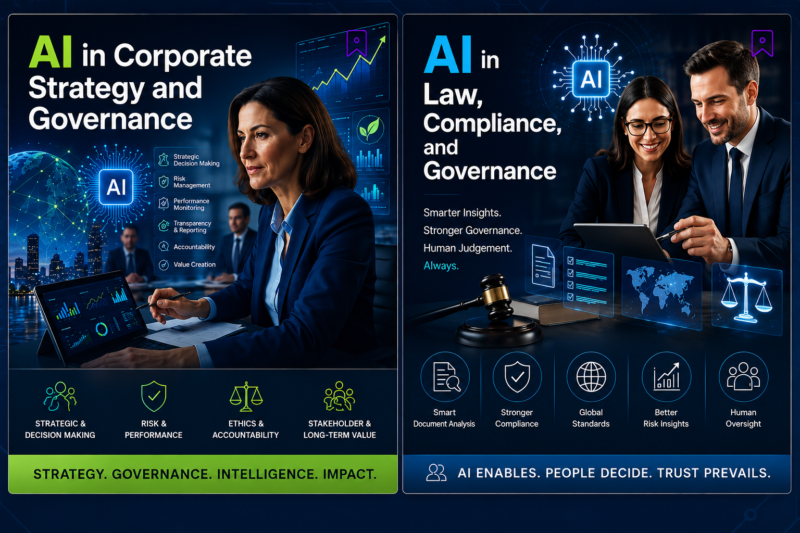
Our AI in Law, Compliance, and Governance course has been extensively expanded to reflect how Artificial Intelligence is transforming legal and governance functions. The updated course explores AI assisted contract analysis, regulatory interpretation, compliance monitoring, audit and reporting, fraud detection, investigations, dispute resolution, cross border governance, privacy, ethical oversight, and the future direction of AI governance. Throughout the course the emphasis remains practical, globally relevant, and focused on helping professionals understand how AI supports responsible governance without concentrating on any single legal jurisdiction.
Our AI in Corporate Strategy and Governance course has also undergone a comprehensive update. It now examines how AI is influencing board level decision making, enterprise strategy, organisational risk management, transparency, accountability, workforce governance, stakeholder engagement, organisational culture, performance monitoring, corporate reporting, governance maturity, and long term value creation. The course also introduces learners to reasoning models, AI agents, predictive analytics, and intelligent decision support, explaining how these technologies strengthen governance while maintaining meaningful human oversight.
Together, these two courses provide a comprehensive understanding of how AI is reshaping governance across both operational and strategic levels of modern organisations.
The Future of AI Corporate Governance
The conversation surrounding Artificial Intelligence is continuing to evolve.
Improving productivity remains important. Automating repetitive work remains valuable. However, the organisations that achieve the greatest long term success will not necessarily be those that adopt AI the fastest.
They will be the organisations that govern AI effectively.
Successful organisations will combine intelligent systems with experienced leadership. They will establish clear governance frameworks, maintain strong ethical standards, invest in workforce education, strengthen transparency, and ensure accountability always remains with people.
Artificial Intelligence is becoming one of the most influential technologies organisations have ever adopted. Like every major business innovation, its long term success depends not only on what the technology can do, but on how responsibly it is governed.
Strong AI corporate governance is therefore becoming a defining characteristic of modern business leadership.
Explore the Updated Courses
Both AI in Law, Compliance, and Governance and AI in Corporate Strategy and Governance have now been extensively updated on AI Tuition Hub, reflecting the latest developments in AI governance, board oversight, corporate strategy, compliance, leadership, and responsible AI adoption.
Whether you work in law, finance, governance, compliance, risk management, or executive leadership, these courses provide practical, globally relevant guidance on how Artificial Intelligence is reshaping modern organisations.
As always, new members can use our exclusive FOUNDER50 discount code to receive 50% off their first month, giving full access to over 110 AI courses for under £10. It’s an affordable way to stay ahead of one of the most significant changes currently transforming business around the world.