Why AI Education Cannot Stand Still became obvious almost immediately after we launched AI Tuition Hub.
Many AI courses, YouTube videos, blogs, and training programmes were already struggling to keep pace with the speed of artificial intelligence developments.
Some provided excellent introductions to AI. Others explained the basics of prompting or covered the latest tools available at the time. However, many were highly generalised, lacked industry specific relevance, and in some cases were becoming outdated within a matter of months. This created a problem.
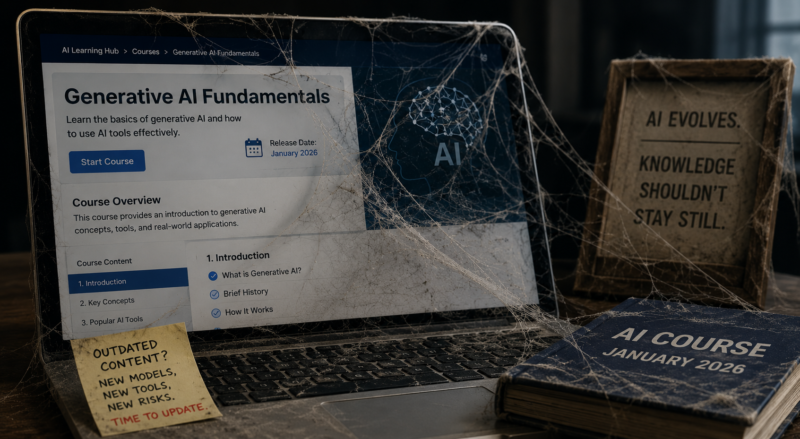
Artificial intelligence is evolving far more rapidly than many previous technology cycles. People need AI education that reflects what is happening now, not what was happening six months or a year ago.
That challenge became one of the driving forces behind AI Tuition Hub.
AI Is Moving Faster Than Traditional Technology
Technology has always evolved.
Most of us have adapted to new versions of operating systems, software platforms, smartphones, cloud services, and online tools throughout our working lives.
When a new version of Windows was released, businesses usually had time to prepare, update procedures, and adjust training materials. The underlying concepts remained familiar, and training content could often remain relevant for years.
Artificial intelligence is different.
New models appear regularly. New capabilities emerge. New risks are identified. New workplace applications are discovered. Governments and regulators continue developing new approaches to governance and oversight.
The pace of change means AI training can become outdated much faster than traditional technology training.
What was considered best practice a year ago may no longer represent the reality of how AI is being used today.
The Need For Industry Specific AI Training
Another issue we identified early was the lack of industry specific AI education.
Many artificial intelligence courses explain what AI is, but far fewer explain what it means for a particular profession or industry.
The questions facing a finance professional are very different from those facing a teacher, administrator, marketer, compliance officer, healthcare worker, or business owner.
People are not simply asking:
“What is AI?”
They are asking:
“How will AI affect my role?”
“What AI skills do I need?”
“How is AI changing my industry?”
“What risks should I be aware of?”
These questions require practical, industry focused answers rather than generic explanations.
What Has Changed In Just Three Months?
One of the easiest ways to understand the speed of AI developments is to look back only a few months.
Topics such as agentic workflows, context engineering, AI governance, workflow automation, AI verification, digital trust, and synthetic media have all become increasingly important.
Many organisations have moved beyond experimentation and are now integrating AI directly into workplace processes.
Employees are increasingly expected to understand how to use AI tools effectively, responsibly, and securely.
At the same time, businesses are facing new questions around oversight, accountability, compliance, and governance.
These developments demonstrate how quickly the AI landscape continues to evolve.
Why Static AI Courses Are Becoming A Problem
Traditional online courses are often designed to remain unchanged for long periods.
That model works well in many subjects. It does not work particularly well for artificial intelligence.
Many AI courses available online were created during the first wave of public interest in generative AI. While much of the foundational content remains useful, some courses have not evolved alongside the technology itself.
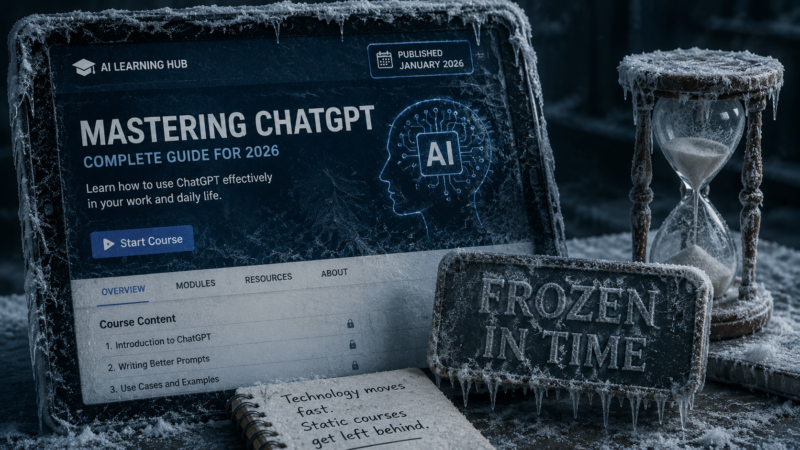
As a result, learners may miss important developments, emerging workplace practices, new governance considerations, and rapidly changing AI capabilities.
This is not necessarily because the content is wrong.
It is because AI continues to move forward.
Effective AI education requires continuous review and updating.
Why We Continuously Review Our AI Courses
From the beginning, we recognised that AI Tuition Hub could not operate as a traditional training platform.
Publishing courses and leaving them unchanged for years was never a realistic option.
Instead, we built our platform around continuous improvement.
Our AI courses are regularly reviewed and updated to reflect significant developments across artificial intelligence, workplace adoption, governance, regulation, and emerging best practices.
In many cases, lessons are expanded or rewritten entirely as new developments emerge.
This approach requires ongoing effort, but we believe it is essential if AI training is to remain relevant.
Monitoring More Than Just New AI Tools
Keeping AI education current is not simply about following the latest software releases.
Some of the most important developments involve the wider impact AI is having on jobs, workplaces, governance, and society.
For example, we recently examined the PwC 2026 AI jobs report, which generated significant discussion around the future of work, workforce transformation, and the potential impact of artificial intelligence on employment across multiple industries.
We have also explored the growing concern around employees using AI tools without their employer’s knowledge – Link. While these tools can improve productivity, they also raise important questions about data security, governance, compliance, accountability, and workplace policy.
These developments demonstrate that AI is no longer simply a technology story.
It is increasingly a business, workforce, governance, leadership, and skills story.
Understanding these wider developments is just as important as understanding the technology itself.
Separating Meaningful AI Developments From Noise
Every day brings new AI headlines, product launches, predictions, studies, and opinions.
Not all of them matter.
One of the challenges facing learners is distinguishing meaningful developments from short term noise.
At AI Tuition Hub, we continuously monitor AI news, workplace trends, governance developments, regulatory changes, research findings, and industry developments.
This helps us identify the changes that are likely to have a genuine impact on careers, businesses, and professional development.
Our goal is to help learners focus on what matters rather than becoming overwhelmed by the volume of information available.
Looking Ahead
Artificial intelligence will continue to evolve, bringing new opportunities, challenges, workplace changes, and governance considerations. The challenge is no longer finding information about AI. The challenge is finding information that remains relevant.
At AI Tuition Hub, we continuously review our courses to reflect significant developments across artificial intelligence, industry adoption, workplace skills, regulation, and governance. Many of these updates are influenced not only by industry news and research, but also by feedback from the shop floor. Conversations with professionals, business owners, employees, and learners often highlight emerging trends and practical challenges long before they appear in formal reports.
If you visit our homepage, you can use the course search facility to browse our growing library of AI courses, which are displayed in release order. This makes it easy to find the latest additions and newly published content as the AI landscape continues to evolve.
We are also open to suggestions for future courses and topics. Artificial intelligence is affecting almost every profession, and we welcome ideas that help us create practical, industry focused AI training.
For new members, our FOUNDER50 offer remains available, providing 50% off the first month of membership and full access to our expanding library of AI education and training resources.
Our goal is simple: to provide AI education that evolves alongside the technology itself, helping learners stay informed, adaptable, and prepared for the changes ahead.