Governments around the world are facing growing pressure. Citizens increasingly expect public services to be faster, simpler, more responsive, and easier to access. At the same time, governments are dealing with ageing populations, rising healthcare costs, staffing shortages, increasing demand for support, and growing financial pressure.
Against this backdrop, Artificial Intelligence is moving rapidly from theory to reality.
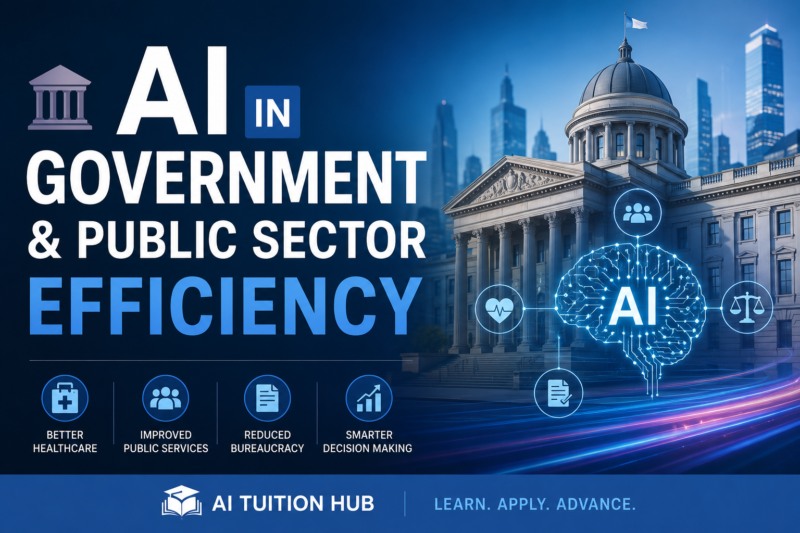
At AI Tuition Hub, we have recently created a new course, 🏛️ AI in Government & Public Sector Efficiency, exploring how governments around the world are increasingly using AI to improve public services, reduce bureaucracy, strengthen decision making, and prepare for future challenges.
The subject is no longer simply about technology. Increasingly, it is about how governments adapt to changing expectations while balancing efficiency, fairness, privacy, and public trust. Whether people feel excited or cautious about AI, one thing is becoming increasingly clear: governments are paying attention.
Why AI in Government & Public Sector Efficiency Matters
Public services across the world are under strain. Many governments face a difficult balancing act. Citizens want better services, yet budgets remain constrained. Healthcare systems are under pressure, housing affordability remains a challenge in many countries, and public expectations have shifted dramatically in the digital age.
People increasingly compare government services with private sector experiences. If banks, travel companies, and online retailers can provide instant updates and smooth digital systems, citizens naturally begin asking why government services can still feel slow, fragmented, or overly bureaucratic.
This is one reason governments are increasingly exploring AI. The goal is not necessarily to replace public servants or automate every process. Instead, many governments see AI as a practical tool that may help improve efficiency, reduce repetitive administration, improve communication, and support staff managing growing workloads.
However, governments must move carefully. Public services are not online shopping. Decisions involving healthcare, taxation, education, housing, and social support affect people’s lives directly. The stakes are much higher.
The Lasting Lessons Learned from Covid 19
For many governments, Covid 19 accelerated digital transformation more than any other event in recent memory.
The pandemic exposed both strengths and weaknesses in public systems. Healthcare services came under extraordinary pressure. Governments faced enormous challenges involving healthcare demand, staffing shortages, emergency planning, vaccine distribution, and rapidly changing public communication.
In many places, weaknesses became more visible. Hospitals faced capacity challenges. Public services struggled with demand. Citizens often expected faster updates and clearer communication at a time of uncertainty.
At the same time, Covid highlighted the value of digital systems. Online healthcare appointments, digital communication, forecasting tools, and better coordination suddenly became essential rather than optional.
The pandemic forced many governments to rethink preparedness. Could better forecasting have improved readiness? Could data have supported quicker decisions? Could public systems become more connected during periods of crisis?
These questions pushed AI higher up the agenda. No technology can predict every crisis perfectly, but governments increasingly recognise the importance of becoming more adaptable and resilient.
Reducing Bureaucracy Without Losing Accountability
Few issues frustrate citizens more than bureaucracy. Long forms, repeated requests for information, confusing systems, and slow approvals remain common complaints around the world.
Government administration often involves enormous amounts of repetitive work. Staff process applications, review documents, organise records, and respond to enquiries every day. Much of this work is essential, but some of it can also be time consuming and inefficient.
This creates an obvious question: could technology help governments reduce repetitive administration?
Increasingly, many believe the answer may be yes.
AI may help governments organise information more effectively, support document handling, improve communication, and streamline repetitive tasks. For citizens, this could eventually mean faster services and simpler systems. For workers, it may reduce time spent on repetitive administration and allow greater focus on higher value work requiring judgement and expertise.
However, governments cannot simply prioritise speed above all else. Public administration requires fairness, accountability, and legal consistency. Efficiency matters, but public trust matters just as much.
Healthcare and Public Services Under Pressure
Healthcare remains one of the biggest challenges facing governments globally. Ageing populations, workforce shortages, rising demand, and increasing costs are creating difficult questions for policymakers.
This is one area where AI is increasingly attracting attention.
Around the world, governments are exploring whether technology may help improve planning, scheduling, waiting list management, and healthcare administration. Some systems are already exploring ways technology might support doctors by helping identify patterns more quickly or improve hospital efficiency.
Importantly, however, technology is generally viewed as support rather than replacement.
Healthcare remains deeply personal. Citizens still want reassurance that doctors, nurses, carers, and specialists remain central to care. AI may help improve efficiency, but empathy, communication, and human judgement remain essential.
The same principle applies to wider public services. Governments increasingly ask how citizen experiences can become faster, simpler, and easier to access while still remaining fair and inclusive.
Privacy, Ethics, and Public Trust
Whenever governments begin using more technology, concerns naturally follow.
Governments often hold enormous amounts of sensitive information, including healthcare records, tax details, housing information, education history, and personal circumstances. Citizens understandably expect this information to be protected.
Questions around privacy are becoming increasingly important. How much information should governments collect? How securely should it be stored? Who should have access?
Trust may become one of the defining issues of government AI.
Citizens may welcome faster services, but confidence can weaken quickly if systems appear unfair, intrusive, or difficult to challenge. This becomes especially important when technology intersects with sensitive areas such as healthcare, taxation, welfare, or immigration.
Governments therefore face a difficult balancing act between innovation and accountability.
Technology may improve efficiency, but citizens still expect fairness, transparency, and human oversight.
Will Government Jobs Change?
One of the biggest questions surrounding AI involves jobs.
Whenever technology advances, concerns about employment naturally follow. Some people worry AI may replace public workers. Others believe it will simply help employees become more productive.
The reality is likely to be more complex.
Certain repetitive tasks may increasingly become automated, particularly administrative workloads and routine processes. However, many government roles involve communication, leadership, empathy, and judgement, qualities that remain difficult to automate.
Healthcare workers, teachers, social workers, emergency responders, and many frontline professionals are unlikely to disappear.
Instead, technology may increasingly become part of everyday public sector work. Future workers may collaborate with AI tools while focusing more heavily on human skills and decision making.
At the same time, new opportunities may emerge in cybersecurity, digital ethics, AI governance, and public sector innovation.
Why This Conversation Matters
Government AI is not simply a technology discussion. Increasingly, it affects how societies function.
How public money is managed. How healthcare is delivered. How citizens interact with public services. How governments prepare for crises. How efficiently public institutions respond to growing pressure.
The choices governments make over the coming years may shape the speed, quality, and accessibility of public services for decades.
Some governments may modernise successfully. Others may struggle with ageing systems, staffing shortages, and increasing public frustration.
What seems increasingly clear is that standing still may not be an option.
Looking More Deeply at the Future of Government AI
At AI Tuition Hub, our course 🏛️ AI in Government & Public Sector Efficiency explores these issues in far greater depth.
The course examines why governments are increasingly turning to AI, the lessons learned from Covid 19, how public services may evolve, the opportunities for improving efficiency, and the ethical questions governments will increasingly face.
Most importantly, it explores the balance governments must strike between innovation, accountability, and public trust in an increasingly digital world.
AI may not solve every challenge facing governments, but it is increasingly becoming part of the conversation about how public services evolve in the years ahead.