(As of May 2026)
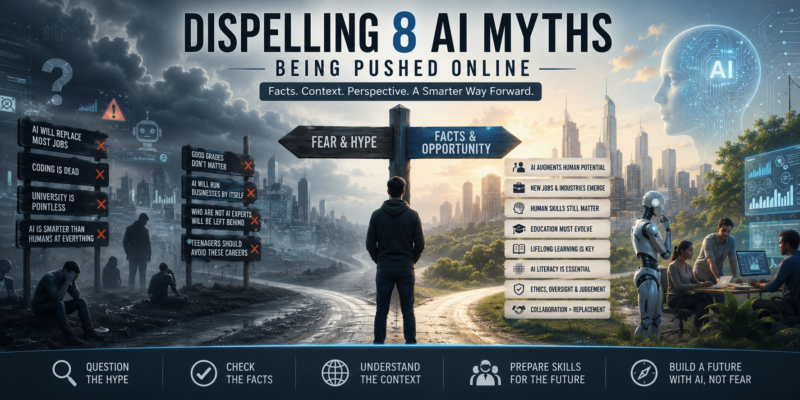
Dispelling 8 AI Myths Being Pushed Online is perhaps ambitious, but as of May 2026 some of the boldest claims circulating about Artificial Intelligence deserve closer scrutiny.
Spend enough time scrolling through social media and you may come away believing that university is becoming pointless, coding is dead, teenagers should avoid entire professions, and AI will soon replace most white collar workers.
Some concerns are valid. AI is already reshaping parts of the workplace. However, many of the stronger claims deserve closer scrutiny.
As of May 2026, here are eight AI myths being pushed online that may require a more balanced discussion.
Myth 1: “AI Will Replace Most Jobs Within A Few Years”
This is perhaps the biggest claim currently circulating online.
There is no doubt that AI is beginning to automate some tasks, especially repetitive, process driven and administrative work. However, replacing an entire profession is very different from automating parts of a role.
What we are increasingly seeing is task disruption rather than complete job elimination.
For example, AI can already assist with document drafting, customer queries, data analysis, coding, reporting and administration. In sectors such as finance, accountancy, legal services and technology, some firms are exploring how fewer people may be needed for routine tasks.
At the same time, organisations still require human oversight, decision making, client relationships, accountability and quality control.
The reality may be more about jobs changing than disappearing completely.
Myth 2: “Teenagers Should Avoid Entire Career Paths”
A growing number of online commentators are telling parents that teenagers should completely avoid certain careers because AI will make them obsolete.
This deserves caution.
Nobody can confidently predict the labour market of the 2030s. Careers rarely disappear overnight. More often, they evolve.
That said, there are genuine reasons to think carefully about highly repetitive work. Some entry level white collar roles may face pressure if organisations can automate large parts of routine tasks.
In parts of financial services, there are already discussions in some regions about fewer trainee positions being advertised, particularly where AI can assist with reporting, administration, onboarding or compliance tasks. Accountancy is another sector where bookkeeping, reconciliations, invoice processing and basic analysis are becoming increasingly automated.
Rather than abandoning professions completely, a more balanced approach may be helping young people build adaptability, communication skills, digital confidence and AI literacy.
Myth 3: “Coding Is Dead”
The phrase “learning to code is pointless” is becoming increasingly common online.
As of May 2026, AI can certainly generate impressive code, identify bugs and accelerate software development. This has understandably created concern about entry level programming roles.
However, coding itself is unlikely to disappear entirely.
Technology still requires human judgement, architecture, security, testing, problem solving and oversight. Many developers are increasingly using AI as a tool rather than seeing it as a replacement.
The future may involve working with AI rather than competing against it.
Myth 4: “University Degrees Are Becoming Useless”
Another growing claim is that university education no longer matters because AI can simply provide answers.
This feels overly simplistic.
Certain qualifications may need to evolve, especially if they rely heavily on memorisation or repetitive knowledge work. However, professions involving expertise, ethics, regulation and judgement still matter.
Healthcare, engineering, finance, law, teaching and many specialist fields still require structured learning and accountability.
The bigger question may not be whether degrees matter, but how education adapts to an AI influenced world.
Myth 5: “AI Is Smarter Than Humans At Everything”
AI can certainly appear impressive.
However, people sometimes forget that AI systems still make mistakes, generate false information and occasionally present incorrect answers with confidence.
Historical data itself may already contain inaccuracies, outdated assumptions, bias or poor quality information. AI can sometimes amplify these weaknesses.
As of May 2026, AI still performs best when humans remain involved to question, check and validate important decisions.
This is particularly important in regulated industries and higher risk situations.
Myth 6: “Good Grades No Longer Matter”
Some online discussions now suggest academic achievement is becoming irrelevant because AI can simply do the thinking for us.
This deserves scrutiny.
Strong grades still demonstrate effort, discipline, learning and commitment. However, employers may increasingly value additional strengths such as problem solving, communication, judgement, adaptability and digital confidence.
The future workplace may reward a combination of traditional knowledge and practical AI literacy.
Myth 7: “AI Will Run Businesses By Itself”
There are increasingly bold claims that businesses will soon operate with minimal human involvement.
As of May 2026, this appears highly unlikely across many industries.
AI can certainly improve efficiency, automate repetitive workflows and reduce manual effort. However, businesses still depend on leadership, accountability, trust, relationships and human judgement.
In regulated sectors especially, decisions often require explanation, oversight and responsibility that cannot simply be handed over to software.
Efficiency gains do not necessarily mean organisations stop needing people.
Myth 8: “If You Are Not An AI Expert Immediately, You Will Be Left Behind”
Fear based messaging about AI is becoming increasingly common online.
The reality is that most people probably do not need to become AI specialists overnight.
What may matter more is developing basic AI literacy. Understanding what AI can and cannot do, recognising risks, checking outputs, protecting personal data and using tools responsibly may be more important than chasing every new development.
Learning steadily may be more valuable than panic.
Final Thoughts
As of May 2026, AI is undoubtedly changing education, workplaces and parts of the economy. Some concerns being discussed online are absolutely valid, especially around entry level work, repetitive tasks and changing skill requirements.
At the same time, history shows that periods of technological disruption often create fear, hype and exaggerated predictions.
The challenge may not simply be understanding AI itself, but learning to separate realistic concerns from sensational claims.
The future is unlikely to be as simple as “AI changes nothing” or “AI replaces everything.”
The reality probably sits somewhere in between.
For those wanting to understand how AI may affect careers, skills and future job opportunities in more detail, AI Tuition Hub offers a growing range of practical AI courses covering workplace change, emerging technologies, automation, digital skills and the future of work across multiple industries. You can explore the full course library here: Full course library.