Artificial intelligence is rapidly changing the way businesses operate. One of the biggest changes is that AI efficiency is reducing operational costs and increasing pressure on businesses to lower fees.
As more companies adopt AI powered workflows, business competition is increasingly being shaped by speed, scalability, and cost efficiency rather than simply staffing levels or traditional working methods.
In many industries, customers are also becoming more aware that artificial intelligence can complete certain tasks faster and at lower cost. As a result, businesses may face growing pressure to justify pricing structures that were originally built around slower, manual processes.
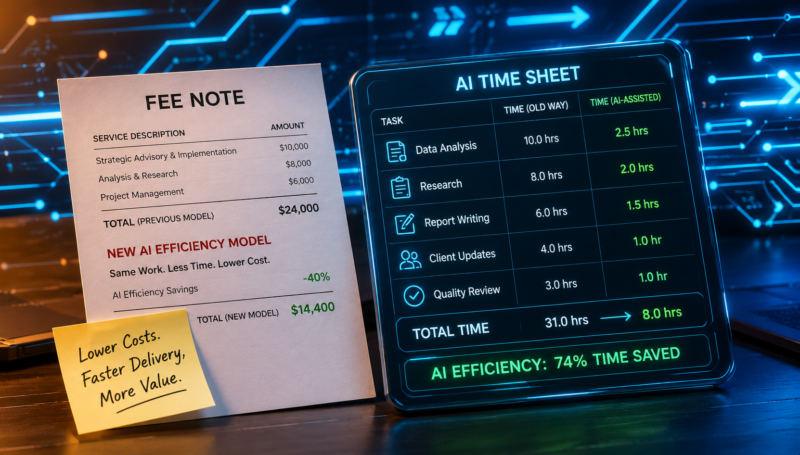
These changes are not only improving productivity but are also beginning to reshape customer expectations around pricing, turnaround times, and overall business value.
This shift is beginning to reshape pricing expectations across many industries.
AI Efficiency Is Reducing Operational Costs
One of the biggest advantages of artificial intelligence is improved efficiency.
AI tools can assist with customer support, administrative work, reporting, document handling, scheduling, research, drafting content, and data organisation.
Tasks that previously took hours can now often be completed much faster through AI assisted workflows.
For businesses, AI efficiency reduces operational costs and improves productivity.
Initially, companies using artificial intelligence may gain a strong competitive advantage because they can complete work more quickly while using fewer resources.
However, this advantage becomes smaller once competitors begin adopting similar AI tools.
AI Competition Is Increasing Pricing Pressure
As AI adoption spreads, businesses are increasingly competing against companies using similar AI driven efficiencies.
This changes the economics of business competition.
Faster service becomes expected.
Lower costs become expected.
Businesses that fail to modernise may struggle to compete against firms using artificial intelligence to improve efficiency and reduce costs.
In highly competitive industries, AI efficiency is now becoming part of the business model itself rather than simply an optional technology upgrade.
Customers Are Beginning to Expect Lower Fees
One of the most important developments is changing customer expectations.
Once customers know artificial intelligence is being used within a business, many begin questioning why prices and fees remain unchanged.
From the customer perspective, the logic is straightforward.
If AI efficiency reduces the amount of labour and time needed to complete work, customers often expect some of those savings to be reflected in lower fees.
This creates additional pressure on businesses.
While companies may initially improve profitability through AI efficiency, competitive markets often force some of those savings back toward customers through lower pricing or increased service levels.
Recent reporting has already highlighted signs of this shift beginning in real markets. Some large corporate clients are reportedly starting to challenge traditional consulting and project pricing where artificial intelligence significantly reduces the amount of labour required. As AI efficiency improves, customers are increasingly expecting faster delivery and lower fees rather than historic pricing models built around manual work.
AI Efficiency Could Reduce Profit Margins
Artificial intelligence may improve efficiency, but it may not permanently increase profits for every business.
Once AI tools become widely available, efficiency improvements can spread rapidly across entire industries.
As more businesses adopt similar artificial intelligence systems, the competitive advantage begins shrinking.
Companies then compete more aggressively on pricing, responsiveness, and turnaround times.
This can eventually compress profit margins even while productivity improves.
The same pattern has appeared throughout economic history whenever major efficiency technologies became widely adopted.
Professional Services May Face Growing Fee Pressure
AI efficiency and lower fees may become especially important in professional and office based industries.
Examples include:
- Financial services
- Consulting
- Administration
- Customer support
- Marketing
- Research services
- Compliance support
- Business administration
Many of these sectors are already using artificial intelligence to reduce the time required for routine work.
As customers become more aware of AI assisted workflows, businesses may need to explain more clearly where human expertise and oversight continue to provide value beyond automation alone.
Final Thoughts
Artificial intelligence is not only changing how work is completed.
AI efficiency is changing business competition, operational costs, pricing pressure, and customer expectations around lower fees.
Businesses are becoming faster and more efficient, but customers are also becoming more aware of how AI changes the economics of service delivery.
The long term impact of artificial intelligence may therefore be less about sudden job replacement and more about growing pressure on pricing, competitiveness, and lower fees across many industries.
At AI Tuition Hub, a growing number of courses also explore how artificial intelligence is reshaping white collar work, business operations, workplace efficiency, and the future of professional roles as AI adoption continues accelerating across the global economy.