Artificial intelligence is changing cybersecurity faster than many organisations expected. Security teams are now dealing with environments that generate enormous amounts of behavioural data every minute, from logins and endpoint activity to cloud access, emails and application interactions.
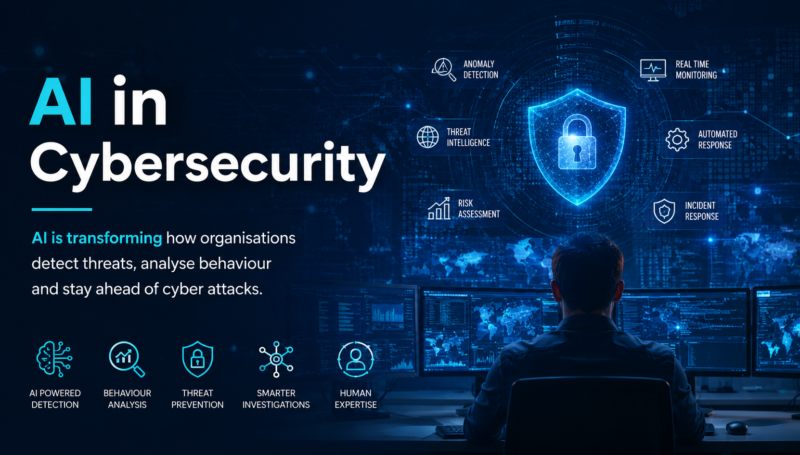
The challenge is no longer simply collecting information. The challenge is understanding what actually matters.
Traditional cybersecurity methods still play an important role, but many organisations are now recognising that static rules and signature based detection alone are no longer enough for modern environments. This is why AI in cybersecurity is becoming such a major area of focus.
AI helps security teams detect patterns, identify behavioural changes and organise large volumes of activity into something analysts can realistically interpret. It does not replace cybersecurity professionals. Instead, it expands visibility and helps analysts focus attention more effectively.
The future of cybersecurity is becoming increasingly behavioural, contextual and AI assisted.
Why Cybersecurity Is Becoming More Behaviour Based
For many years, cybersecurity focused heavily on known indicators such as malicious files, suspicious IP addresses or recognised exploit signatures. Those approaches still matter, but digital environments have become far more dynamic.
Modern organisations now operate across:
• Cloud platforms
• Remote workforces
• SaaS applications
• Mobile devices
• Identity driven access systems
• Distributed endpoints
Every interaction creates telemetry and behavioural signals. The scale of this information can quickly overwhelm traditional manual review methods.
This is one reason why behaviour based cybersecurity is becoming increasingly important.
Instead of looking only for known threats, many modern systems now focus on identifying unusual behaviour, irregular patterns and structural changes across environments.
How AI Is Changing Cybersecurity Operations
AI in cybersecurity is increasingly being used to support areas such as:
• Behavioural anomaly detection
• Identity monitoring
• Endpoint analysis
• Email security
• Threat correlation
• Log summarisation
• Investigation support
Rather than manually reviewing thousands of disconnected alerts, analysts can increasingly review grouped behavioural summaries and prioritised investigative signals.
This changes how cybersecurity professionals work.
The role becomes less about manually searching through endless logs and more about interpreting behavioural patterns and contextual relationships.
AI helps structure complexity. Human analysts determine meaning.
The Rise of Behavioural Security Monitoring
One of the biggest shifts taking place across cybersecurity is the move towards behavioural monitoring.
Modern threats increasingly attempt to blend into normal operational activity. AI generated phishing campaigns, credential theft and identity manipulation often avoid obvious signatures.
This means security teams increasingly monitor for things such as:
• Unusual login timing
• Unexpected access pathways
• Irregular endpoint behaviour
• Sudden communication changes
• Abnormal privilege usage
• Multi step behavioural sequences
AI systems can model what typical behaviour looks like inside an organisation and highlight structural deviation when behaviour changes.
The anomaly itself does not automatically indicate malicious intent. Human analysts still evaluate organisational context, operational timing and business relevance before conclusions are reached.
Human Analysts Remain Central
There is growing discussion around automation in cybersecurity, but most organisations still rely heavily on human judgement.
AI can identify behavioural irregularities, but it cannot fully understand:
• Organisational priorities
• Operational nuance
• Business context
• Human behaviour
• Commercial impact
This is why many organisations continue adopting “human in the loop” security models where AI supports investigations while analysts remain responsible for interpretation and decision making.
Cybersecurity is becoming increasingly interpretive rather than purely reactive.
AI Generated Threats Are Changing the Landscape
The growth of AI generated cyber threats is also accelerating changes within defensive strategy.
Security teams are increasingly monitoring risks associated with:
• AI generated phishing emails
• Deepfake impersonation attempts
• Identity manipulation
• Automated reconnaissance activity
• Adaptive malware behaviour
Many of these threats are designed to appear legitimate. Warning signs are often behavioural rather than signature based.
This is one reason why AI assisted behavioural analysis is becoming more important across modern cybersecurity operations.
Governments, financial institutions and large technology firms are also increasing focus on AI related cyber risks as the technology continues evolving.
The Future Cybersecurity Analyst
The role of the cybersecurity analyst is evolving alongside these changes.
Future analysts will likely spend less time manually reviewing isolated alerts and more time:
• Interpreting behavioural patterns
• Linking activity across systems
• Building investigative context
• Managing ambiguity
• Evaluating risk
• Explaining findings clearly
Pattern recognition and contextual reasoning are becoming increasingly valuable professional skills.
Cybersecurity is gradually becoming a discipline centred around behavioural understanding supported by AI assisted visibility.
Why AI in Cybersecurity Will Continue Expanding
Digital environments continue to grow in complexity. Cloud adoption, remote access, identity based security and AI integrated business systems all contribute to increasing volumes of behavioural data.
As environments expand, organisations increasingly need systems capable of:
• Identifying structural change
• Detecting subtle behavioural deviation
• Correlating activity across domains
• Prioritising investigative focus
• Supporting faster situational awareness
This is why AI in cybersecurity will likely continue expanding across both defensive operations and investigative workflows.
However, despite advances in automation, cybersecurity remains fundamentally human led.
AI enhances visibility and analytical reach. Human professionals provide interpretation, accountability and judgement.
AI Tuition Hub Cybersecurity Course
AI Tuition Hub includes the course:
🛡️ AI for Cybersecurity & Information Security Analysts
The course explores:
• AI in cybersecurity
• Behaviour based security
• AI assisted investigations
• Anomaly detection
• Endpoint and identity monitoring
• Human in the loop defence models
• AI driven security workflows
Cybersecurity and AI continue to evolve rapidly, with new risks, defensive tools and behavioural monitoring approaches appearing constantly. AI Tuition Hub reviews and updates its courses every week to help keep content practical, current and aligned with real world developments.
Access this course and 100+ others for £19.95 per month at AI Tuition Hub.
Further reading :Reuters report on AI driven cyber threats and regulatory response.