Generative AI is evolving faster than most people realise. The evolution of generative AI is no longer about simple text tools. It now includes multi modal systems, workflow automation, and deep integration into everyday platforms.
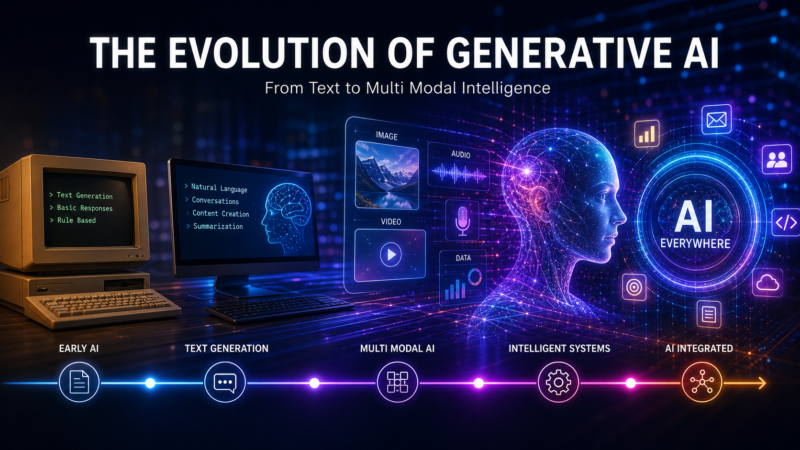
Just a short time ago, most people associated generative AI with writing emails or answering questions. That phase built awareness, but it was only the starting point.
Today, generative AI is moving beyond tools and becoming part of how work, communication, and decision making actually happens.
It Is No Longer Just About Text
The early wave of generative AI focused almost entirely on text. Systems could write articles, summarise documents, and generate responses. That alone felt transformative.
But the landscape has already moved on.
Modern generative AI can now work across multiple formats at the same time. It can generate images, interpret data, assist with coding, produce structured reports, and even support audio and video creation.
More importantly, these capabilities are no longer separate. They are being combined into single systems that can move between formats seamlessly.
This is where the real shift begins.
From Tools to Workflows
One of the biggest misunderstandings is that people still treat generative AI as something you open, use, and close.
That is not where things are heading.
Generative AI is now being embedded into the tools people already rely on. It sits inside document editors, email platforms, data dashboards, and business systems.
Instead of asking AI to perform one task, users are starting to rely on it across entire workflows.
For example, a single process might now include:
- Drafting content
- Analysing data
- Creating visuals
- Structuring output
All supported by AI within one environment.
This shift from task based use to workflow support is what turns generative AI into infrastructure rather than a feature.
The Rise of Multi Modal AI
A major driver behind this change is multi modal AI.
This simply means systems that can understand and generate different types of content together.
You can now:
- Upload an image and ask for analysis
- Provide data and receive a written explanation
- Combine text, visuals, and structure in one request
This reflects how humans naturally process information. We do not think in isolated formats. We combine context, visuals, language, and structure constantly.
Multi modal AI brings systems closer to that reality.
However, it also increases responsibility. When systems handle multiple forms of input, accuracy and verification become even more important.
Generative AI Is Becoming Infrastructure
Perhaps the most important shift is that generative AI is no longer just a product category.
It is becoming infrastructure.
This means:
- It operates behind the scenes
- It supports everyday tasks
- It is integrated into existing platforms
Often without users actively thinking about it
This is similar to how the internet evolved. At first, it was something you used directly. Over time, it became something everything else depends on.
Generative AI is now following the same path.
The Move Toward Smarter Systems
Another key development is the move toward more structured and capable systems.
Generative AI is no longer limited to producing single responses. It is starting to support multi step processes.
This includes:
- Gathering information
- Structuring analysis
- Generating outputs
- Reviewing results
This shift is already visible in productivity tools, business environments, and research workflows.
The result is greater efficiency, but also greater reliance on how these systems are designed and managed.
Why This Matters for Work and Business
The evolution of generative AI is already changing expectations in the workplace.
Tasks that once took hours can now be completed in minutes. Drafting, summarising, and structuring information are being accelerated across industries.
However, this does not remove the need for expertise.
If anything, it increases it.
Professionals are now expected to:
- Verify outputs
- Apply judgement
- Provide context
- Ensure accuracy
Generative AI can produce content quickly, but it cannot guarantee that the content is correct or appropriate.
Human oversight remains essential.
The Risks That Come With It
As generative AI becomes more powerful and more integrated, the risks become more important to understand.
These include:
- Over reliance on generated content
- Misinformation that sounds convincing
- Bias based on training data
- Lack of transparency in how outputs are created
These are not theoretical concerns. They are practical issues that affect how AI should be used responsibly.
The key point is simple.
Generative AI produces what is plausible, not necessarily what is true.
The Skills That Now Matter
As generative AI becomes part of everyday systems, the most valuable skill is not knowing which tool to use.
It is understanding how the systems actually work.
This includes:
- Knowing how to structure inputs clearly
- Recognising limitations in output
- Verifying important information
- Using AI as support rather than replacement
This type of literacy is quickly becoming essential across industries.
Those who understand how to work with generative AI effectively will have a clear advantage.
What Happens Next
The next phase of generative AI is likely to focus less on dramatic breakthroughs and more on refinement.
Systems will become:
- More integrated
- More efficient
- More context aware
- More embedded into everyday workflows
At the same time, governance and responsible use will become more important.
The conversation will shift from what AI can do to how it should be used.
Final Thoughts
The evolution of generative AI is not just a technology story. It is a shift in how information is created, processed, and applied.
It is moving from a tool you use to a system you work alongside.
Understanding that shift is critical.
Because the real impact of generative AI is not in what it produces, but in how it changes the way we think, work, and make decisions.
Learn More
If you want to go deeper into how generative AI actually works, how it is evolving, and what it means across industries, you can explore this topic in much more detail on AI Tuition Hub.
You can access this course along with 100 plus others for just £19.95 per month, which works out at less than 20p per course. Each course is reviewed monthly to ensure you always get the most up to date content.
👉 Explore all courses here: AI Tuition Hub.