Artificial Intelligence is now part of everyday business activity. From content creation and financial analysis to customer service and research, organisations are rapidly integrating AI into their workflows. What was once seen as a specialist capability is now becoming a standard expectation across many roles and industries.
However, as adoption increases, a more fundamental challenge is emerging. While AI can significantly improve speed and efficiency, it does not automatically create structure, consistency, or long term value within an organisation. Without clear systems in place, the benefits of AI often remain fragmented and difficult to scale.
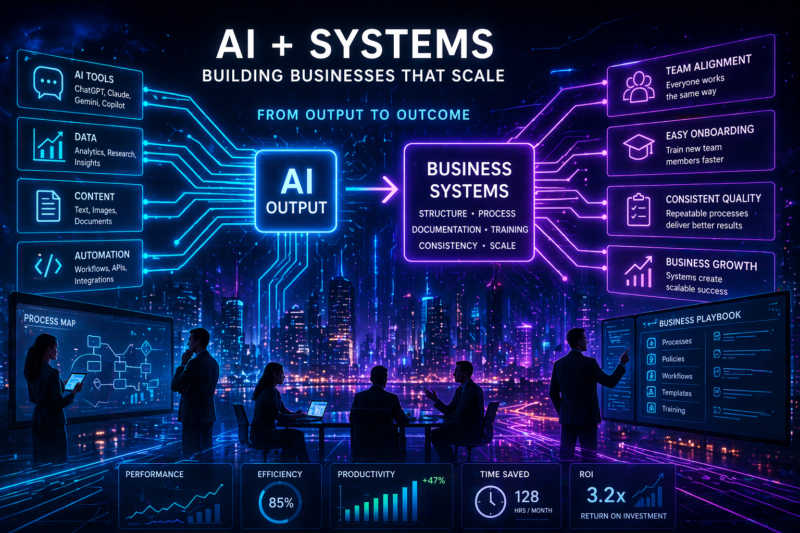
This gap between capability and consistency is where many organisations begin to struggle.
It is often the point where early gains from AI start to lose momentum.
The Growing Importance of AI Business Systems
AI tools are powerful. They can generate reports, assist decision making, and automate routine work. For individuals, this leads to immediate improvements in productivity.
But businesses do not operate on individual performance alone.
They rely on shared processes, consistent standards, and repeatable workflows. Without AI business systems in place, organisations struggle to turn isolated efficiency into scalable results.
This gap is becoming one of the biggest challenges in modern workplaces.
AI Creates Output. AI Business Systems Create Scale
AI is designed to produce output quickly and efficiently. It can generate ideas, process information, and support a wide range of business functions.
Yet output alone does not build a scalable organisation.
AI business systems provide the structure that allows teams to work consistently. They ensure that tasks are completed in a standardised way, regardless of who is performing them.
Without this structure, businesses often see uneven results.
One employee may use AI effectively, while another produces entirely different outcomes for the same task.
Scale requires alignment, and alignment comes from systems.
Why Businesses Struggle Without AI Business Systems
Many organisations experience strong early gains from AI. Productivity improves and teams begin experimenting with new tools.
Over time, however, progress slows.
This typically happens because AI usage remains informal. Knowledge is not documented, processes are not standardised, and there is no clear framework linking tools to outcomes.
As a result, AI becomes fragmented.
AI business systems address this issue by turning individual knowledge into shared processes that can be followed across teams.
Building AI Business Systems in Practice
Developing AI business systems involves more than adopting new technology. It requires a shift towards structured thinking.
Businesses need to document how tasks are completed, define how AI is used within those tasks, and establish clear expectations for outcomes.
Once this structure is in place, organisations can scale their use of AI more effectively.
Teams become aligned, onboarding improves, and outputs become more consistent.
Platforms such as Trainual support this approach by helping businesses create internal playbooks, document workflows, and build structured training environments for employees. These types of tools focus on organising knowledge rather than generating it.
Real World Impact of AI Business Systems
Across industries, the importance of AI business systems is becoming increasingly clear.
In finance, AI supports reporting and forecasting, but consistency depends on structured processes.
In marketing, AI generates content, but quality and messaging rely on defined workflows.
In operations, AI improves efficiency, but repeatability depends on documented procedures.
In each case, the effectiveness of AI is determined not just by the tool, but by the system surrounding it.
The Future of AI Business Systems
AI adoption will continue to grow, but the next phase will focus on structure rather than access.
Most organisations already have the tools they need. The challenge now is integrating those tools into consistent and scalable workflows.
AI business systems will play a central role in this transition.
They will determine whether AI remains an individual productivity tool or becomes a core part of how organisations operate.
AI is transforming how work gets done, but structure determines whether that transformation lasts.
Without AI business systems, organisations risk inconsistency and fragmentation. With the right structure and tools in place, they can achieve scalable and sustainable results.
If you are exploring how to structure AI within a business environment, platforms such as Trainual can help turn knowledge into organised, repeatable systems.
If you are looking to develop practical AI skills and understand how they apply in real world scenarios, explore the full range of courses available on AI Tuition Hub.