AI workflows are becoming a central focus as companies begin to analyse how employees interact with their computers, raising wider questions about privacy, surveillance, and the future of work.
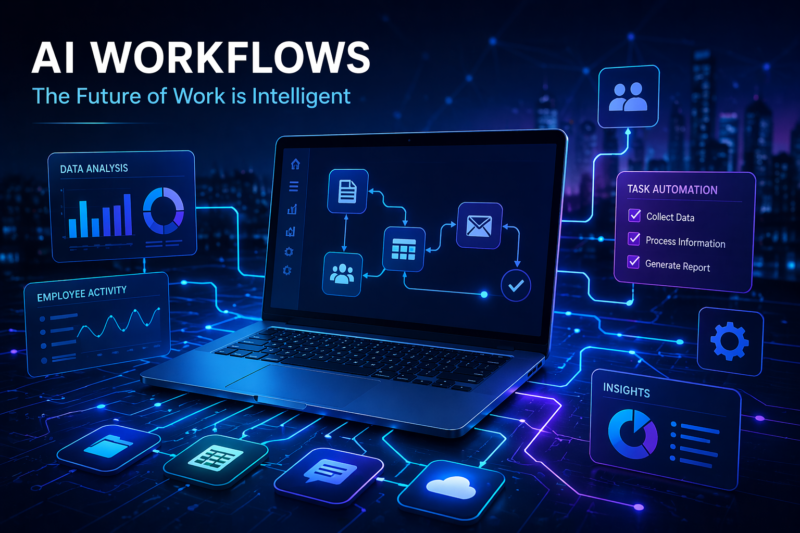
While much of the attention has focused on individual firms such as Meta, the reality is that this reflects a much broader shift taking place across the global economy.
Artificial intelligence is no longer just learning from data. It is beginning to learn from behaviour.
A new phase in artificial intelligence is emerging
The focus of artificial intelligence is now shifting. Instead of simply generating content, systems are increasingly being designed to complete real tasks inside digital environments. This marks a significant change in how AI is being developed and applied across industries.
But focusing only on one company risks missing the bigger picture.
What is happening is not isolated.
It reflects a broader shift in how artificial intelligence is being developed, trained, and deployed across the global economy.
From content generation to task execution
Artificial intelligence has already transformed how content is created. Systems can now produce text, generate images, assist with coding, and summarise information at scale.
However, the next phase is more ambitious.
Leading technology firms including Microsoft and Google are investing heavily in AI systems that can complete tasks inside real software environments.
This means moving beyond generating answers and toward:
- navigating applications
- completing workflows
- executing multi step processes
To do this effectively, AI needs something new.
It needs to understand how work is actually performed.
How AI workflows are changing the workplace
Traditional AI training relies on large volumes of text, images, and structured data.
That approach is no longer enough.
Real work involves:
- switching between tools
- making small decisions continuously
- adjusting processes based on context
These behaviours are rarely captured in standard datasets.
By analysing how people complete tasks on computers, organisations are attempting to give AI systems a more realistic understanding of how work happens in practice.
This is a significant evolution.
It shifts AI from learning information to learning behaviour.
The rise of AI agents
This transition is closely linked to the development of so called AI agents.
Companies such as OpenAI and Anthropic are working on systems designed to:
- follow instructions across multiple steps
- interact with software tools
- complete tasks with limited supervision
Instead of asking a question and receiving an answer, users may increasingly assign tasks and receive completed outcomes.
For example:
- preparing reports
- updating systems
- managing routine communications
To achieve this, AI must learn workflows, not just outputs.
The connection to job roles
At the same time, research from organisations such as McKinsey & Company highlights a growing impact on white collar work.
The early signs include:
- automation of repetitive tasks
- increased productivity per employee
- reduced demand for certain entry level roles
This does not mean that entire professions disappear.
However, it does suggest a shift in how work is structured.
Tasks that follow predictable digital processes are the most exposed to automation.
A global trend, not a local issue
What makes this development important is its scale.
This is not limited to one region, sector, or company.
Across industries, businesses are exploring how AI can:
- reduce operational friction
- improve efficiency
- scale output without increasing headcount
The use of real workflow data accelerates this process.
It allows AI systems to move closer to performing work directly, rather than simply assisting with it.
Changing expectations in the workplace
As AI becomes more capable, the nature of many roles is likely to evolve.
There may be greater emphasis on:
- overseeing automated processes
- validating outputs
- making higher level decisions
At the same time, individuals who can effectively work alongside AI tools may see significant advantages.
Understanding how to structure tasks, guide systems, and interpret outputs is becoming increasingly valuable.
A shift already underway
Perhaps the most important point is timing.
This is not a distant scenario.
The underlying technologies are already being tested, refined, and deployed within major organisations.
Investment levels continue to rise, and competitive pressure is accelerating development.
The shift from AI as a support tool to AI as an active participant in work is already in progress.
Final thoughts
The discussion around companies analysing employee workflows is ultimately about more than data collection.
It signals a deeper transition in artificial intelligence.
The focus is moving from what people produce to how they produce it.
Once that behaviour can be replicated, the impact on productivity, roles, and organisational structures becomes far more direct.
For businesses and individuals alike, the key challenge is not whether this change will happen.
It is how quickly they adapt to it.
Research from McKinsey & Company highlights the growing impact of automation and AI on white collar roles, productivity, and workforce structure.
Continue learning
Understanding how AI workflows are changing the workplace is only part of the picture. The real advantage comes from knowing how to use these systems effectively in day to day work.
You can explore this further through the full range of AI courses available at AI Tuition Hub, covering real world applications across business, finance, and professional roles.