Artists are watching AI systems reproduce voices, styles, melodies, images and writing techniques that took human beings years to develop. AI Copyright in the Arts is therefore no longer an abstract legal debate. It concerns people’s livelihoods, identities and right to control what they created.
The technology is moving faster than copyright law, and artists are expected to tolerate the consequences while courts, governments and technology companies decide what the rules should be.
When Two People Generate the Same Melody
Imagine a musician in Europe asks an AI system to compose a melancholy piano melody. At roughly the same time, somebody in America enters a similar prompt into the same system.
Both receive almost the same eight bars of music.
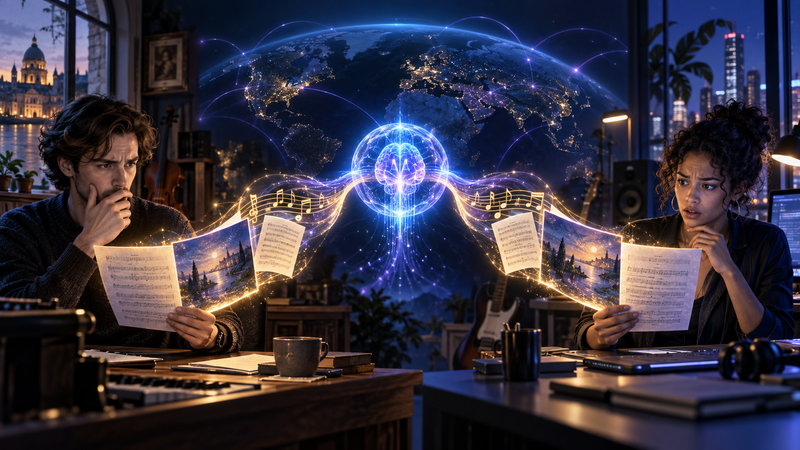
The European musician develops the melody, adds lyrics and releases a song. The American musician registers a completed version first and claims ownership.
Who owns the original melody?
Being first to register something does not necessarily mean that you created it. Registration can provide important legal advantages in some countries, but it cannot turn an unprotected idea or entirely machine-generated output into human authorship.
Copyright normally protects original human expression. In the United States, the Copyright Office says AI-generated material can qualify for protection where a person has contributed sufficient expressive authorship through creative selection, arrangement or modification. Merely providing prompts is generally insufficient.
In March 2026, the US Supreme Court declined to hear a challenge involving an artwork attributed entirely to an AI system. This left the lower ruling requiring human authorship in place. Other countries may reach different conclusions, which makes international publication even more complicated.
If neither musician copied the other, traditional copyright principles may treat the similarity as independent creation. A work can resemble another work without being an infringement when the resemblance is coincidental rather than the result of copying.
However, AI introduces something genuinely uncomfortable. The similarity may not be coincidence at all. It may be the predictable result of two people using the same system, trained on similar music, with similar instructions.
Both musicians could spend months developing their songs, yet neither may have exclusive ownership of the generated melody at their centre.
AI Outputs Are Not Necessarily Unique
One of the greatest illusions surrounding generative AI is that every idea it produces is unique.
The experience feels personal. A user enters an original prompt during what appears to be a private conversation, and the AI produces an answer specifically for them. It is therefore natural to assume that nobody else has received the same melody, image, storyline or design.
That assumption may be completely wrong.
AI systems generate outputs from patterns learned during training. If thousands of people use the same system and request similar ideas, some will inevitably receive closely related results. In certain cases, the similarities may extend beyond a general theme to include comparable wording, compositions, melodies or visual arrangements.
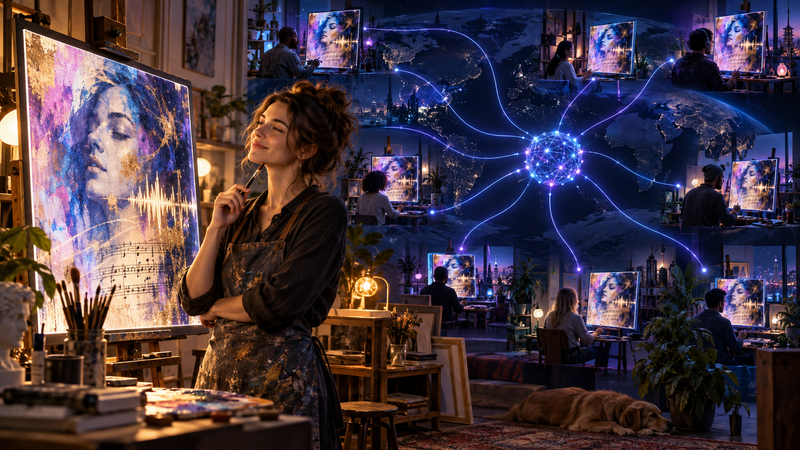
A creator could therefore spend months developing an AI-generated idea without knowing that somebody elsewhere is building a project around almost exactly the same material.
The output may feel personal. That does not make it exclusive. Some AI providers expressly warn that outputs may not be unique and that other users can receive similar material. That warning has enormous implications for professional creativity.
A business could pay a designer for an AI-assisted logo only to discover a similar design elsewhere. A writer could build a novel around an AI-generated plot that has also been supplied to another writer. A musician could release a melody that another user believes belongs to them.
The more creative work depends upon unedited AI output, the less confidently anybody can claim that it is genuinely original.
This is why artists should keep their prompts, sketches, recordings, drafts and editing histories. These records may help show which elements came from the creator and which came from the machine.
What If AI Gives Two Writers the Same Story?
Consider two writers using the same AI system.
One asks for a story about an elderly astronaut returning to an Earth that has forgotten her. Another enters a similar request and receives a story containing the same central idea, similar characters and several comparable scenes.
The first writer publishes immediately. The second substantially rewrites the output but publishes several months later.
Copyright generally does not protect the underlying idea. It protects the particular expression of that idea. Themes, genres, common characters and broad plot concepts are not normally owned by one writer.
Neither writer can own the basic concept of an astronaut returning to Earth.
The position becomes harder if both stories contain nearly identical passages, dialogue or sequences of events. Did one writer copy the other? Did the AI produce similar material independently? Did it reproduce wording encountered during training?
Publication dates alone may not answer those questions.
Each writer may own their original rewriting, structure, dialogue and character development while having little or no claim over the common machine-generated core. If one writer deliberately copied the published version of the other, that would be different. But similarity by itself does not prove copying.
This could become a nightmare for authors. A writer may be accused of stealing a story they have never read because the same machine supplied similar material to somebody else.
“In the Style Of” a Dead Musician
YouTube already contains AI-generated songs made “in the style of” famous performers, particularly musicians who are no longer alive.
Some are clearly labelled experiments. Others use the artist’s photograph, name and synthetic voice so convincingly that a casual listener could believe they have discovered a lost recording.
Creators sometimes defend this by saying the music is available free of charge. That misses the point.
Free does not automatically mean lawful.
A song may involve separate rights in its lyrics, melody, arrangement and sound recording. Those rights may be owned by songwriters, publishers, performers, record companies or estates. The death of the artist does not automatically place their work in the public domain. Copyright frequently continues for decades after death.
Broad musical style is not usually protected in the same way as a particular composition. Nobody owns every slow blues song, distorted guitar sound or orchestral ballad.
But there is a considerable difference between being influenced by a genre and manufacturing what appears to be a new performance by a named dead musician.
A synthetic voice may also involve identity, likeness, publicity, passing off or consumer protection laws. These rights differ between countries and may or may not continue after death. That uncertainty is not a licence to do whatever the technology permits.
When Imitation Becomes Forgery
Imitation and forgery are not necessarily the same thing.
An AI song labelled “an unofficial experiment inspired by 1970s soul music” is not claiming to be an authentic historical recording.
A video titled “Unreleased Final Song by [Artist]”, using that artist’s image and cloned voice, is something else entirely. It is designed to create belief in an authenticity that does not exist.
The uploader may not earn a penny, but listeners can still be deceived. An artist’s reputation can still be exploited, and their family may still be forced to watch a machine place words into the mouth of somebody who can no longer object.
YouTube requires disclosure of realistic altered or synthetic content in relevant circumstances. It also states that disclosure is not a free pass to impersonate another person or channel.
Labelling something as AI-generated is responsible, but it cannot cure copyright infringement, provide consent or make deliberate deception acceptable.
Why Artists Are Angry
Artists are not simply afraid of new technology.
Many are angry because their work may have helped train systems capable of competing with them. Their distinctive styles can be reproduced in seconds, while the original creator receives no payment, credit or meaningful choice.
A painter can spend thirty years developing a recognisable visual identity. A singer can build a voice shaped by age, culture and experience. A writer can develop a rhythm that readers immediately recognise.
An AI system can imitate the surface of that identity without living any of the life that created it.
Current legal disputes remain unresolved. Courts are still considering whether copyrighted books, images, lyrics and recordings can be used for AI training without permission. Meanwhile, the systems continue to develop and generated content continues to flood creative markets.
There are signs of a move towards licensing. In September 2026, AI music company Suno released new models through agreements with Warner Music Group and BMG, including plans for artists to participate on an opt-in basis.
That is significant because consent should not be treated as an obstacle to innovation. It should have been one of its foundations.
Artists Must Remain More Than Training Material
AI can be an extraordinary creative tool. It can help musicians explore arrangements, writers develop ideas and visual artists test new directions.
But there must be a line between assisting creators and industrialising their identities.
Artists should not have to discover synthetic versions of themselves circulating online. Families should not be powerless when dead performers are made to sing words they never chose. Writers should not face accusations of copying because an AI company supplied the same material to thousands of users.
The fact that something can be generated does not mean it should be published.
The fact that it is free does not make it harmless.
And the fact that the law has not caught up does not make every use fair.
Understanding AI in Creative Work
Our updated course, AI in Art, Design, and Music – The Future of Creative Expression, examines how AI is changing art, illustration, photography, music, voice production, film and design.
It also explores copyright, authorship, originality, consent and the responsibilities involved in using creative AI.
The future of creativity should not be decided only by the companies building the machines. Artists, performers, writers and audiences must also have a voice.
AI can reproduce patterns. Human beings create careers, cultures and meaning. If creative technology is to earn public trust, it must learn to respect the people whose work made it possible.
Published: 13th September 2026.