Tax has long been regarded as one of the most specialised and respected professions in finance. Businesses, investors and individuals have traditionally relied on experienced professionals to navigate increasingly complex tax legislation, international treaties and constantly changing regulations. Today, however, artificial intelligence is beginning to reshape that landscape. The rise of the AI Tax Professional is no longer a distant possibility but an emerging reality as AI transforms how tax research, planning and compliance are carried out.
For decades, tax professionals have commanded premium fees because clients were paying not only for technical expertise but also for the considerable time required to research legislation, analyse different tax scenarios and prepare detailed advice. As AI becomes capable of completing much of that technical groundwork in minutes rather than days, the profession may be entering one of its biggest periods of change. Rather than replacing tax professionals altogether, AI has the potential to change where they add value and how clients perceive that value.
Why Tax Is Perfect For Artificial Intelligence
Few professions rely as heavily on structured information as taxation. Every country has its own legislation, tax rates, reporting obligations, reliefs, exemptions and court decisions. Businesses operating internationally must also consider double taxation agreements, transfer pricing rules, withholding taxes and an ever growing list of compliance requirements.
This environment plays directly to the strengths of artificial intelligence.
Modern AI systems can rapidly search technical manuals, compare legislation across multiple jurisdictions, summarise lengthy documents and identify relevant case law within seconds. Tasks that once required many hours of manual research can increasingly be completed almost instantly.
Of course, speed alone is not enough. Tax legislation is often open to interpretation and professional judgement remains essential. AI may provide the information, but experienced professionals are still responsible for deciding how that information should be applied.
How AI Is Already Changing Tax Work
The impact of AI is already being felt across many areas of the profession.
Tax professionals are increasingly using AI to summarise legislation, prepare first drafts of reports, compare tax systems, review calculations, identify potential compliance issues and explain complex rules in more accessible language. Rather than replacing experienced advisers, AI is reducing the amount of time spent on repetitive administrative and research tasks.
This shift allows professionals to concentrate on higher value activities such as advising clients, evaluating commercial risks and developing practical tax strategies.
AI is also becoming increasingly useful for multinational businesses. Instead of researching the tax implications of operating in several countries individually, businesses can use AI to compare multiple jurisdictions simultaneously, helping identify opportunities and highlight potential risks much more quickly than traditional methods.
AI Could Transform Tax Planning
Perhaps one of the most significant developments is the growing role of AI in tax planning.
Imagine asking an AI platform to compare every OECD country before establishing an international business.
Within minutes it could evaluate corporation tax rates, dividend taxation, withholding taxes, capital gains tax, double taxation treaties, reporting obligations and potential legislative risks before presenting several possible structures together with the advantages and disadvantages of each.
Private clients could ask similar questions about relocating overseas, retirement planning, inheritance planning or investment structures. Instead of beginning with days of technical research, professionals could start with an AI generated analysis before applying their own experience and judgement.
The result is not simply faster advice. It has the potential to make sophisticated tax planning available to a much wider range of businesses and individuals that may previously have found specialist advice prohibitively expensive.
Governments Are Building Their Own AI Tax Professionals
Artificial intelligence is not only changing the private sector.
Tax authorities around the world are investing heavily in AI and advanced data analytics to improve compliance, detect fraud and identify unusual financial activity.
Rather than relying entirely on manual investigations, AI can analyse millions of tax returns, banking transactions and financial records to identify patterns that may require further review. It can also help prioritise investigations, allowing tax authorities to focus resources on higher risk cases.
Looking ahead, governments may even use AI to model the likely impact of proposed tax legislation before it is introduced. By simulating taxpayer behaviour, policymakers could identify weaknesses or unintended loopholes and strengthen legislation before it reaches the statute book.
In many respects, governments are developing their own version of the AI Tax Professional.
The Future Value Of Tax Advice
As artificial intelligence continues to evolve, the role of the tax professional is likely to change alongside it.
For decades, businesses have paid substantial fees for specialist tax advice because researching legislation, interpreting complex rules and identifying planning opportunities required years of experience and many hours of detailed analysis. AI has the potential to complete much of that technical groundwork in a fraction of the time.
As these systems become more sophisticated, clients are likely to expect faster responses, more detailed analysis and, in many cases, lower costs for routine advisory work. The value of the profession may therefore shift away from technical research and towards commercial judgement, strategic thinking and the ability to apply AI generated insights to a client’s unique circumstances.
Rather than reducing the importance of tax professionals, artificial intelligence may redefine where their expertise delivers the greatest value.
AI Could Become A Global Tax Strategist
One of the most exciting possibilities is the development of AI systems capable of analysing tax systems across the world simultaneously.
Instead of comparing one or two jurisdictions, future AI platforms could evaluate dozens of countries within minutes, taking into account corporation tax rates, withholding taxes, capital gains tax, inheritance rules, double taxation treaties, economic substance requirements and reporting obligations.
Businesses could model different expansion strategies, while private clients could compare the tax implications of relocating overseas, investing internationally or restructuring family wealth. What currently requires significant specialist research could become an interactive conversation supported by constantly updated global tax intelligence.
The Future Of The AI Tax Professional
The tax professional of the future is unlikely to spend less time advising clients. Instead, they may spend considerably less time carrying out the technical research that has traditionally occupied much of the profession.
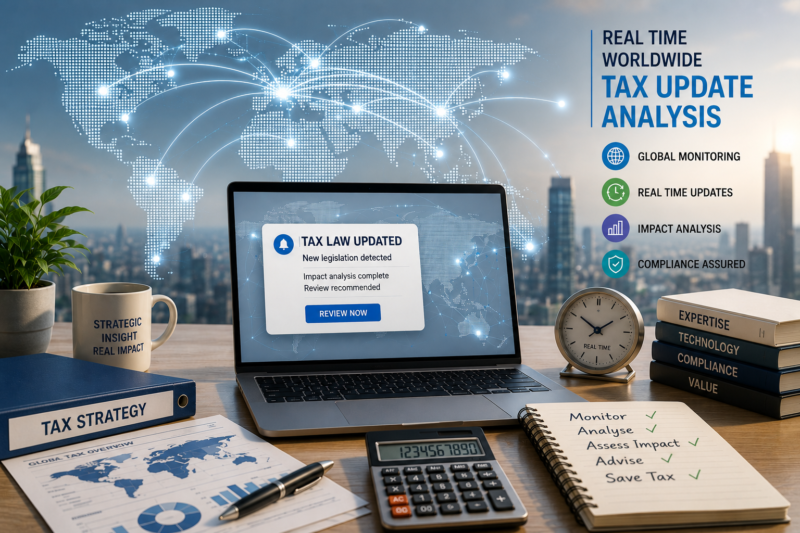
Artificial intelligence will increasingly gather information, compare legislation, analyse tax scenarios and identify planning opportunities. As tax legislation changes around the world, AI could continually monitor existing business structures and alert advisers whenever new rules, tax rates or reporting requirements indicate that a structure should be reviewed. Rather than waiting for an annual tax review, businesses could receive near real time notifications whenever legislative changes affect their tax position or create new planning opportunities.
The role of the tax professional will then be to interpret those findings, assess the commercial implications and recommend the most appropriate course of action. In many respects, AI could perform for tax planning what it is already beginning to do for compliance by continuously monitoring regulatory developments and highlighting issues as they emerge.
As access to sophisticated AI tools becomes widespread, specialist tax knowledge may become far more accessible than it is today. The profession is therefore likely to remain highly respected, but routine technical advice may gradually become less exclusive and, over time, potentially less lucrative than it has traditionally been.
Final Thoughts
Artificial intelligence is unlikely to replace the tax profession, but it is poised to reshape it.
Research that once required many hours could soon be completed within minutes. International tax comparisons may become routine, governments will continue investing heavily in AI driven compliance, and businesses will increasingly expect faster, more data driven advice.
The most successful tax professionals will be those who embrace these technologies rather than compete against them. Their expertise will increasingly lie not in finding information, but in interpreting it, applying sound commercial judgement and helping clients navigate an increasingly complex global tax environment.
If you would like to explore how artificial intelligence is already transforming tax compliance, governance and regulatory oversight, we also offer our course, AI in Tax Compliance and Regulatory Oversight. The course examines how AI is being used to improve compliance monitoring, automate regulatory reporting, identify financial risks and strengthen governance across tax functions, providing practical insights into one of the fastest developing areas of AI within the finance profession.
Explore all of our AI courses on AI Tuition Hub.
Published: 30th July 2026.