How AI is transforming data science workflows is now reshaping how work is done from data preparation through to modelling, evaluation, and communication.
What used to be a structured, step by step process has become something far more fluid, faster, and more dependent on judgement.
For anyone working in data science, the question is no longer whether AI is useful.
The real question is how it is changing the way the work actually gets done.
Why Data Science Workflows Are Changing So Quickly
For years, data science followed a familiar rhythm.
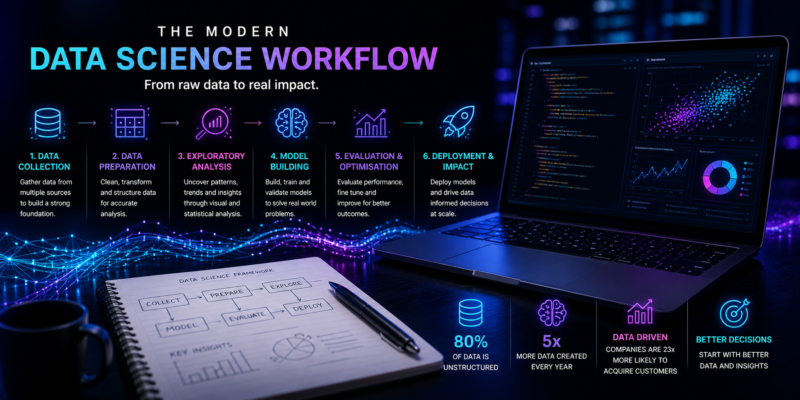
Collect the data. Clean it. Explore it. Build a model. Evaluate the results. Communicate the findings.
It was never perfectly linear, but it was predictable.
AI has disrupted that predictability.
Tasks that once took hours can now be completed in minutes. That means analysts are no longer locked into a single path. They can explore multiple directions, revisit earlier stages, and test ideas far more freely.
Modern data science workflows now behave more like a loop than a pipeline.
Recent research from the MIT Sloan School of Management highlights that AI’s biggest impact is not just improving individual tasks, but reshaping entire workflows and how work is structured across systems.
That is exactly what we are seeing in practice.
AI Is Reducing Manual Work but Increasing Thinking
There is a common assumption that AI simply makes data science faster.
That is true, but it is not the most important shift.
What is really changing is where effort is spent.
Large parts of the job used to involve repetitive execution. Writing code to inspect datasets. Cleaning columns manually. Testing models step by step.
AI now handles much of that groundwork.
You can generate dataset summaries instantly. You can detect missing values and anomalies in seconds. You can compare models without building everything from scratch.
The bottleneck is no longer execution.
It is thinking.
Data Preparation Has Become More Analytical
Data preparation is still one of the most important parts of any workflow.
But the nature of the work is changing.
Instead of manually searching for issues, AI surfaces them immediately. It highlights missing data patterns, identifies inconsistencies, flags unusual values, and suggests possible transformations.
This does not remove responsibility.
It shifts it.
Analysts now spend less time finding problems and more time deciding what those problems actually mean.
Is this missing data important?
Is this outlier real or an error?
Should this structure be preserved or corrected?
Preparation is no longer just cleaning.
It is interpretation.
Exploration Has Become Broader and Faster
Exploratory analysis is where real insight begins.
Previously, it required careful, step by step inspection. Analysts would test variables individually and gradually build an understanding of the dataset.
AI has changed that completely.
It can surface relationships across multiple variables at once, detect clusters, highlight unusual behaviour, and suggest areas worth investigating.
This dramatically expands what is possible.
But it also introduces a new challenge.
When everything looks interesting, what actually matters?
The skill is no longer just finding patterns.
It is knowing which ones are worth trusting.
Model Prototyping Is Now an Iterative Process
Building models used to be time intensive.
Now it is fast.
AI can generate baseline models, suggest feature combinations, structure experiments, and compare outputs quickly.
This encourages a different way of working.
Instead of committing to one approach early, analysts can test multiple ideas and refine them continuously.
This leads to better outcomes, not just faster ones.
More experimentation means deeper understanding.
And deeper understanding leads to stronger models.
Model Evaluation Is Becoming More Realistic
For a long time, model evaluation focused heavily on metrics.
Accuracy, error rates, and performance scores often dominated decisions.
That is changing.
AI makes it easier to understand how a model behaves, not just how it performs overall.
It can highlight differences across segments, show where errors concentrate, reveal sensitivity to input changes, and identify instability over time.
This leads to a more honest view of performance.
A model is no longer judged only by its score.
It is judged by how it behaves in real conditions.
Communication Is Now the Hardest Part
As AI makes analysis easier, communication becomes harder.
It is now relatively easy to generate insight.
It is much harder to decide what to say about it.
What matters?
What can be trusted?
What needs to be explained carefully?
What should stakeholders actually do?
AI can help summarise results and translate technical outputs into plain language.
But it cannot decide what is important.
That responsibility remains with the analyst.
In modern data science workflows, communication is no longer a final step.
It is a core skill.
Structured Workflows Matter More Than Ever
With increased speed comes increased complexity.
More experiments, more iterations, and more moving parts can quickly lead to confusion.
Without structure, projects become difficult to manage, reproduce, or explain.
AI helps by improving organisation.
It can track experiments, document decisions, highlight inconsistencies, and map how different stages connect.
This improves collaboration and trust.
A structured workflow turns data science into a system.
Without it, even good analysis can become unreliable.
Ethics and Responsibility Are Central
As AI becomes more embedded in data science workflows, responsibility increases.
AI can surface patterns, but it does not understand context or consequences.
It cannot judge whether a pattern reflects reality or bias. It cannot decide whether a model is being used appropriately.
That responsibility remains human.
Analysts must ensure that results are not overstated, limitations are clearly communicated, and models are used responsibly.
The more powerful the tools become, the more important judgement becomes.
The Future of AI in Data Science Workflows
AI will continue to integrate more deeply into analytics environments.
We are already seeing real time analysis support, automated experiment tracking, built in explainability tools, and continuous monitoring of model behaviour.
Data science workflows will become more adaptive, more intelligent, and more interconnected.
But one thing will not change.
Human judgement will remain central.
Final Thoughts
AI is not replacing data scientists.
It is changing what the role requires.
Less time is spent on repetitive execution.
More time is spent on interpretation and decision making.
Modern data science workflows are faster, more flexible, and more powerful.
But they also demand clearer thinking, stronger communication, and greater responsibility.
Those who adapt will not just work faster.
They will work better.
Learn How to Apply This in Practice
If you want to understand how AI is transforming real world data science workflows step by step, we cover this in detail in our course:
AI for Data Scientists & Analytics Professionals
Inside the course, we break down:
- AI supported data preparation
- Modern exploratory analysis techniques
- Faster model prototyping and experimentation
- Behaviour focused model evaluation
- Workflow design and optimisation
- Communication and stakeholder alignment
- Ethical and responsible AI use
You can access this course and all our other courses on the platform.
Full access is £19.95 per month. With over 100 courses available, that works out at less than 20p per course.