In a trial audit of a FTSE 250 company, AI asked better questions than KPMG’s accountants in some areas. In another, an AI agent failed to match the relevant regulations to the company’s documents and a human had to step in. Those two moments, reported in a Financial Times exclusive, capture how AI is now reshaping the role of accountancy. It can do work that once occupied teams of people, and it still takes an experienced accountant to know when it has got something wrong.
KPMG used more than 100 AI agents to gather evidence, analyse documents, suggest further enquiries and draft conclusions. The firm ran the trial alongside a conventional audit, which it used for the official sign-off. It now plans to extend the trial to up to 20 larger audits. What stands out is how much of the process the agents were given. They could examine evidence, identify an issue and suggest where to look next.
AI is moving into everyday accountancy
KPMG has also announced the US rollout of Clara intelligence, its AI audit platform. Auditors direct the agents and review their work. Meanwhile, Wolters Kluwer and Inscope are bringing AI into financial statement preparation. Their tools are designed to help firms carry forward last year’s accounts, update disclosures and check that figures agree across tables. On one set of accounts, those tasks might take part of an afternoon. Across dozens of clients, they can account for a substantial share of a team’s working week.
The same shift is reaching tax departments and smaller practices. Thomson Reuters says its expanded CoCounsel tools can flag invoice compliance issues and prepare quarter-end tax work for review. ICAEW has opened applications for early access to its own AI platform, designed to help firms research standards, review source material and draft client communications. A small practice could use it to prepare a first answer to a technical question. An accountant still has to check that the guidance applies to the client’s circumstances.
Experienced accountants still have to challenge the evidence
Imagine an AI agent finds a December invoice that agrees with the ledger and concludes the expense belongs in December. An experienced accountant might ask when the work was actually carried out. If it happened in January, the supporting documents may point to a different reporting period. The figures can agree and the accounting can still be wrong. Someone has to know when to go back to the source and ask for better evidence.
There are professional boundaries too. In November, the UK Financial Reporting Council issued guidance on auditor independence when using AI and other technology. An audit tool might uncover something useful to management. Sharing that insight can raise independence concerns, particularly when the work behind it falls outside the audit. The auditor has to make that judgement and remains accountable for the work.
Fewer people will be needed for the same work
Once a firm can reliably complete the same volume of work in fewer staff hours, including time for review and corrections, it needs fewer people to deliver it. That may show up in recruitment before it appears in redundancy figures. A firm can take on fewer trainees, leave a vacancy unfilled when someone moves on or give the same team more clients. A growing practice may keep its headcount steady even as the number of hours it takes to serve each client falls.
KPMG hasn’t disclosed the exact size of its pilot team, so the trial gives us no reliable figure for jobs saved. The staffing implications are easier to see in the work itself. If collecting evidence, checking figures and assembling workpapers take up fewer junior hours on each engagement, firms may reconsider how many graduates they need to recruit.
Will accountants still be paid the same?
A firm’s total wage bill can fall even if the accountants it retains earn the same or more. Robert Half’s 2027 UK Salary Guide found that 36% of finance and accounting hiring managers surveyed were paying more for professionals with generative AI skills. Its US salary guide also identifies AI, data analytics and process automation as skills that can command higher pay. Experienced accountants who can investigate exceptions, challenge AI outputs and defend a decision could find themselves in greater demand.
Trainee pay could go either way. Fewer graduate vacancies could mean more applicants for each place and less pressure on firms to raise starting salaries. Firms may also pay more for recruits they expect to handle complex work earlier. Accountancy could become harder to enter at the same time as some experienced roles become better paid.
Could some parts of accountancy disappear for good?
Manually carrying forward last year’s accounts, checking the same figure across several tables and building the first set of audit workpapers could largely disappear from the working week. Accountants would still investigate discrepancies and review the finished accounts. Tasks that a senior accountant once did every week might become things a trainee encounters only when something goes wrong.
Those tasks doubled as training. Trace enough figures back to bank statements and invoices and you learn to recognise weak evidence. Work through an awkward disclosure and you learn where a standard leaves room for judgement. Firms could give trainees selected cases to work through from the original documents, then have them compare their conclusions with the AI’s. That takes time and supervision, and firms will have to decide how much of the time they save to put back into training.
What could AI in accountancy look like by 2030?
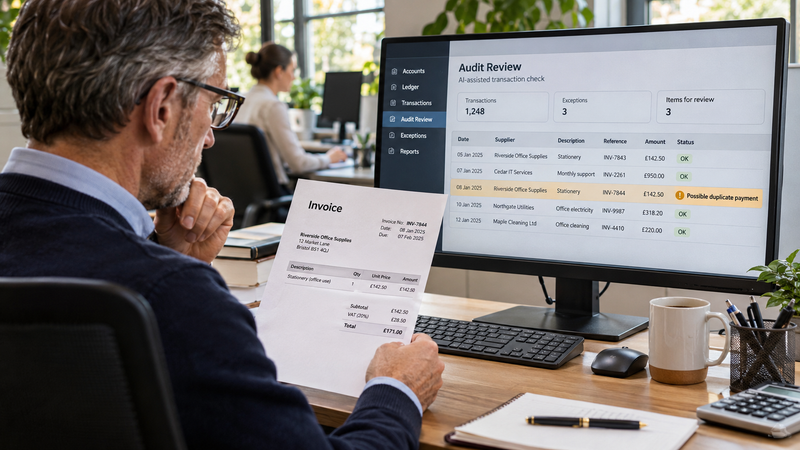
Today, a finance team might spot a duplicate payment when it reconciles accounts at month-end. By 2030, more teams could be running those checks as transactions come in. AI could flag the duplicate and pull together the invoice, payment record and ledger entries for someone to review. As firms refine their systems using feedback from reviewers, the tools could get better at recognising recurring issues and identifying which ones deserve a closer look.
If a routine check takes one hour instead of five, the firm gets four hours back before allowing for review. That illustrates what a fivefold speed increase could mean for an individual task. Across dozens of clients, savings on that scale could change how firms staff engagements. The time saved on an entire audit would depend on how much work can be automated reliably and how much still needs an experienced person to investigate.
ICAEW’s 2026 research into mid-tier accountancy firms found that 68% of firms surveyed expected AI to reduce demand for some early-career accountants, while 83% expected demand for accountants to continue as the role changes. By 2030, the work may involve less routine compliance and reporting and more interpretation, judgement and oversight. The question for firms is how they develop enough people to make those judgements when so much of the work that once taught them has been automated.
Explore our AI for Accounting & Auditing course
Our popular AI for Accounting & Auditing course explores how AI is changing financial reporting, audit work and professional judgement. We review the course as developments happen and update it to reflect new tools, how firms use them and emerging guidance from regulators.
With AI Tuition Hub All Access, you can explore this course plus 115 others for only £9.95 a month.
Published: 18th November 2026.