For many people, the words “AI translation” still bring back memories of the early days of Google Translate. While it was undoubtedly revolutionary at the time, it often produced literal translations, awkward grammar and, occasionally, some unintentionally hilarious results.
Fast forward to today, and the landscape has changed dramatically.
Artificial Intelligence has transformed translation from a simple word-for-word process into technology capable of understanding context, recognising different writing styles and even translating spoken conversations in real time. Whether you’re travelling abroad, attending an international business meeting or watching a webinar with live subtitles, chances are you’ve already benefited from AI translation without giving it much thought.
At AI Tuition Hub, we’ve recently completed a major update of our AI in Translation and Cross Language Communication course, and reviewing the latest developments made one thing very clear: AI translation is advancing far faster than many people realise.
Your Smartphone Has Become Your Personal Translator
Perhaps the easiest way to appreciate how much the technology has improved is to imagine yourself on holiday.
Only a few years ago, communicating in another language often involved pointing at phrase books, typing short sentences into an online translator or relying on hand gestures and hope.
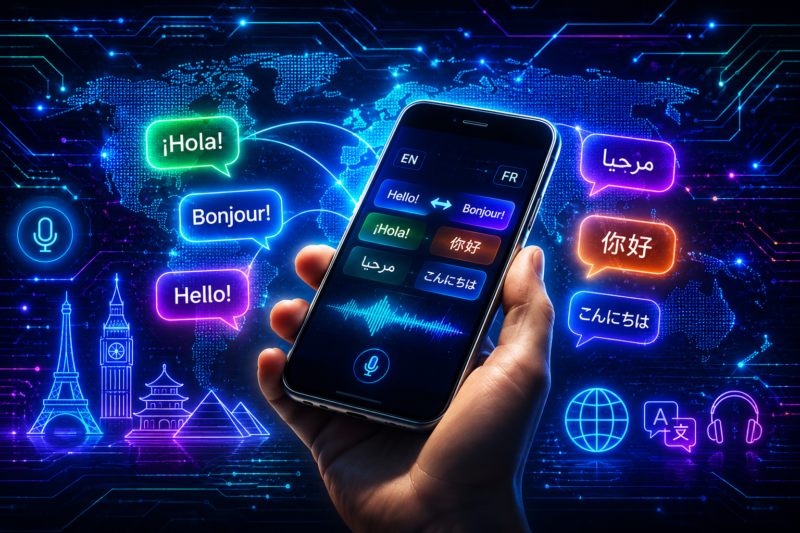
Today, you can simply speak into your smartphone in English. Within seconds, your words are translated and spoken aloud in another language. The person you’re speaking to can then reply in their own language, and your phone translates their response back into English almost instantly.
Whether you’re ordering food in a restaurant, checking into a hotel, asking for directions or speaking to a taxi driver, conversations that once felt intimidating have become remarkably straightforward.
For routine conversations, AI has effectively put a translator into millions of people’s pockets.
AI Translation Is Far More Advanced Than Many People Realise
The biggest improvement is not simply speed.
Modern AI translation systems no longer focus purely on translating individual words. Instead, they analyse complete sentences and attempt to understand the overall meaning before generating a translation.
Large Language Models and Neural Machine Translation have dramatically improved how AI handles:
- Context
- Grammar
- Sentence structure
- Common idioms
- Natural sounding language
- Some regional expressions and dialects
The result is communication that feels far more natural than the robotic translations many people remember from years ago.
No system is perfect, but the difference between today’s AI translation and the technology of even five years ago is remarkable.
AI Translation Is Already Part of Everyday Life
Translation is no longer something people only use when travelling. It has quietly become part of everyday life. Businesses are using AI to support multilingual customer service, while video conferencing platforms can generate live translated captions during international meetings. Web browsers can instantly translate websites from around the world, educational organisations use AI to help students learn in multiple languages, and even social media platforms increasingly rely on AI to translate posts so people can interact across different languages more easily. In many cases, users do not even realise AI is working behind the scenes.
Breaking Down Global Language Barriers
One of the most exciting aspects of AI translation is its ability to make global communication more accessible. International businesses can collaborate more easily, remote teams can communicate across different countries, healthcare providers can support patients who speak different languages, tourists can travel with greater confidence, educational organisations can reach students from around the world, and public services can communicate with increasingly diverse communities. Rather than language becoming a barrier, AI is helping remove many of the obstacles that previously slowed communication down.
Does This Mean the End of Human Translators?
Not at all.
While AI has become exceptionally good at handling routine conversations and everyday communication, there are many situations where human expertise remains essential. Legal contracts, medical reports, diplomatic negotiations, court proceedings, literature, and marketing campaigns that rely on emotion, humour or cultural understanding all require careful judgement that AI cannot yet replicate.
Rather than replacing professional translators, AI is increasingly becoming another tool they use to work more efficiently. Human expertise remains vital whenever accuracy, cultural sensitivity or legal responsibility matters.
We Have Completely Updated Our AI Translation Course
Because this area of AI is evolving so quickly, we’ve completely refreshed our AI in Translation and Cross Language Communication course.
The updated course explores:
- How modern AI translation systems work
- Real time multilingual meetings
- AI powered cross language collaboration
- Cultural awareness and tone
- Governance and responsible AI use
- Translation workflows
- Popular AI translation tools used in today’s workplace
The aim is not simply to explain the technology but to show how it is already transforming communication across business, education, customer service and many other sectors.
More Courses Recently Updated
This translation course joins a growing number of AI Tuition Hub courses that have recently been completely refreshed to reflect the latest developments in Artificial Intelligence.
Recent updates include AI in Marketing, Advertising and Social Media, AI for Digital Creators and Content Strategy, together with several other revised courses from our growing library of more than 110 AI courses.
As AI continues to evolve at an extraordinary pace, we’re committed to ensuring our courses remain practical, relevant and up to date.
Explore Our Newly Updated AI Courses
If this article has shown anything, it’s that AI translation has moved far beyond the basic online translators many of us remember. It is now helping businesses, educators, travellers and organisations communicate across languages faster and more naturally than ever before.
We’ve recently completed a comprehensive update of our AI in Translation and Cross Language Communication course, along with a number of other AI courses refreshed this week to reflect the latest developments in Artificial Intelligence.
You can explore all of our updated courses here:
TUITION HUB COURSE LIBRARY
With more than 110 AI courses covering business, finance, marketing, education, governance, cybersecurity, healthcare and many other subjects, we’re continually updating our content to keep pace with one of the fastest moving technologies in the world.
Don’t forget to use our FOUNDER50 introductory offer, giving you 50% off your first month. At under £10 for your first month, you’ll gain access to our entire AI course library. We genuinely believe you won’t find a more affordable way to access this breadth of practical AI training anywhere else.