Buying something online can take longer than it should. You compare websites, read conflicting reviews and wonder whether the cheaper option is actually a good deal.
AI shopping assistants promise to handle much of that searching. Explain what you need, set a budget and let the assistant compare the options. Some can also help complete the purchase.
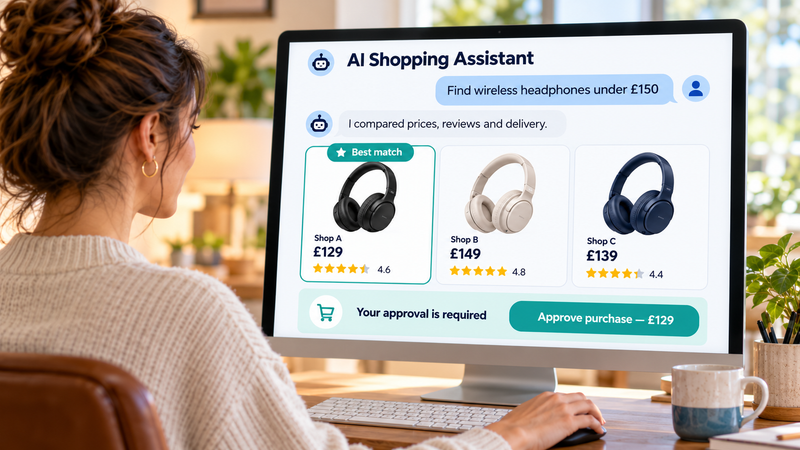
But convenience brings questions. Which shops does the assistant consider? Why does it recommend one product over another? And what happens when it buys the wrong thing?
Recent news shows why shoppers, retailers and sales teams should start paying attention.
Walmart Opens the Door to AI Buyers
On 21 October 2026, Reuters reported that Walmart had introduced tools allowing AI agents to shop and complete transactions for customers.
Its plans include spending limits, purchase approvals and the ability to withdraw an assistant’s access. Walmart is connecting its retail systems with outside assistants, while Amazon has sought to restrict their access.
That difference matters. An assistant can only compare what it can access. If certain retailers are unavailable, its recommendation may overlook a better product or price elsewhere.
Customers need to know the limits of the search before treating the result as the best available option.
Explaining What You Need
The appeal becomes obvious when buying something complicated.
Rather than searching through dozens of laptops, you could tell an assistant that you need one for studying, video calls and occasional photo editing, with a £700 budget.
You might add that it needs to be light enough to carry daily and have a battery that lasts through lectures.
The assistant could prepare a shortlist and explain the compromises without expecting you to understand every processor specification.
That could save time and help people make more informed purchases. However, the final details still matter. A convincing explanation does not guarantee that prices, specifications or stock information are correct.
Brands Want a Place on the Shortlist
Businesses are already working out how to get their products recommended.
On 21 October, Business Insider reported that Azoma had raised $11.2 million to help brands improve their visibility through AI shopping platforms. Its clients include Unilever, L’Oréal and Mars. Its work includes improving product listings and online content so assistants can find and recommend products.
Businesses have always competed for attention through advertising, search rankings and shelf space. AI recommendations create another place to compete.
If an assistant presents only three options, getting onto that shortlist becomes valuable. A business left out may lose the opportunity before the customer ever visits its website.
Whose Interests Come First?
Improving product information does not mean buying a recommendation. Nevertheless, customers deserve clarity about how suggestions are selected.
Does the assistant search widely or rely on particular partners? Are sponsored results clearly identified? Does it consider delivery costs, returns and warranty arrangements?
The lowest price is not always the best deal. Saving £20 means little if returning an unsuitable item costs £30.
Reviews need scrutiny too. An assistant can summarise them neatly, but the summary is only useful if those reviews are reliable and relate to the correct product.
The danger is accepting a polished answer as proof that everything behind it has been checked.
An Opportunity for Smaller Shops
AI shopping assistants could help customers discover specialist retailers they would otherwise miss.
A small business might stock exactly the right replacement part, unusual clothing size or specialist equipment without having a large advertising budget.
A Business Insider article published on 5 October described how Public cofounder Leif Abraham was using Meta’s Muse to find specialist products and buy directly from brands. That is one person’s experience, but it illustrates the possibility.
For smaller retailers, clear information could help. Product descriptions should explain suitability, dimensions, compatibility and limitations. Delivery charges and returns policies should be easy to find.
An assistant cannot confidently match a product to a customer’s needs if essential details are missing or contradictory.
When the Assistant Gets It Wrong
Recommending a purchase and making one involve different levels of responsibility.
Ask an assistant to order printer ink and it might choose the correct manufacturer but the wrong cartridge. Ask for a cheap delivery service and it might overlook that your parcel needs insurance.
The payment succeeds, but the task has failed.
Purchase approvals therefore need to show more than a product name and a button. Customers should check the exact item, seller, total cost, delivery arrangements and any subscription commitment.
Spending limits help control the financial exposure. They cannot prevent every misunderstanding.
For expensive or complicated purchases, a human check remains worth the time.
What This Means for Sales
Sales teams may increasingly deal with customers who arrive carrying an AI generated comparison.
Some will have useful research. Others may have outdated prices, incorrect specifications or unrealistic expectations.
Staff will need to explain those differences clearly and recognise when the comparison exposes a genuine weakness in their own offer.
Businesses should also review their product information. Broad claims about excellent quality tell an assistant less than clear facts about materials, performance, compatibility and support.
The sales process may begin before anyone speaks to a salesperson. If an assistant cannot understand what makes a product suitable, the customer may never hear about it.
Learning About the Change
AI shopping assistants could make buying easier. Their value will depend on reliable information, access to retailers and customers retaining control.
For businesses, understanding how these assistants influence purchasing could become an important sales skill.
At AI Tuition Hub, we have a number of courses on sales, alongside marketing, customer service and AI in business. Get full access to over 114 work related courses for just £9.95 a month, helping you keep up with AI developments across a wide range of industries and professions.
Published: 24th October 2026.