For more than twenty years, businesses have relied on Google Search to attract visitors to their websites. By publishing useful articles and investing in search engine optimisation, companies could build an audience, generate enquiries and grow their online presence through organic search.
That model is now beginning to change.
AI search is transforming how people find information online. Instead of simply displaying a list of websites, Google is increasingly providing AI generated answers directly within search results. While this offers greater convenience for users, it also raises important questions for businesses, publishers and marketers who depend on website traffic.
A New Era For Search
Google has made it clear that artificial intelligence will play a central role in the future of Search. AI Overviews and AI Mode are designed to help users receive faster, more conversational answers rather than simply presenting a list of website links.
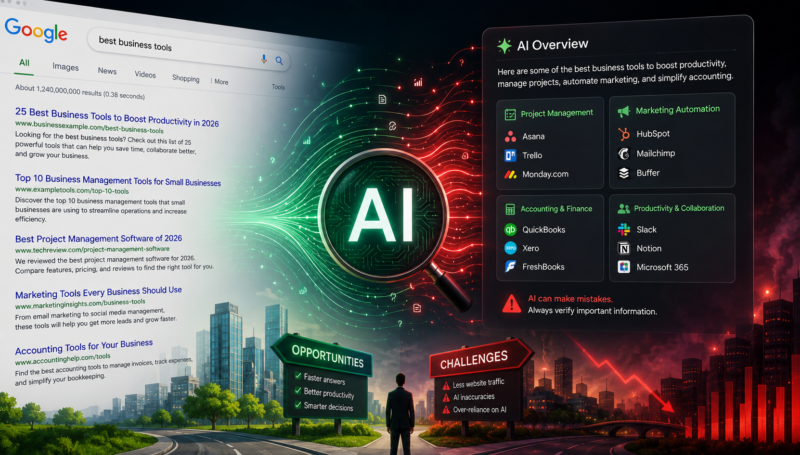
For many everyday questions this works extremely well. Instead of opening several websites to compare information, users can often receive a summary within seconds.
For website owners, however, the picture is more complicated. If users receive the information they need without clicking through to the original source, fewer visitors may reach the websites that invested time and effort creating that content.
Google says its aim is to improve the search experience while continuing to connect users with useful information. Google announcement.
Why Website Owners Are Concerned
Many publishers and businesses are already reporting changes in the way people interact with search results.
The growth of so called zero click searches means users often receive an answer without ever visiting another website. This has led many organisations to question whether traditional search engine optimisation and content marketing will continue to deliver the same results over the coming years.
Google has also published guidance explaining that high quality, helpful content remains important, even as AI becomes a larger part of Search. Google Search Central guidance.
The internet is not disappearing, but the way people discover information is clearly evolving.
AI Is Powerful But It Is Not Perfect
One important issue often overlooked in discussions about AI search is accuracy.
Generative AI can produce excellent summaries, but it can also misunderstand context, generate incorrect calculations or confidently present information that is simply wrong. These errors, often referred to as hallucinations, remain one of the biggest concerns surrounding the use of AI in professional environments.
This matters particularly in professions such as accountancy, law, governance and healthcare.
An incorrect accounting calculation, a legal document containing hallucinated case references or inaccurate compliance advice could have serious consequences if accepted without verification.
Throughout the development of AI Tuition Hub, one lesson has become increasingly clear. AI should support professional judgement, not replace it.
Knowing how to question AI, verify important information and recognise its limitations may become one of the most valuable workplace skills over the coming decade. The greatest danger may not be people who never use AI. It may be those who trust AI without understanding what it can and cannot do.
Finding An Answer Is Not The Same As Learning
This is where we believe structured education still has an important role.
AI search is excellent at providing quick answers.
Learning is something different.
Understanding how artificial intelligence is changing an industry requires context, practical examples and professional judgement that cannot always be captured in a short AI generated summary.
At AI Tuition Hub, our courses aim to go much deeper than an internet search.
For example, our course on AI in Trust and Company Administration explores how artificial intelligence is beginning to influence the sector, where experienced professionals believe further adoption is likely and how workplace roles may evolve over the coming years. Similar approaches are used throughout our finance, governance, healthcare, education and business courses.
Rather than simply explaining what AI is, we examine how AI is changing real workplaces, where it is already making an impact, where it may expand next and what those developments could mean for employees, employers and organisations.
We also believe in presenting a balanced picture. Alongside the opportunities created by AI, our blogs regularly discuss the challenges, including changing employment patterns, the impact on entry level careers, the growth of remote working and the increasing ability for AI knowledgeable professionals in lower cost countries to compete for work internationally.
Could AI Free Search Become Popular?
As AI search becomes more widespread, another interesting debate is beginning to emerge.
Will some people actively choose search engines that avoid AI generated summaries?
Platforms such as DuckDuckGo and Brave already give users greater control over AI features, suggesting there is interest in allowing people to choose how they search.
Whether AI free search becomes a significant market remains uncertain. Many users value the speed and convenience of AI generated answers, while others prefer to read original sources, compare opinions and reach their own conclusions.
The future of search may ultimately provide room for both approaches.
Looking Ahead
Artificial intelligence is changing how we search, how businesses market themselves and how people access information online.
Website owners will almost certainly need to adapt, producing more original, insightful and trustworthy content rather than simply repeating information that AI can already summarise.
At AI Tuition Hub, we believe the future belongs to people who know how to work alongside AI while applying critical thinking, professional judgement and industry knowledge.
AI search can help people find information. Our goal is to help people understand it.
If AI is going to influence professions such as accountancy, governance, law, healthcare, finance and trust administration, simply asking an AI chatbot a question will rarely be enough. Professionals will still need the knowledge and experience to recognise when AI is right, when it is wrong and when further investigation is required.
That is why our growing library of more than 110 AI courses focuses not only on what artificial intelligence is, but how it is already changing industries, workplaces and careers. We believe there is an important difference between finding an answer and developing genuine understanding.
Published: June 2026.