AI in decision making is now embedded in everyday workflows across business, finance, and education. Artificial intelligence is used to draft communications, analyse data, and support operations at scale. What was once experimental is now routine.
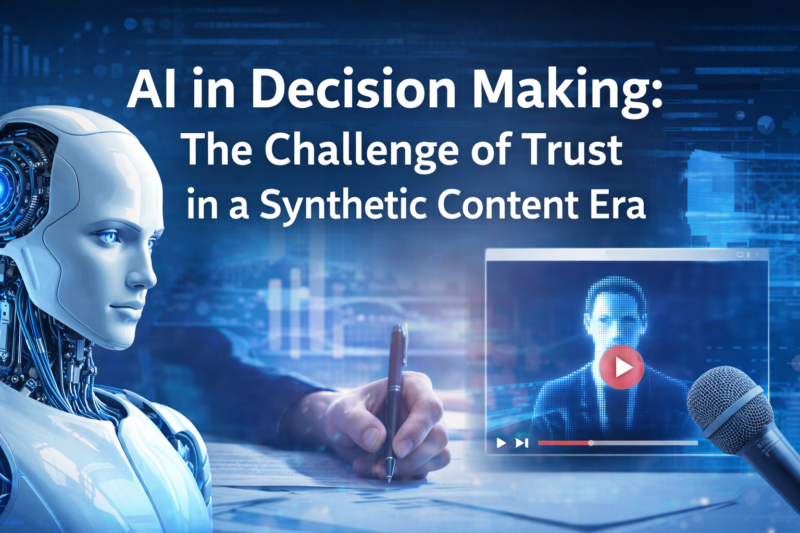
For many organisations, this shift has delivered clear benefits. Processes are faster, outputs are more consistent, and access to insight has improved. AI is no longer operating at the edges. It is part of how work gets done.
However, alongside these advantages, a quieter issue is beginning to emerge.
The reliability of digital content is becoming harder to assess.
This is not because there is less information available. In fact, there is more than ever. The challenge is that artificial intelligence is now capable of generating content that closely resembles human output. Emails, reports, voice recordings, and even video can now be produced with a level of realism that removes many of the signals people once relied on to judge authenticity.
As a result, decision making is entering a new phase. It is no longer just about analysing information. It is about questioning where that information has come from.
The shift from analysing data to generating content
Artificial intelligence has traditionally been associated with analysing structured data. It identifies patterns, highlights trends, and supports forecasting. These capabilities remain central to its value.
What has changed is the expansion into generating content that can directly influence perception.
AI can now produce written material that reads as if it has been created by a professional. It can generate images that appear realistic. It can replicate tone and language with a high degree of accuracy.
This changes the role of AI in decision making environments. Instead of simply supporting interpretation, it now contributes to the creation of the information being interpreted.
That distinction matters.
When information is generated as well as analysed, the question of reliability becomes more important. Not all content carries the same level of assurance, and the ability to distinguish between sources becomes less straightforward.
When realism removes the warning signs
Digital communication has long relied on subtle cues to assess credibility. Poor grammar, unusual phrasing, or inconsistent formatting often acted as indicators that something was not quite right.
Those signals are becoming less reliable.
AI generated content can now match professional standards in tone, structure, and clarity. Messages can appear polished and consistent. In many cases, they are indistinguishable from human produced content.
This does not mean that all content is unreliable. It means that the cues traditionally used to assess credibility are no longer sufficient on their own.
For decision makers, this introduces a shift. Confidence can no longer be based purely on how something looks or sounds. It must also consider how that content has been produced and whether its origin can be verified.
The emerging pressure on trust
Trust has always been a central part of how decisions are made. Whether in business, finance, or education, there has been an assumption that most interactions are genuine unless proven otherwise.
Artificial intelligence challenges that assumption.
As the ability to generate realistic content increases, the margin for doubt also increases. Trust does not disappear, but it becomes more conditional.
In practical terms, this can influence a wide range of scenarios. Communications that appear to come from known sources may require confirmation. Information used in decision making may need to be validated through multiple channels. Processes that once prioritised speed may begin to incorporate additional checks.
This creates a balance between efficiency and certainty.
A move towards verification driven decision making
As trust becomes less automatic, verification becomes more important.
This does not mean introducing unnecessary complexity. It means recognising that the environment in which decisions are made has changed. When content can be generated at scale and with high realism, confirming its origin becomes more relevant.
Verification may involve confirming identity, cross checking information, or relying on systems designed to detect inconsistencies. In many cases, it becomes part of the process rather than an exception.
The key point is that decision making is evolving. It is no longer based solely on access to information, but also on confidence in that information.
Implications across business and professional environments
The integration of AI into decision making continues to offer clear advantages. It enables faster analysis, improved scalability, and more consistent outputs.
At the same time, the trust challenge introduces new considerations.
In business environments, communication and reporting processes may need to adapt. In finance, the validation of information becomes increasingly important in managing risk. In education, the way work is assessed may continue to evolve as AI generated content becomes more common.
These changes do not represent a limitation of AI. They reflect the increasing complexity of the environments in which AI operates.
Why AI literacy now includes understanding trust
AI literacy is often discussed in terms of understanding tools. While this remains important, it is no longer sufficient on its own.
There is a growing need to understand how AI generates content, how realistic that content can be, and where its limitations lie. This includes recognising that outputs may appear credible even when they require validation.
For individuals and organisations, this represents a shift from simply using AI to understanding how to interpret it.
Conclusion
Artificial intelligence continues to enhance how decisions are made across multiple sectors. It improves efficiency, expands access to information, and supports more informed outcomes.
At the same time, it is changing the nature of digital trust.
As content becomes easier to generate and harder to distinguish from human output, the role of verification becomes more important. Decision making is no longer just about analysing information. It is about understanding its origin and reliability.
In this evolving environment, the ability to balance trust with verification will play a key role in how effectively AI is used.