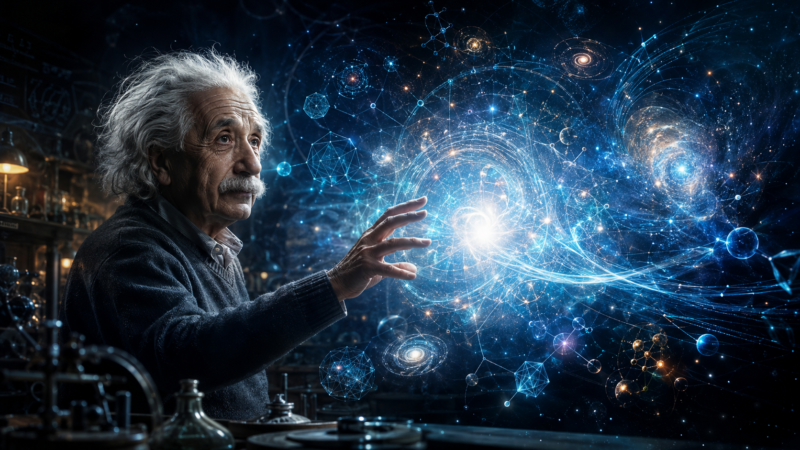
AI and education at the frontier are entering fascinating territory. Schools and universities are still dealing with AI being used in essays and assessments, yet scientists are now confronting an altogether different possibility. What happens when AI begins answering questions that humans have been unable to solve?
This is one reason we have substantially updated our course, AI Leadership & Global Competition: Education at the Frontier. In such a fast changing field, our courses cannot stand still.
From Learning What We Know to Discovering What We Do Not
OpenAI recently published a collection of ten advances produced by an internal AI model across mathematics and theoretical computer science. The work covered areas including geometry, cryptography, coding theory and quantum complexity.
These were not examination questions with answers waiting to be found online. They involved longstanding research problems, with the AI reportedly resolving some and making substantial progress on others. The supporting reasoning and proofs were published so that specialists could examine them.
In one particularly striking case, an internal OpenAI model disproved a longstanding conjecture connected to a mathematical problem first posed by Paul Erdős in 1946. The proof was subsequently checked by external mathematicians. OpenAI described it as an example of a general reasoning model contributing to frontier research rather than merely repeating established knowledge. Read OpenAI’s account of the discovery.
The results must still be tested, challenged and verified. Nevertheless, they suggest that AI may be moving from explaining discoveries made by humans to helping make discoveries itself.
For some scientists, it must feel a little like being a child opening an encyclopaedia for the first time, except this encyclopaedia does not merely contain the answers humanity already has. It may be capable of helping them search for answers that have never appeared on any page.
How Can AI Discover Something Its Creators Do Not Know?
This initially sounds impossible. If humans created AI, how can it answer a question that its creators cannot?
Humans built the system, but we did not manually give it every conclusion it might reach. AI can examine enormous amounts of information, compare possible solutions and identify connections far faster than any individual human brain.
We also built telescopes that revealed objects nobody had previously seen. Building a tool does not mean already knowing everything that the tool may reveal.
AI may be able to explore possible answers at a speed and scale beyond any single researcher. However, producing an answer is not the same as proving that it is correct. Experts must still examine the reasoning, reproduce the result and decide whether it can be trusted.
How AI and Scientific Discovery Could Change Our Future
Mathematics may be only the beginning. AI can search across vast collections of research, recognise patterns and test possibilities without becoming tired or being limited by the reading capacity of one person.
Could it help explain diseases that remain poorly understood? Might it discover a new material, identify an unexpected treatment or find a connection between separate areas of science that researchers have overlooked?
The honest answer is that nobody yet knows how far this will go. AI may encounter serious limits in reliability, reasoning or access to good data. Some apparent breakthroughs may fail when tested. Others may open entirely new areas of research.
The exciting part is that questions which once appeared permanently beyond reach may now be approached in a different way.
Education Becomes More Important, Not Less
If AI can produce new knowledge, it might appear that people will need to learn less. The opposite may be true.
Someone must know which questions matter. Someone must recognise whether a proposed answer is plausible and understand its consequences. Without strong subject knowledge, a person may be presented with an impressive discovery but remain unable to see whether it is brilliant, dangerous or simply wrong.
Teaching people to write prompts is not enough. We will still need mathematicians, scientists, doctors, engineers, lawyers, teachers and other specialists who understand their fields deeply enough to challenge AI rather than automatically accept its output.
Education must therefore prepare people to work with systems that may sometimes operate beyond the knowledge of an individual user. That requires curiosity, judgement and the confidence to question an answer even when it has been produced by an extremely powerful model.
Education Is Now Part of Global AI Competition
The competition for AI leadership is often presented as a race to build the most powerful model. However, access to advanced technology alone will not determine which countries benefit from it.
Countries also need researchers who can direct AI towards worthwhile problems, professionals who can use discoveries responsibly and regulators who understand the risks. They need education systems capable of responding as technology changes.
A country may purchase access to an AI model. It cannot create an educated and experienced population overnight.
This is why education increasingly resembles strategic national infrastructure. It shapes whether a country can create new technology, apply it productively and retain control over how it is used.
What We Have Updated in the Course
The six lessons in AI Leadership & Global Competition: Education at the Frontier have been reviewed to reflect these developments.
The course examines education as a strategic national asset and considers how countries are competing for AI talent, research capability and technological leadership. It looks at the decisions education leaders must make when the technology is changing faster than traditional institutional planning.
One lesson considers workforce readiness, skills alignment and entry level career pathways. As AI takes over more routine work, employers and education providers may need to reconsider how new professionals gain the practical experience that was previously developed through junior tasks.
Other lessons examine AI tutors, personalised learning and the possibility of widening access to education. However, they also ask whether instant AI assistance could remove the effort, mistakes and gradual understanding through which real learning develops.
Governance is another important part of the update. AI systems are no longer limited to producing text. AI agents can increasingly use software, access information and complete actions. Education leaders must therefore consider privacy, accountability and how much authority an AI system should ever receive.
The final lesson looks towards the frontier of education, including AI supported research, simulation and discovery. It also considers why human subject knowledge remains essential even as AI becomes more capable.
Why We Chose Written Lessons
The speed of AI development is one reason why, when creating AI Tuition Hub, we decided against relying on prerecorded video lessons.
In this field, material that is only three months old could already be missing an important development. A video may remain online for years even when its examples, predictions and advice are no longer current.
Written lessons can be reviewed and refreshed much more easily. As existing users will already know, every lesson can also be listened to using the audio option, so learners can choose whether to read the content or hear it. Users can also see when a course was last updated, giving them a clear indication of how recently its content has been examined.
We cannot claim that any AI course will remain current indefinitely. What we can do is continue reviewing our material and updating courses when important developments come to our attention.
How Far Will AI Go?
The most significant advance in AI may not be a chatbot that writes a better essay. It could be a system that helps solve a scientific question humanity has been asking for generations.
We built the tool, just as we built the telescope. We do not yet know everything it may allow us to see.
If AI begins revealing answers that have remained beyond human reach, education will sit at the centre of what happens next. We will need people capable of asking the right questions, recognising a genuine discovery and deciding whether the answer should change the world. Explore this updated course alongside more than 110 others on AI Tuition Hub.
Published: 12th August 2026.