Your next job interview might involve answering questions from a system rather than a person. The relationship between AI and HR is changing quickly, with employers using AI to assess applicants while candidates use it to prepare CVs, write applications and rehearse their answers.
On 5 October 2026, TechCrunch reported that HackerRank was making its AI interviewer, Chakra, generally available to its customers, following around six months of beta testing. For HR professionals, this brings a familiar question into sharper focus: how much of recruitment should we hand over to technology?
What an AI interviewer actually does
HackerRank explains that Chakra adapts its questions as the conversation develops. This moves AI into work normally requiring an interviewer to listen carefully, interpret a response and decide what to ask next. Employers still need to establish how reliably it does that for the roles they are filling.
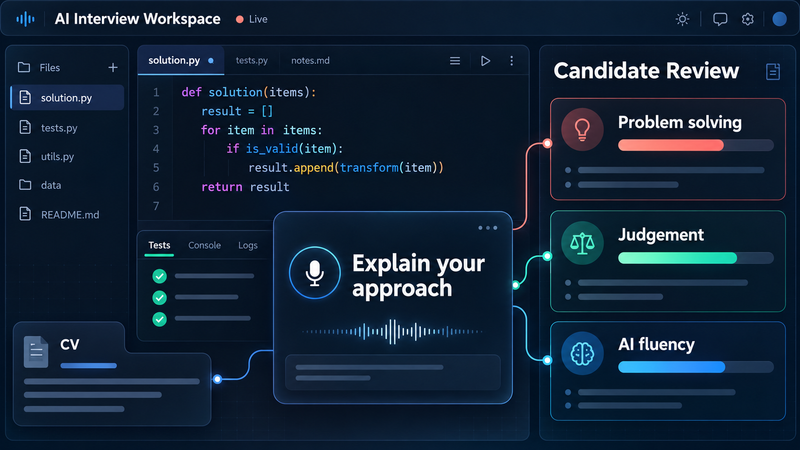
For technical recruitment, that makes sense. When applicants can use AI to produce a convincing solution, the answer alone tells an employer less than it once did. Can the candidate explain it, recognise a mistake and adapt when the requirements change? Those are more useful indicators of understanding.
HackerRank’s explanation of how Chakra works describes an adaptive interview, with questions changing as the conversation develops. That moves AI into work normally requiring an interviewer to listen carefully, interpret a response and decide what to ask next. Employers still need to establish how reliably it does that for the roles they are filling. www.hackerrank.com
Applicants are using AI too
Employers are only one side of this story. Applicants can now ask AI to rewrite their CV, tailor a covering letter to a vacancy and prepare persuasive answers to likely interview questions. Someone who struggles to describe their experience can produce a much more polished application in minutes.
That can be useful. An excellent employee is not necessarily an excellent application writer. Helping someone explain genuine experience clearly could give them a fairer chance of being considered.
The problem starts when polish obscures what the applicant actually knows. A convincing statement about leadership, analytical thinking or technical ability is easy to generate. Demonstrating those qualities under questioning is another matter.
This is not confined to younger applicants. Anyone can use AI to make an application sound more impressive. HR teams therefore need to distinguish between help with presentation and claims that overstate a person’s experience or ability.
When every application sounds impressive
There is another difficulty. If applicants use similar tools and prompts, their applications can end up sounding remarkably alike. Everyone appears highly motivated, adaptable and passionate, while the details that might reveal something useful about the individual become harder to find.
A modest but genuine achievement may tell an employer more than a paragraph of polished claims. Organising a difficult project, resolving a customer complaint or improving a routine process gives an interviewer something concrete to explore.
For HR, this makes evidence more valuable. What did the person do? What went wrong? What did they learn? Can they explain their contribution without retreating into general statements?
The relationship between AI and HR becomes particularly awkward when AI helps write the application, another system screens it and an AI interviewer assesses the candidate. The process may look sophisticated, but it still needs to establish what the person can actually do.
The appeal for busy HR teams
Anyone who has managed recruitment knows how much time disappears into arranging interviews, chasing availability and collecting feedback. Candidates withdraw, managers cancel and vacancies remain open while everyone tries to find an hour in the diary.
An AI interviewer could ease some of that pressure. It could also help employers apply a more consistent assessment structure, instead of allowing each manager to improvise an entirely different conversation.
Human interviews have their own weaknesses. An unprepared interviewer can miss important evidence, favour someone with similar interests or place too much weight on confidence. There is room to improve the process.
But saving time and improving hiring are separate outcomes. A faster assessment is only valuable if it helps the organisation identify suitable people. HR should be able to explain how it will measure that improvement before relying on the results.
Consistency does not guarantee fairness
Applying the same criteria to every applicant sounds reassuring. It still leaves the question of whether those criteria are appropriate. An unsuitable measure can be applied consistently and still reject good candidates.
Consider a role where careful analysis matters more than a quick verbal response. Does the assessment allow someone time to think, or reward whoever answers most confidently? If a candidate challenges an assumption, will that be recognised as good judgement?
These are questions employers should test. They are not faults we should assume any particular product has. A supplier’s demonstration can show what a tool is designed to do, but HR needs evidence that it works for the actual vacancy and the range of people applying.
The same scrutiny should apply to the employer’s own expectations. If a scoring framework rewards presentation more than ability, introducing AI may simply make that weakness more efficient.
Candidates deserve a process they understand
Some applicants may welcome an AI interview. It could offer flexibility and feel less intimidating than facing a panel. Others may find it difficult to judge when to speak, how much detail to give or whether their answer has been understood.
HR teams should consider people who need extra processing time, use assistive technology, have a speech difference or communicate differently because of neurodivergence. The assessment should give them a reasonable opportunity to demonstrate skills relevant to the job.
Applicants should also understand when AI is involved, what information is collected and how the assessment will be used. A clear explanation can prevent uncertainty from becoming distrust.
There needs to be someone to contact when things go wrong. An interrupted answer, connection problem or request for an adjustment should reach a person who can help. Candidates should not have to argue with an automated support system about an automated interview.
Human review needs to mean something
HackerRank’s candidate guidance explains that Chakra evaluates responses and work against criteria defined by the hiring team. The employer’s decisions therefore remain central to the assessment. candidatesupport.hackerrank.com
A human reviewer needs enough information to question the result. If all they see is a score and a recommendation, accepting it becomes tempting, particularly when hundreds of applications are waiting.
Meaningful oversight requires time, evidence and the authority to disagree. Otherwise, human involvement risks becoming a final click in a process nobody has properly examined.
HR should know who reviews borderline cases, whether the reasoning behind an assessment is available and how concerns are investigated. A capable applicant should not disappear from consideration simply because nobody felt able to challenge a score.
What this means for HR
AI and HR are becoming more closely connected, but that does not make the professional judgement involved in recruitment less important. It makes the quality of that judgement more consequential.
HR teams may spend less time scheduling interviews and more time evaluating suppliers, examining assessment results and helping managers understand their limitations. They also need to recognise when an impressive application reflects good writing assistance rather than the ability required for the role.
There is potential here to improve recruitment. Practical assessments could reveal more than polished CVs, while automation could free people to have better conversations with candidates.
But employers still need to know who they are hiring and why. If AI produces the application, conducts the interview and supplies the assessment, HR must make sure a convincing performance has not been mistaken for a capable person.
At AI Tuition Hub, we offer over 110 courses exploring how AI is currently being used across individual careers and industries, including HR and recruitment. Our courses help you understand the tools, practical uses and limitations relevant to your work, giving you the knowledge to make informed decisions as your profession changes.
Published: 6th October 2026.