An AI judge deciding a real court case still sounds like something from science fiction. However, one of Britain’s most senior legal figures believes machines could eventually settle millions of relatively small disputes. His prediction raises a question many of us may soon have to answer: would you let an AI judge decide your court case?
Sir Geoffrey Vos, the Master of the Rolls and Head of Civil Justice in England and Wales, has predicted that people may choose to have straightforward cases decided by AI within minutes and at little or no cost.
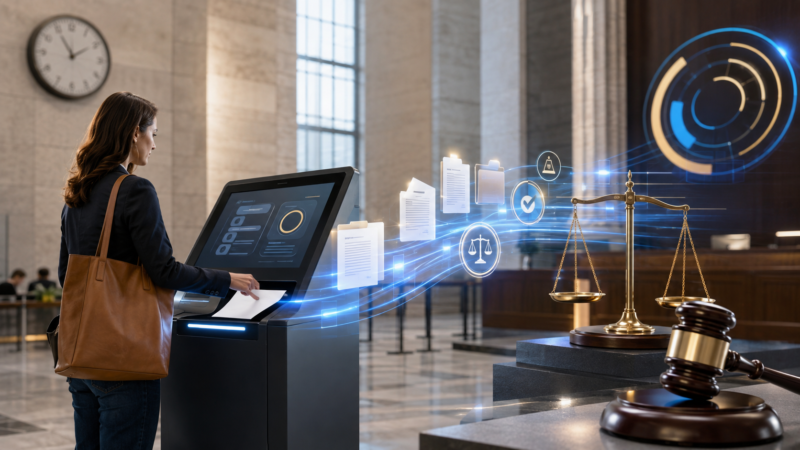
His comments were highlighted in the story The AI Judge Is Coming: Top UK Legal Figure Predicts Machines Will Start Deciding Small Court Cases.
This does not mean computers are about to replace every judge or begin sentencing people in criminal courts. It does, however, suggest that AI could eventually move from helping legal professionals to making certain legal decisions itself.
Why Would Anyone Choose an AI Judge?
Court proceedings can be slow, expensive and intimidating.
Even relatively small civil cases can take months to resolve. Legal representation may cost more than the amount being claimed, while people representing themselves must navigate unfamiliar procedures and complicated legal language.
Imagine being offered another option.
Both parties could submit their evidence to a specialist legal AI system. It could examine the relevant law, compare the dispute with similar cases and produce a decision within minutes.
For a straightforward disagreement involving a relatively small amount of money, many people would probably find that attractive. If the alternative involved waiting months for a hearing and paying substantial legal costs, an AI judge might begin to look like the more practical choice.
Sir Geoffrey believes people could develop confidence in machine made decisions if those systems are eventually shown to be as reliable as human judges.
Which Cases Could AI Decide First?
AI is unlikely to begin with serious criminal cases, child custody disputes or complex questions involving fundamental human rights.
The first uses would probably involve decisions in which established rules are applied to clearly defined facts. These could include calculating compensation for certain injuries, assessing damages, valuing shares or resolving straightforward financial disagreements.
Automated dispute resolution is not an entirely new concept.
Online platforms have been using automated systems to resolve customer disputes for years. Sir Geoffrey referred to eBay, which deals with millions of disagreements between buyers and sellers through its online processes, with most reportedly settled without human involvement.
The American Arbitration Association has also introduced an AI assisted system for certain document based construction disputes. A human arbitrator reviews the proposed outcome, but AI carries out a substantial part of the analysis.
These examples are not the same as a machine delivering a judgment through a public court. Nevertheless, they show that automated legal decisions are no longer purely theoretical.
Could AI Make Justice More Accessible?
There are some obvious potential benefits.
A legal system may technically be open to everyone, but that means little if ordinary people cannot afford to use it. A reliable AI judge could give individuals and small businesses access to justice in cases that would otherwise be abandoned because of the cost.
AI could also help reduce court backlogs and allow human judges to spend more time on complicated cases requiring experience, empathy and careful interpretation.
Consistency could be another advantage. Human decisions can differ because judges have different experiences and interpretations. A properly designed AI system could apply the same legal rules across thousands of similar cases.
However, that would only be beneficial if the system itself were accurate and fair.
An AI trained on biased historical decisions could reproduce those biases on a much larger scale. It could misunderstand unusual evidence or overlook important personal circumstances. We already know that general purpose AI models can occasionally produce confident answers that are simply wrong.
A court decision cannot become an unexplained answer generated inside a computer system. People must be able to understand why they won or lost and how the evidence was assessed.
Would You Still Have a Right to a Human Judge?
Sir Geoffrey placed some important limitations around his prediction.
The right to have a case decided by an independent and impartial human judge is deeply embedded in the legal system. Human judges could not simply be removed without new legislation, public debate and substantial safeguards.
The earliest AI court decisions would therefore probably be voluntary. Both parties might agree to use AI because it offered a quicker and cheaper resolution, while retaining some form of appeal to a human judge.
There is also a difficult boundary between AI making a decision and AI assisting a judge.
If an AI system analyses the evidence and recommends an outcome that a busy human judge approves, who has really decided the case? Economic pressure and growing court backlogs could gradually lead judges to rely more heavily on machine generated recommendations.
A human might remain officially responsible while AI performs most of the actual reasoning.
What Will Legal AI Look Like in Five Years?
As we discussed in our blog yesterday, people often forget that modern generative AI is still in its infancy. Widely available systems capable of producing detailed answers and analysing complex information have only been with us for a few years.
What will specialist legal AI applications be capable of five years from now?
Future systems could be trained specifically on legislation, court procedures, judgments and carefully selected legal information. They may be able to examine thousands of previous cases, analyse complicated evidence and apply legal principles within seconds.
Their capabilities may bear little resemblance to the general purpose chatbots people use today.
AI judges are not about to take control of Britain’s courts, but the fact that the Head of Civil Justice is openly discussing machine made judgments is significant.
The real question may no longer be whether AI will enter the courtroom. It may be how much authority we are prepared to give it when it does.
AI Tuition Hub explores how Artificial Intelligence is transforming society through more than 110 courses, including our course on AI and Modern Policing. Members can access our complete course library for only £9.95 a month.
Published: 25th August 2026.