AI has not reached your office yet, but that does not mean your employer is standing still. If you work for an international accountancy practice, bank, insurer or financial services business, the technology could already be under development elsewhere within the network.
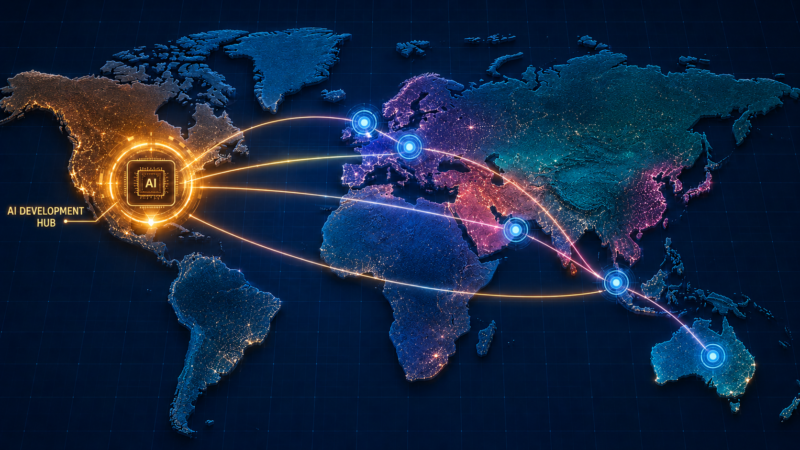
Once tested and approved, it may arrive in your office as a finished system capable of completing a substantial amount of existing work. This is why it is far too early to dismiss warnings about AI and employment simply because widespread job losses have not yet occurred.
Where Is the AI Jobs Apocalypse?
Sensational YouTube videos have predicted that AI will destroy millions of jobs almost immediately. These dramatic claims are excellent for attracting clicks, but many exaggerate the speed and certainty of the changes taking place. The absence of an immediate employment collapse has now produced the opposite type of headline.

Recent stories have asked, “AI was supposed to destroy jobs. Where’s the carnage?” and suggested that the predicted AI jobs apocalypse may never happen. Current evidence does support some caution. Widespread unemployment directly caused by AI has not materialised, and many occupations predicted to disappear continue to employ large numbers of people.
However, it is too early to conclude that the threat has passed. Many of the most significant forecasts concern changes expected by 2030 or 2031. Judging them in 2026 means assessing a five year transformation near its beginning.
Most Businesses Are Still Experimenting
For many organisations, 2026 remains a period of testing and experimentation. Companies are investigating which tasks AI can complete reliably, how it can be connected to internal information and where human oversight must remain. They are also developing controls covering security, confidentiality, accuracy and professional responsibility.
This is especially important in finance, accountancy, insurance and other regulated sectors. A financial organisation cannot simply provide a public chatbot with confidential client information and allow it to make important decisions. Systems must be developed around the organisation’s own processes and data. They must also meet regulatory, legal and professional requirements.
Job losses are unlikely to be the first stage of this process. Businesses must initially understand the technology, test it against genuine work and decide whether it delivers reliable savings. The workforce consequences may only become apparent after successful systems move beyond trials and become part of normal operations.
The AI May Be Somewhere Else
Employees naturally judge technological change by what they see in their own workplace. If their daily responsibilities remain largely unchanged, they may assume their employer is making little progress with AI. That assumption may be wrong when the organisation has offices around the world.
An international business does not need every office to develop its own AI system. Specialist teams can build and test the technology in one location before introducing it across the wider network. The office developing the system could be in London, New York, Singapore or another major business centre.
Employees elsewhere may know very little about the project until it is ready for wider use. Development may take several years, but distribution across an established company network could happen much faster.
Imagine This Appearing on Your Company Intranet
Imagine working in the finance department of an international business. You prepare reports, review documents, reconcile information and respond to internal queries. Your office has access to basic AI tools, but nothing appears capable of completing a significant part of your job.
Then a message appears on the company intranet. The organisation announces that a new internal AI platform will be introduced across its global network. Specialist teams in other offices have already developed and tested it. The system has passed the company’s security, accuracy and governance assessments.
Training sessions are arranged and employees are told that the platform can analyse documents, extract financial information, perform reconciliations, prepare initial reports, identify unusual transactions and answer routine internal questions. Within weeks, work that previously occupied several employees is being completed automatically and reviewed by one experienced member of staff.
Nothing appeared to be happening in your office because the important work was happening elsewhere. This is one way AI could reach international organisations. It may not arrive through years of visible experimentation in every location. It could appear as a centrally approved system ready to be connected to existing company platforms.
Job Losses May Not Begin With Redundancies
The first announcement is unlikely to say that AI is replacing employees. Management may describe the technology as a tool for improving productivity, helping staff and releasing capacity. That may be entirely accurate during the early stages.
The employment effects could appear more gradually. When an employee leaves, the organisation may decide that the position no longer needs to be filled. A department may handle increasing workloads without recruiting additional people. The next graduate intake may be smaller because AI completes much of the research and preparation previously assigned to trainees.
Headcount can decline without a dramatic redundancy programme. This makes the effects more difficult to identify. A business may not formally report that it has replaced 20 employees with AI. It may simply employ fewer people than it would otherwise have needed.
Global Accountancy Networks Are Already Moving
The Big Four accountancy networks demonstrate that this development model is not hypothetical. EY is introducing agentic AI through EY Canvas, its global assurance platform. The technology is intended to support approximately 160,000 audit engagements worldwide.
KPMG is incorporating AI agents into KPMG Clara, its global audit platform used by more than 95,000 audit professionals. The technology can analyse financial information, support testing, automate routine processes and direct human attention towards higher risk areas.
PwC reported that employees performed more than 20 million actions through Microsoft Copilot during April 2026. It estimated that this released more than one million hours of employee capacity in that month.
Deloitte’s internal PairD assistant was introduced in the United Kingdom, extended into Belgium and subsequently made available to approximately 75,000 employees across Europe and the Middle East. These are not employees occasionally asking a public chatbot to improve an email. They are examples of major organisations developing controlled AI systems around professional work and distributing them through international networks.
AI Is Replacing Parts of Jobs
At AI Tuition Hub, we regularly write and update courses covering the use of Artificial Intelligence across different professions. We also speak to people working in finance, accountancy and other industries. From those conversations, we know that parts of some jobs are already being automated.
AI can summarise documents, extract information, produce initial reports, review data and complete administrative work in a fraction of the time previously required. We also know that many jobs are unlikely to disappear completely in the way some sensational stories suggest.
Professional roles involve responsibility, judgement, communication and knowledge of individual circumstances. AI can support these activities, but it cannot always accept accountability for the final decision. Nevertheless, AI does not need to replace an entire profession to change employment.
If it removes a quarter of the work across a large department, the organisation may eventually require fewer employees. The job title can survive while the number of people holding that position falls.
Graduate Recruitment May Be an Early Warning
The number of UK graduate vacancies advertised in July 2026 reportedly fell to 8,383. This was the lowest since comparable tracking began in 2016 and represented a fall of 45% in one year.
It would be misleading to blame the entire decline on AI. Higher employment costs, weak economic conditions and uncertainty are also affecting recruitment. Some businesses may employ junior workers without advertising the positions specifically as graduate vacancies.
Even so, something appears to be changing at the beginning of the career ladder. AI is particularly capable of completing the research, document preparation, data processing and routine analysis traditionally given to junior employees. Businesses may therefore reduce graduate recruitment before making experienced professionals redundant.
A reduction in advertised graduate roles does not prove that AI is responsible. It does provide another reason not to dismiss the employment debate prematurely.
The Danger of Declaring the Threat Over
Telling workers that an immediate AI jobs apocalypse is inevitable is irresponsible. Declaring in 2026 that the threat has already been disproved could be equally damaging.

Premature reassurance may persuade people that there is no urgency to understand AI or prepare for changes within their profession. They could then be caught unprepared when a new internal platform suddenly appears.
Employees do not all need to become programmers or AI engineers. They should understand what the technology can do, where it makes mistakes and how it may change their responsibilities. The sensible response is neither panic nor complacency.
Artificial Intelligence may not have reached your office yet. However, if you work within a global organisation, another part of the network may already be developing the system that eventually will.
Published: 24th August 2026.