AI watermarks and student cheating could become one of the most contentious education issues of the next few years. Anthropic is introducing invisible patterns into text generated by Claude, potentially allowing computers to identify assignments that have been processed by artificial intelligence.
Headlines have suggested that this could finally expose students who use AI to cheat. The technology may provide stronger evidence than today’s unreliable AI detectors, but it cannot establish who developed the ideas, how extensively AI was used or whether the student actually broke any rules.
What Is Anthropic Introducing?
Anthropic has committed to adding machine readable markings to content produced by supported Claude models. New models launched in the European Union from 2 August 2026 will include marking from their release, while the company is also working to add the system to older models.
The change is connected to the transparency requirements of the EU AI Act, although Anthropic intends to apply the markings worldwide.
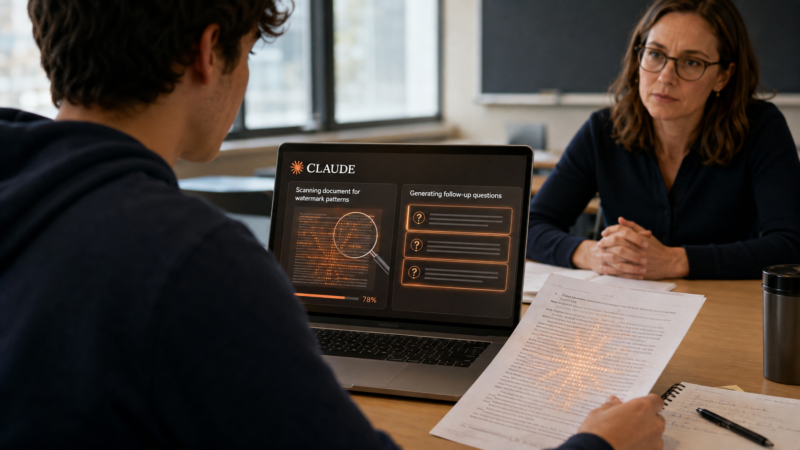
Text generated by supported Claude models will contain an imperceptible watermark woven into the language. It will not appear as a visible label or a collection of hidden characters. Instead, Claude will produce a statistical pattern through the words and phrases it selects.
The writing should appear entirely normal to a person, but a detection system may be able to recognise the underlying pattern. Anthropic says the watermark will remain when text is copied and pasted and may survive some editing.
Anthropic is also developing tools that will allow users and third parties to check text for its marks. However, detailed technical information about the detection process has not yet been published.
Could Schools Scan Every Assignment?
Schools and universities could eventually place assignments through a detection system and receive a signal indicating that Claude may have processed the text.
This would be different from most existing AI detectors. Current detection services generally make statistical guesses based on sentence structure, predictability and writing style. Human writing has sometimes been incorrectly labelled as AI generated, creating the risk of innocent students being accused of cheating.
A deliberate watermark inserted by Claude should provide more meaningful evidence that the system was involved. However, it would still not prove that Claude wrote the assignment.
A student might research the subject, develop the argument and write every paragraph before asking Claude to correct the grammar. Another might use it to reorganise their work, remove repetition or translate something written in another language. All of these assignments could potentially carry a watermark.
Anthropic acknowledges this limitation. According to its own guidance on marking AI generated content, detecting a mark indicates that the content may have been processed by Claude. It does not confirm that Claude was the original author.
AI involvement, AI authorship and AI cheating are not the same thing. Treating them as interchangeable could produce serious and unfair consequences for students.
Why Not Test Whether the Student Understands the Assignment?
There may be a much simpler and fairer way to establish whether a student genuinely understands the work they submitted.
The assignment could be placed into an approved AI system and the system asked to generate a short series of questions based on its particular arguments, evidence, sources and conclusions. The student could then answer those questions in person.
They might be asked why they selected a particular source, how they reached their conclusion, what an important term means or how their argument would change if one piece of evidence were removed.
A student who researched and understood the subject should normally be able to explain their reasoning. Someone who asked AI to generate an entire assignment and submitted it without understanding the content would be much more likely to struggle.
This idea already exists in education. Universities have long used oral defences, sometimes known as post assignment vivas, to test whether students understand their submitted work.
Australia’s Tertiary Education Quality and Standards Agency includes a student’s inability to answer questions about an assignment during a post assignment viva among the signals that may support an investigation into undeclared AI use. Crucially, its academic integrity guidance also states that an AI detection score alone is insufficient evidence of misconduct.
Researchers are now taking the idea further. A system called AutoViva can automatically create viva style questions based on both the coursework requirements and an individual student’s submission.
This could make short oral checks far easier to conduct. A teacher would not need to prepare separate questions manually for every assignment because AI could identify the main claims and generate appropriate questions within seconds.
Testing Knowledge Rather Than Hunting for AI
A short conversation would test something far more important than whether a computer had been involved. It would test whether the student had actually learned and understood the subject.
Watermark detection asks: “Did Claude touch this document?”
A tailored oral assessment asks: “Does this student understand what they submitted?”
The second question is surely more relevant to education.
This would also allow legitimate uses of AI to be treated sensibly. A student with dyslexia might use it to improve spelling and sentence structure. Someone working in a second language might use AI for translation. Another student may use it to receive feedback on an early draft.
If they can explain their evidence, defend their conclusions and demonstrate an understanding of the subject, the educational objective may still have been achieved.
The approach would not need to become another formal examination. A brief five minute conversation containing several questions tailored to the assignment could provide more useful evidence than a detector producing an unexplained percentage score.
Students would also know that they could be questioned about any submitted work. That alone might discourage people from submitting assignments generated entirely by AI without learning the material.
Can AI Watermarks Be Removed?
Anthropic does not claim that its watermarking system will be infallible.
Heavy editing, paraphrasing, translation or combining the output with human writing may weaken or remove the signal. Short passages may not contain enough text for reliable detection, while assignments generated by older or unsupported models may have no watermark.
A student could use an AI provider without compatible watermarking or ask another system to rewrite Claude’s output. Determined users may therefore find ways around the technology.
The absence of a watermark will never prove that an assignment was written by a human. It will only show that the detector did not find a supported mark.
This is another reason why demonstrating knowledge may be more reliable than attempting to identify how every sentence was produced.
The Implications Beyond Education
Although student cheating has attracted the headlines, watermarking could eventually reveal hidden AI use elsewhere.
Businesses might examine reports prepared by employees, consultants or contractors. Clients could check whether supposedly original professional work had been processed by AI. Recruiters might scan CVs and covering letters, while publishers could examine articles and manuscripts.
These checks would face the same limitation. A watermark could indicate AI involvement but would not reveal whether the system corrected a few sentences or produced the entire document.
Clear rules and human judgement would therefore remain essential in education, employment and professional services.
AI Detection Is Entering a New Phase
Anthropic’s announcement is significant, but claims that AI watermarks will simply expose student cheating are premature.
Watermarking could provide stronger evidence of Claude’s involvement than detectors attempting to guess from writing style. It still cannot establish how AI was used, who supplied the original ideas or whether a student understands the work.
A short AI assisted viva may offer a better answer. Artificial intelligence can read the assignment, produce several tailored questions and help the teacher discover whether genuine learning has taken place.
Invisible watermarks may reveal that Claude processed an assignment. Only the student can demonstrate that they understand it.
Learn More About AI in Education
AI Tuition Hub offers a number of AI education courses covering the use of artificial intelligence by students, teachers and educational institutions. These courses explore how AI is changing learning, assessment and teaching, alongside the opportunities and risks it creates.
Published: 15th August 2026.