AI in Financial Services by 2030 will fundamentally reshape how banks, insurers, investment firms and other financial institutions operate. From customer service and financial advice to fraud detection, regulatory compliance and risk management, artificial intelligence is rapidly becoming one of the most important technologies influencing the future of the financial services industry.
Recognising the scale of this transformation, the Financial Conduct Authority commissioned the independent Mills Review to examine how AI in financial services could evolve by 2030. Rather than focusing on individual technologies, the review explores how artificial intelligence will influence customer behaviour, competition, regulation and innovation across the financial sector.
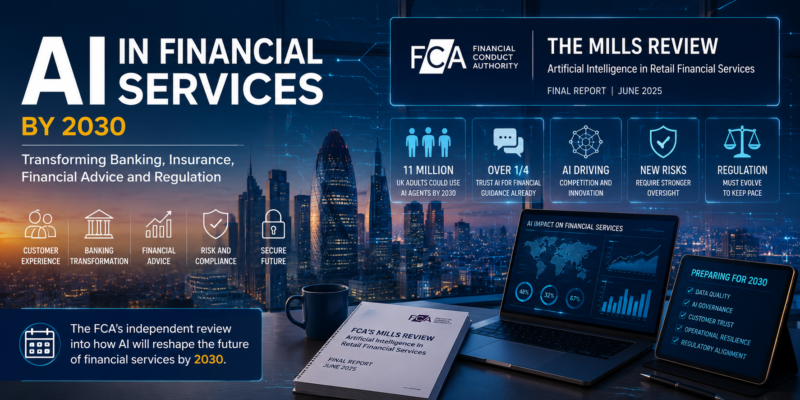
Its conclusions are significant. AI is expected to become embedded across almost every part of financial services, from customer interactions and fraud detection to lending, insurance, compliance and financial advice. The report also makes clear that regulation will need to evolve just as rapidly if innovation is to continue while maintaining consumer trust.
So, what does the review actually tell us, and why should financial services professionals be paying attention?
AI Is Becoming the New Front Door to Financial Services
One of the most interesting themes running throughout the review is that AI may fundamentally change how customers interact with financial institutions.
Today, if someone wants to compare mortgages, open a savings account or arrange insurance, they usually visit a bank’s website, use a comparison site or speak to an adviser.
The Mills Review suggests that this process could soon look very different.
Instead of searching for products themselves, consumers may increasingly rely on intelligent AI assistants capable of comparing financial products, switching providers, monitoring savings, recommending investments and completing routine financial tasks on their behalf.
These so called AI agents could become the primary interface between customers and financial institutions.
The report estimates that around 11 million UK adults could be willing to use these services by 2030.
If that prediction proves accurate, financial institutions may find themselves competing not only for customers, but for the attention of the AI systems acting on those customers’ behalf.
Personalised Financial Advice Could Become Accessible to Millions
For many years, the financial services industry has struggled with what is often called the financial advice gap.
Professional financial advice provides enormous value, but it is also expensive and therefore unavailable to many people who would benefit from it.
Artificial intelligence has the potential to change that.
Rather than replacing professional advisers, AI could provide affordable guidance for routine financial decisions, helping consumers better understand savings, borrowing, investments and retirement planning.
The review highlights this as one of the most positive opportunities created by AI.
Interestingly, separate research referenced alongside the review suggests that more than one quarter of consumers already trust general purpose AI systems for some forms of financial guidance. That illustrates just how quickly consumer behaviour is changing and why regulators are paying such close attention.
Human expertise will remain essential for complex financial planning, but AI could make basic financial guidance available to millions who currently receive little or none.
Competition Will Be Driven by AI Capability
For decades, banks competed primarily through branch networks, product ranges, pricing and customer relationships.
The next decade may look very different.
The Mills Review argues that organisations with the strongest AI capabilities, highest quality data and most effective technology infrastructure are likely to gain a significant competitive advantage.
Artificial intelligence can improve operational efficiency, accelerate decision making, strengthen fraud detection and provide more personalised customer experiences.
Those organisations that successfully integrate AI into everyday operations are likely to innovate faster while reducing costs.
Equally, firms that delay investment risk finding themselves falling behind competitors that can respond more quickly to changing customer expectations.
AI Creates New Risks as Well as New Opportunities
While much of the discussion around AI focuses on productivity and innovation, the review also highlights several important risks.
Artificial intelligence is helping organisations identify suspicious transactions more quickly than traditional systems, detect unusual customer behaviour and strengthen cyber security.
Unfortunately, criminals now have access to many of the same technologies.
Deepfake voices, synthetic identities, sophisticated phishing campaigns and highly convincing AI generated scams are becoming increasingly difficult to detect.
The report also raises another issue that receives far less attention.
As more financial organisations rely on a relatively small number of AI models and cloud computing providers, there is a growing risk of concentration. If large parts of the financial sector become dependent on the same technology providers, a single failure, cyber incident or significant AI error could have consequences far beyond one individual institution.
Managing these new forms of risk will become just as important as embracing AI itself.
Regulation Must Keep Pace
The Financial Conduct Authority recognises that today’s regulatory frameworks were largely designed before generative artificial intelligence became widely available. As AI becomes increasingly embedded in financial services, regulators face a series of new challenges that existing rules were never intended to address. If consumers begin relying on AI generated financial guidance, who is responsible when something goes wrong? Should AI systems that recommend financial products eventually fall within the FCA’s regulatory perimeter? How can innovation continue without weakening consumer protection?
While the Mills Review does not attempt to answer every one of these questions, it makes clear that regulators must develop their own AI capabilities and work more closely with industry to ensure governance evolves alongside technological progress. The pace of AI development means regulation can no longer remain static, and maintaining public confidence will require regulatory frameworks that are flexible enough to keep pace with rapidly advancing technology.
The Biggest Question the Report Does Not Answer
One of the most interesting aspects of the Mills Review is not what it says, but what it deliberately avoids discussing. The report does not attempt to forecast job losses or estimate how many roles artificial intelligence may ultimately replace across financial services. That is understandable, as its purpose is to examine retail financial services rather than labour markets. Nevertheless, it is difficult to ignore what many of its findings imply. If AI increasingly handles customer enquiries, processes documentation, supports lending decisions, detects fraud, performs compliance monitoring and delivers routine financial guidance, the nature of many financial services roles will inevitably change.
This does not necessarily point towards widespread redundancies, but it does suggest that routine administrative work is likely to become increasingly automated while demand grows for skills involving professional judgement, governance, customer relationships, regulatory oversight and AI management. For financial services professionals, developing AI literacy is becoming less of an advantage and more of an investment in long term career resilience.
Looking Towards 2030
The Mills Review is not a prediction that artificial intelligence will replace banks or the professionals who work within them. Instead, it recognises that AI is becoming part of the fabric of modern financial services and will increasingly support how organisations operate, compete and serve their customers. Banks, insurers, wealth managers and lenders that embrace AI responsibly are likely to benefit from faster services, stronger fraud prevention, more personalised customer experiences and greater operational efficiency.
Those that hesitate risk falling behind competitors that recognise AI is no longer simply another technology project, but a core business capability. Perhaps the most important message from the review is that the future of financial services will not be defined by artificial intelligence alone. It will be shaped by how successfully organisations combine AI with strong governance, experienced professionals, sound judgement and responsible decision making to build trust in an increasingly digital financial world.
Continue Your AI Learning with AI Tuition Hub
Understanding artificial intelligence is no longer just for technology specialists. It is becoming an essential skill for professionals working across banking, insurance, accounting, auditing, compliance, governance, payroll, trust and company administration, wealth management and financial crime prevention.
At AI Tuition Hub, we have developed more than 20 specialist AI courses dedicated to financial services, helping professionals understand how artificial intelligence is transforming the industry and how these technologies can be applied responsibly in real world environments.
Whether you are taking your first steps into AI or expanding your professional knowledge, our growing Financial Services Academy provides practical, accessible learning designed specifically for today’s finance professionals.
For a limited time, you can access our complete Financial Services Academy for less than £10 per month by using the exclusive discount code Founder50.
The future of financial services is already taking shape. There has never been a better time to understand the technology that will help define it.